

In the GCC, petrochemical compressor lubricants are chosen in a business environment shaped by export routes, feedstock flows, and disruption risk. ICIS describes the closure of the Strait of Hormuz after a late-February escalation between the US–Israel and Iran as triggering “one of the most significant petrochemical feedstock disruptions in decades.” ICIS also notes that most Middle Eastern cargoes must pass through Hormuz and that “there is no short-term workaround.” For lubricant selection teams supporting ethylene, ammonia, and hydrogen service, this context matters because it pushes a stronger focus on proven practices, builder and association recommendations, and dependable technical support when operations and supply lines are strained.
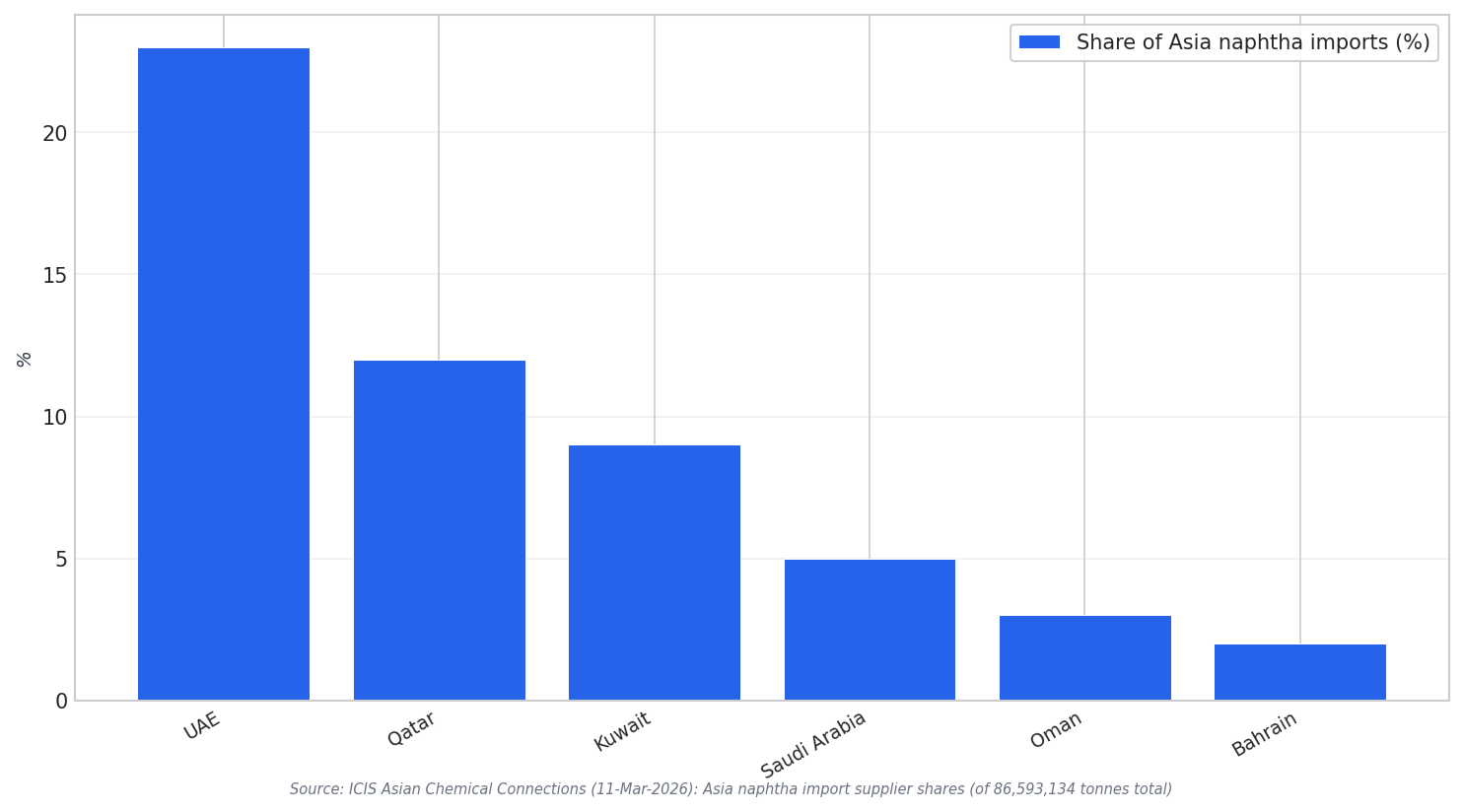
Trade concentration highlights why resilience is part of the selection conversation for petrochemical compressor lubricants GCC stakeholders. ICIS provides an Asia naphtha import total of 86,593,134 tonnes, with Middle Eastern suppliers (UAE, Qatar, Kuwait, Saudi Arabia, Oman, Bahrain) providing 54% of all naphtha imported by Asia’s petrochemical sector. The same table shows UAE at 19,669,421 tonnes (23%), Qatar at 9,972,008 tonnes (12%), Kuwait at 7,945,619 tonnes (9%), Saudi Arabia at 3,960,787 tonnes (5%), Oman at 2,690,791 tonnes (3%), and Bahrain at 1,586,115 tonnes (2%). ICIS adds that Russia provides 12% (10,812,792 tonnes) but “cannot fill the gap” quickly due to sanctions, tanker availability constraints, and long voyage times.
Selecting Lubricants for Ethylene, Ammonia and Hydrogen Service in a Risk-Exposed GCC Supply Chain
For ethylene, ammonia, and hydrogen compressor service, selection work often begins with structured guidance rather than guesswork. A sponsored Mining Technology article notes that Mobil’s equipment team has recommendations from leading global equipment builders and industry associations, and that this serves as an initial guide for users to select appropriate lubricants for specific applications and equipment. It also describes proactive maintenance and productivity improvement approaches, plus understanding customer maintenance practices based on industry standards. In practice, this means that lubricant choice for critical compressors should be anchored to equipment and association recommendations, then verified through operating practices and maintenance realities at site.
Ammonia service has an extra lens because it overlaps with refrigeration compressor applications and refrigerant compatibility lists used in industry communications. A Renewable Lubricants announcement references refrigeration/compressor oils and lists refrigerants including R-717, along with others such as R-11, R-12, R-13, R-113, R-114, R-115, R-22, R-123, R-14b, R-500, R-501 and R-502. This does not prescribe a product for GCC ammonia plants by itself, but it reinforces a practical selection step: confirm the lubricant is positioned for the relevant refrigerant and compressor duty, and do so in writing, especially when plants face logistical constraints and rising costs from freight and insurance pressures described by ICIS during the regional disruption.
Across ethylene, ammonia, and hydrogen operations, the support model around the lubricant can be as important as the base product claim when disruption hits. The Maritime Executive notes that extensive technical support, both onsite and remotely, allows suppliers to provide fleet surveys, fluid condition monitoring, and customized maintenance plans that support safety and operational efficiency. It also reports that some modern synthetic EALs exceed a VGP requirement of breaking down by 60% or more within 28 days, illustrating how specific performance thresholds can be embedded in selection criteria when they apply. In parallel, ICIS warns that recovery can be slow “not just in plant restarts but also across supply lines and logistics networks,” so teams benefit from lubricant programs that keep monitoring and decision-making tight when the supply chain is not.
Why does petrochemical compressor lubricants GCC selection need a supply-chain lens?
What are the ICIS supplier shares that show Middle East concentration in Asia naphtha imports?
What is a practical starting point for selecting compressor lubricants for ethylene, ammonia, and hydrogen service?
Which refrigerant is explicitly listed that connects to ammonia service discussions?
What support practices are described that can strengthen lubricant programs during disruption?