
For wind turbine gear oil Saudi Arabia projects under NREP-style expectations, the key issue is not only lubrication. It is maintainability. Wind farms are often treated as remote assets that must keep operating with limited intervention. In offshore wind, an industry view is that assets should be protected for 35 years or more with minimal maintenance. That framing matters because it sets the tone for how operators evaluate every reliability lever, including lubrication practices, contamination control, and condition monitoring. It also creates pressure to move beyond legacy assumptions that were validated for shorter lifetimes.
Long service life targets can collide with older validation habits. Protective coating standards such as NORSOK M-501 and ISO 12944-9 were developed for oil and gas environments, and they generally validate coating performance for up to 25 years. Offshore wind developers are now targeting 35 to 40 years of service life, which the same source calls insufficient coverage for the new target window. While this example is about coatings, it signals the same general lesson for lubrication programs: when the service-life target stretches, operators need evidence, lifecycle thinking, and partners who can support validation methods that go beyond legacy assumptions.
Design-Life Reality: Reduce Call-Outs and Extend Intervals
Operationally, oil decisions should be made in the context of service rhythm. A wind industry perspective is that making a component last longer between service intervals changes the rhythm of an entire wind farm. The stated benefits include fewer technical call-outs, fewer crane mobilizations, and fewer unplanned outages. The same discussion also notes that availability is measured to fractions of a percentage point, so small reliability gains can translate into commercial advantage. That matters when fleets approach the 20- to 25-year design limit described for many first-generation turbines, because extending useful life requires focusing on reliability levers that reduce avoidable interventions.
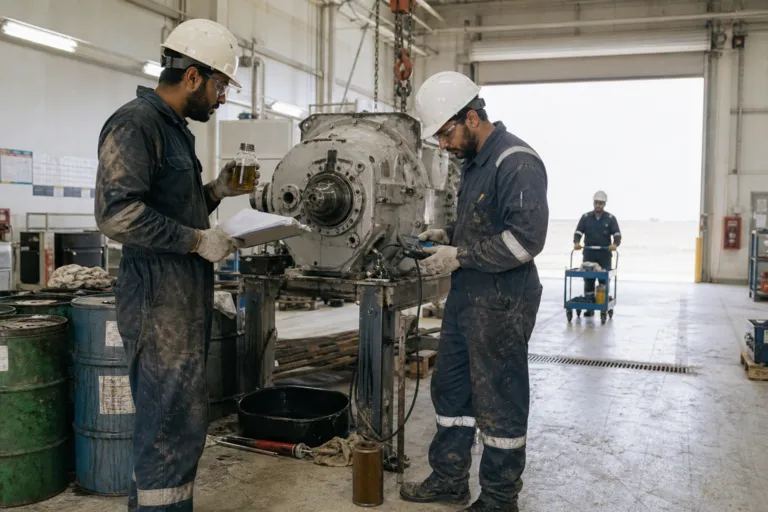
In practice, gear oil selection and the supporting program should emphasize durability under challenging conditions and the ability to detect problems early. Industrial lubricant product positioning gives useful language for what operators tend to want from gear oils: one source describes gear oils that aim to extend gearbox life and support drive system efficiency, even in challenging conditions. It also highlights support services that pair lubricants with inspection and condition monitoring, including Shell LubeExpert for technical support and inspection services and Shell LubeAnalyst as an oil condition monitoring service that provides preventive maintenance recommendations based on equipment and lubricant insights.
Procurement and operations planning in Saudi Arabia also bring a governance layer. For the R6 wind project, bidding requirements mandate that newly established project companies execute multiple agreements, including an operations and maintenance agreement and a grid connection agreement. The same source states that the project development agreement and grid connection agreement are governed by Saudi law, while the PPA is governed by the laws of England and Wales, and disputes go to arbitration administered by the Saudi Centre for Commercial Arbitration. For lubrication programs, this reinforces the need to align oil supply, service scope, and monitoring responsibilities with the contract structure from the start.
The overall takeaway for wind turbine gear oil Saudi Arabia is to treat gear oil as part of a reliability system designed for long operating lifespans and low intervention. The offshore wind viewpoint calls for systems proven by data and experience, and for partners who use modern validation methods to support 35+ year operational lifespans. The wind O&M viewpoint stresses that longer intervals reduce disruptions like call-outs and unplanned outages. Combine that with a condition monitoring service model that delivers preventive recommendations, and you have a practical framework to pursue a low-maintenance goal while keeping accountability clear across the project’s contractual chain.
What does “wind turbine gear oil Saudi Arabia” mean in practice for NREP-style projects?
Why do long service-life targets change lubricant program expectations?
What operational benefits come from extending service intervals?
What support services are mentioned for condition monitoring and preventative recommendations?