

The Middle East lubricants market is on a steady upward path, reflecting the region’s rapid industrialization and growing automotive sector. In 2025, lubricant consumption in the region reached 2.87 billion liters, with projections showing an increase to 3.31 billion liters by 2030, growing at a compound annual growth rate (CAGR) of 2.85%, according to Mordor Intelligence.
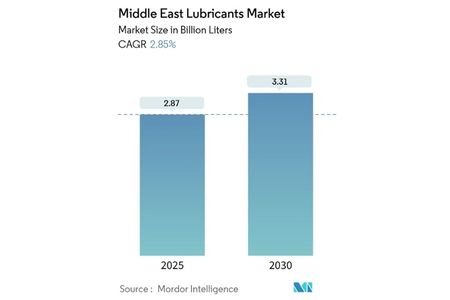
This growth underscores the region’s resilience and its critical role in global energy and manufacturing value chains. The market’s expansion is strongly supported by industrial diversification, infrastructure development, and an expanding vehicle base—all of which drive lubricant consumption across multiple segments.
Saudi Arabia Leads with Over One-Third of Regional Market Share
Saudi Arabia stands as the clear leader, holding 37.75% of the Middle East lubricants market by volume. The Kingdom’s strong petrochemical base, vast transportation sector, and expanding industrial activities continue to boost demand.
In 2025, Saudi Arabia’s lubricant market reached approximately 677.67 million liters, and this volume is expected to rise further as vehicle ownership is forecast to surpass 17 million by 2030. Vision 2030 initiatives—aimed at industrial diversification and automotive modernization—are expected to add a +1.5% impact to the nation’s lubricant demand growth rate.
A noticeable shift is also underway in the Saudi automotive segment toward premium synthetic lubricants, as consumers and industries increasingly prefer higher-performance and longer-lasting products. This evolution reflects both rising income levels and growing awareness of product quality and efficiency.
Sustainability and High-Performance Segments Drive Innovation
While industrial and transportation sectors remain the backbone of lubricant consumption, the market’s fastest-growing categories reveal a deeper transformation. Transmission and hydraulic fluids are expanding at a CAGR of 3.12%, largely fueled by large-scale infrastructure and construction projects across the Gulf region. These projects demand heavy machinery and vehicles, increasing lubricant use in hydraulic systems and transmissions.
At the same time, bio-based lubricants—once a niche product—are gaining momentum with a CAGR of 3.27%. This reflects a growing regional focus on sustainability, as industries seek cleaner, environmentally responsible alternatives without compromising performance. For many governments and industrial players, these products also align with national energy transition and ESG goals.
The market’s financial performance mirrors this trajectory. The Middle East lubricants market size was valued at approximately USD 9.54 billion in 2024 and is forecast to reach USD 12.95 billion by 2033, growing at a 3.4% CAGR. This indicates a balanced combination of volume growth and higher-value product adoption across both automotive and industrial applications.
A Strong Outlook to 2030
The growth of the Middle East lubricants volume is a direct reflection of the region’s industrial and economic diversification. Mega infrastructure projects, new manufacturing hubs, and rising vehicle ownership continue to strengthen demand. Meanwhile, the shift toward synthetic and bio-based products marks an evolution toward higher efficiency and sustainability.
As the market approaches 3.31 billion liters by 2030, led by Saudi Arabia’s dominant position and supported by regional growth initiatives, the Middle East is poised to remain one of the most dynamic lubricant markets globally.
Read also: Middle East Industrial Lubricants: Heavy Industries Fuel Steady Regional Demand