
Bulk lubricant distribution commonly depends on drums and Intermediate Bulk Containers (IBCs). IndexBox notes steady demand for 55-gallon steel drums and 275-gallon IBCs for bulk lubricant transport, while also describing growth in reusable drum exchange programs to lower packaging costs for end-users. In parallel, IndexBox’s hazardous-chemicals coverage states that automotive and industrial oil distribution networks rely heavily on a reverse-logistics system for drums and IBCs, which makes container durability and service life a critical cost factor. For GCC lubricant operations, that framing matters because reverse flows are not a side project. They are a core operating system that determines how quickly assets return, how reliably they can be redeployed, and how well risk is controlled during handling and transfer.
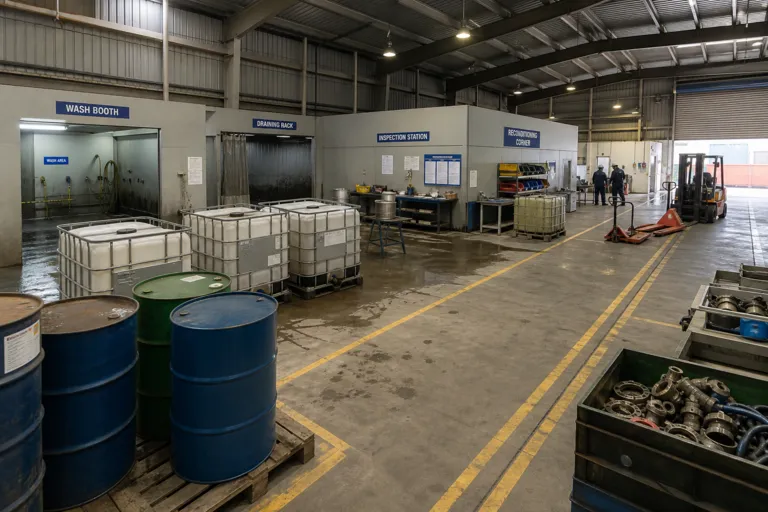
A returnable loop becomes stronger when it is designed around reuse services, not just container selection. Stratistics points to the growth opportunity in reusable and reconditioned drum and IBC services, describing reconditioning as cleaning, refurbishing, and recertifying used containers to extend lifespan by multiple cycles at a fraction of the cost of new units. It also notes that many logistics providers and chemical companies prefer closed-loop systems in which containers are returned, inspected, and redeployed. Fortune Business Insights echoes the same direction, highlighting increasing adoption of reconditioned drums and returnable IBC systems, and stating that reusable packaging systems reduce waste and long-term operational costs. In practical terms, the loop is built on predictable return lanes, standardized inspection, and clear rules for when a unit is reconditioned versus removed from service.
How to Design a Drums-and-IBCs Reverse-Logistics Loop
Start with formats that match lubricant handling realities and the compliance environment. Fortune Business Insights highlights that industrial bulk packaging such as steel drums, plastic drums, and IBCs is used for lubricants and petrochemical derivatives, and it emphasizes strict regulatory requirements that make certified packaging essential, with leak prevention, chemical compatibility, and durability as critical performance criteria. IndexBox adds that the shift toward synthetic lubricants and fuel additives, described as more chemically aggressive, is pushing packaging specifications higher. This is where material choices and design features matter: Fortune Business Insights notes demand for plastic IBCs and drums due to lower transportation costs, while IndexBox points to trends such as anti-corrosion coatings and liners and the use of specialized linings for aggressive or high-purity chemicals. A loop should define which products require liners, which lanes require higher specification, and how each asset is validated before it is sent back out.
Next, plan the economics of empty returns and the operational controls that keep assets moving. Stratistics states that flexible IBCs (FIBCs) can be folded flat for return shipping and can reduce logistics costs by up to 70% on empty returns, a reminder that reverse logistics is often won or lost on how efficiently empties travel back. DataIntelo also describes a structural shift toward lightweight plastic alternatives and collapsible designs that reduce shipping weight by 65% and enable cost-effective reverse logistics. Visibility helps prevent loss and delays. DataIntelo notes IoT-enabled smart tags embedded in drums and crates to provide real-time visibility into temperature, humidity, and location, and IndexBox highlights integration of RFID and IoT sensors for tracking container location, condition, and fill level in logistics. Together, these approaches support a managed loop with fewer blind spots and clearer accountability for turnaround time.
Finally, make the loop scalable by formalizing services and governance across partners. IndexBox describes growth in container rental and managed service models to reduce end-user capex and manage compliance. Stratistics describes the closed-loop preference where containers are returned, inspected, and redeployed, and emphasizes the role of reconditioning and recertification in extending life over multiple cycles. Fortune Business Insights highlights that stackable and returnable packaging systems help reduce logistics costs and improve efficiency, and it ties adoption to just-in-time manufacturing needs. For a GCC-focused lubricant returnable packaging reverse logistics strategy, the key is to combine these building blocks into a single operating rhythm: standardized container specs by product class, disciplined return lanes, reconditioning with documented decision rules, and tracking that keeps assets from becoming “lost inventory” in the field.
Why do lubricant distribution networks care so much about reverse logistics for drums and IBCs?
What container sizes are commonly referenced for bulk lubricant transport in the sources?
How can empty-return costs be reduced in a returnable packaging loop?
What is reconditioning in drum and IBC return programs?
How do GCC lubricant operators approach returnable packaging and reverse logistics without losing visibility?