
Looking at the Algeria lubricants market means first reading the energy system it depends on. Sonatrach’s role in Algeria’s oil and gas value chain is repeatedly highlighted in recent market analysis, including the way policy and investment set the conditions for downstream supply and blending. Mordor Intelligence values Algeria’s oil and gas market at USD 9.36 billion in 2025, with an estimate of USD 9.7 billion in 2026 and a forecast of USD 11.58 billion by 2031, implying a 3.61% CAGR for 2026–2031. In 2025, upstream activities captured 76.42% of the market share, while midstream infrastructure is forecast to post a 9.46% CAGR through 2031. These signals matter for lubricants because stable feedstock, logistics, and industrial activity are all tied to the same investment cycle.
North Africa’s import-substitution narrative shows up most clearly in refined petroleum products, where domestic capacity and product availability shape how much a country depends on imports for fuels and related supply chains. In the North Africa refined petroleum products market, Algeria ranks second with roughly 28% of demand and a 4.5% CAGR, and Sonatrach achieved refined-product self-sufficiency in 2023. The same report states that a 110,000-barrel-per-day Hassi Messaoud refinery broke ground in 2025, and that self-sufficiency could free capacity for export once Hassi Messaoud starts up in 2027. While these are refined-products facts, not lubricant-volume figures, they still frame the supply-resilience logic that underpins local blending strategies across the region.
Sonatrach’s Investment Cycle and What It Signals for Blending
Sonatrach’s upstream investment program is another indicator of how Algeria is positioning for continuity of supply and industrial activity, which indirectly sustains lubricant demand in transport, power, and heavy equipment. Mordor Intelligence projects Algeria’s upstream oil and gas market at USD 7.30 billion in 2026, growing at a 2.58% CAGR to USD 8.29 billion by 2031 (from USD 7.14 billion in 2025). The same source describes a USD 60 billion five-year budget being channeled into brownfield optimization and reserve boosting, and cites a USD 2.3 billion Hassi R’Mel Phase III Step 2 boosting project as an example of that focus. It also notes a flaring tax of 12,000 dinars per 1,000 m³ to incentivize gas capture. This investment backdrop supports the case for local blending to rely on steadier domestic energy operations and associated maintenance cycles.
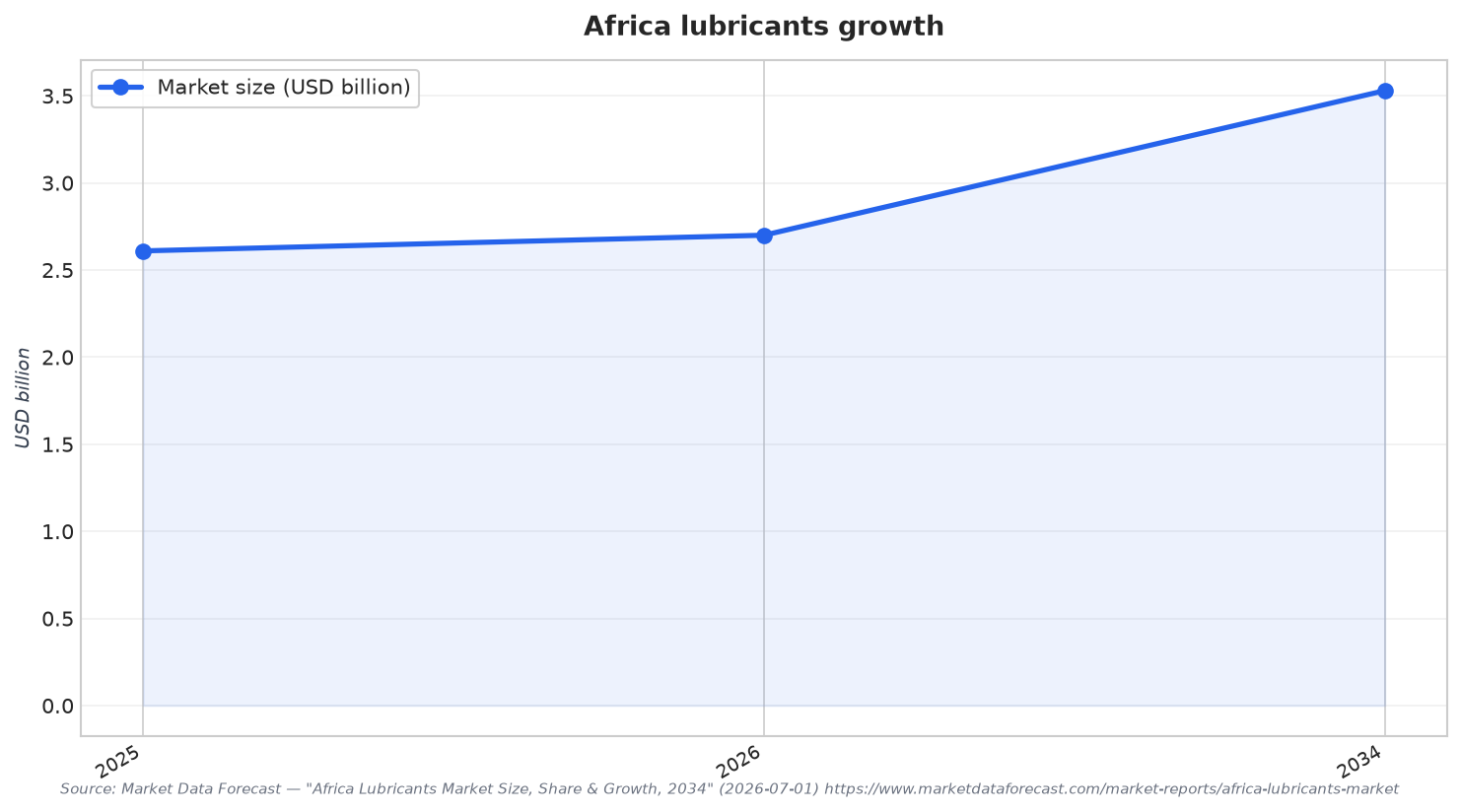
At the Africa level, lubricant demand is expanding, and that sets the context in which Algeria competes for product availability, technology, and blending capacity. MarketDataForecast values the Africa lubricants market at USD 2.61 billion in 2025, estimates USD 2.70 billion in 2026, and projects USD 3.53 billion by 2034, with a 3.43% CAGR from 2026 to 2034. Mordor Intelligence measures the same Africa market in volume terms, expecting it to grow from 2.68 billion liters in 2025 to 2.77 billion liters in 2026, reaching 3.27 billion liters by 2031 at a 3.36% CAGR over 2026–2031. In 2025, automotive engine oil led with a 36.05% share, the automotive end-user segment held 44.75%, and mineral oils accounted for 79.60% of the market. These continent-wide shares help explain why local blenders across North Africa prioritize reliable mineral formulations while watching the gradual shift toward synthetics described in regional analysis.
Import-substitution also depends on demand stability and the ability to keep blender utilization high, especially when end markets swing. The Africa lubricants report notes that predictable operating schedules of construction consortia can create baseline orders that stabilize blender capacity utilization, even when passenger car consumption dips seasonally. It also warns that policy uncertainty can discourage heavy capital investment in blending plants and storage, prolonging reliance on toll blending and third-party logistics. For Algeria, the refined-products trajectory under Sonatrach, plus the broader North Africa market structure where state players dominate throughput and logistics, shapes how quickly local blending can become a stronger pillar of supply resilience. In that sense, Algeria’s path aligns with a regional playbook: expand domestic refining capability, keep logistics moving, and build a blending ecosystem that can serve both industrial and automotive lubricant demand over time.
What is driving the direction of Algeria’s lubricants market today?
How big is the African lubricants market, and why does it matter for Algeria?
Which lubricant segment leads in Africa, based on the cited sources?
What does North Africa’s refined-products data suggest about import substitution?