
Rail lubrication programs are increasingly defined by how intensively a network is operated, not only by how much track exists. IndexBox links global rail track lubricant demand to rail network length, traffic density, and wheel-rail interface management, and places annual consumption in the tens of thousands of metric tonnes worldwide. For GCC networks and Etihad Rail-aligned operators, this framing matters because it focuses procurement on repeatable maintenance cycles, curve management, and consistent friction control as traffic builds. In parallel, qualification and approval cycles for new rail track lubricants can extend 12–24 months, which influences how quickly newer formulations can be adopted in any cross-border GCC supply chain.
Wheel-flange lubrication is a core part of that interface strategy. IndexBox projects the global wheel flange lubricant compounds market to grow at a 4–6% CAGR between 2026 and 2035. In that same view, heavy-haul freight rail accounts for approximately 45–55% of global demand, while urban transit contributes 25–35%. This split is useful context for GCC planning because it highlights how demand can be pulled by both freight corridors and metro growth, even when product specifications differ. The report also states that premium, environmentally compliant formulations are expected to represent over 30% of value by 2030, up from an estimated 20–22% in 2026, reinforcing why buyers increasingly ask for longer-lasting and cleaner options.
Wheel-Flange, Traction, and Track: What Procurement Specs Are Optimizing
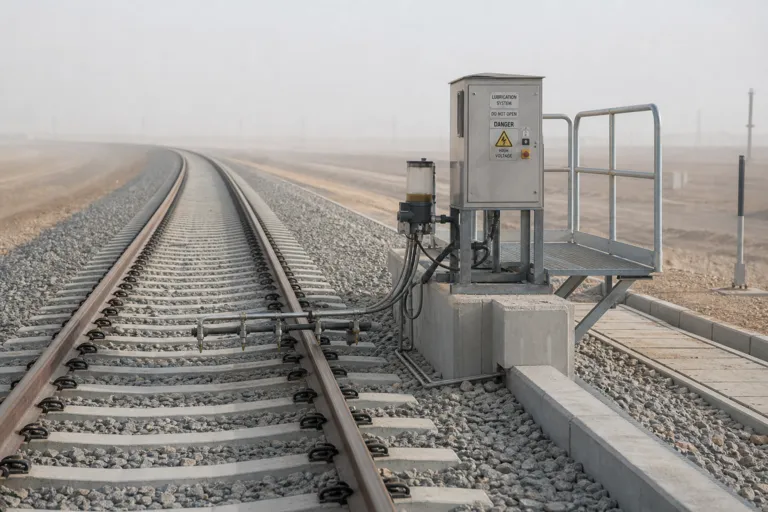
Across rail lubrication categories, suppliers are being pushed toward performance documentation and application precision. Fact.MR describes rail lubricants as formulations that reduce friction, wear, noise, and energy consumption, and distinguishes gauge-face (flange) lubricants from top-of-rail friction modifiers that optimize traction and braking adhesion. Fact.MR also reports that wayside applicators from SKF and LB Foster reduce lubricant waste by 40% to 60% while improving application consistency, a direct argument for automated dosing when access windows are tight. IndexBox adds that digital condition-monitoring integration is influencing lubricant specification, with operators requiring compatibility with wayside sensors and automated tribometer feedback and documented friction coefficient performance across varying weather and load conditions.
For trackside and onboard supply planning, it helps to anchor expectations in the global market’s measured trajectory rather than assumptions. Fact.MR values the global rail lubricant market at USD 1,050.00 million in 2025, projects USD 1,092.00 million in 2026, and forecasts USD 1,616.43 million by 2036 at a 4.0% CAGR, with an absolute expansion of approximately USD 524.43 million between 2026 and 2036. In the same report, oil-based product holds a 70.0% share in 2026, and on-board application holds a 55.0% share. IndexBox also highlights that premium synthetic and high-temperature greases account for roughly 30–40% of market value by volume share, tied to extended relubrication intervals and improved wear reduction, especially in high-traffic and curved-track sections.
GCC buyers watching Etihad Rail’s growing demand signals still need to manage volatility and compliance forces that show up in global supply chains. IndexBox estimates base oil price volatility and supply constraints for specialty thickeners have compressed gross margins for lubricant formulators by an estimated 8–12% since 2022, with pass-through to rail customers occurring with a 6–12 month lag. At the same time, IndexBox expects adoption of biodegradable and environmentally acceptable lubricants to reach 20–25% of world demand by 2030, and notes that growth in urban rail and metro systems in Asia-Pacific and the Middle East adds 3–5% incremental demand annually in those regions over 2026–2030 for high-fire-point, low-spatter greases. In this context, “railway lubricants Etihad Rail GCC” procurement becomes a balancing act between proven approvals, automation-driven waste reduction, and the product attributes that align with fire safety and environmental expectations.
What is driving global demand for rail track lubricants?
How fast is the wheel flange lubricant compounds market expected to grow?
What do sources say about automation benefits in rail lubrication?
What supply-chain cost pressures are affecting rail lubricant suppliers?
How should GCC procurement teams interpret the topic of railway lubricants for Etihad Rail and the wider GCC network?