
Power-sector operators increasingly tie reliability to lubricant condition and deposit control. One industry view on power lubricants says they support over 74% of global installed power generation capacity, and that power-sector lubricants account for nearly 38% of total industrial lubricant consumption, with turbine oils representing 41% of volume usage. In that same analysis, power assets are described as operating above 6,000 hours annually, and plants using high-performance lubricants have recorded operational uptime improvements of 18%–22% and component wear reduction averaging 26% across turbines and compressors. For service providers, this creates a practical bridge from “better oil selection” to “better oil condition,” where flushing and varnish-removal work becomes part of reliability planning rather than a reactive cleanup.
Market context helps explain why maintenance services can move with lubricant trends. Market Research Future estimates the Turbine Oil Market Size at USD 4.126 billion in 2024, and also notes that the Middle East and Africa region accounts for about 5% of the global share. The same source highlights more stringent regulations and a shift toward eco-friendly turbine oils to meet environmental standards. Separately, ConsaInsights projects Middle East and Africa turbine oil market growth from $0.09 billion in 2023 to $0.15 billion by 2033. These figures are not about flushing services directly, but they show growing attention to turbine oils and how they are specified, managed, and audited—conditions that can widen demand for specialized cleaning methods that reduce deposits and help oils perform as intended.
Why Varnish Control and Flushing Are Becoming a Standalone Service
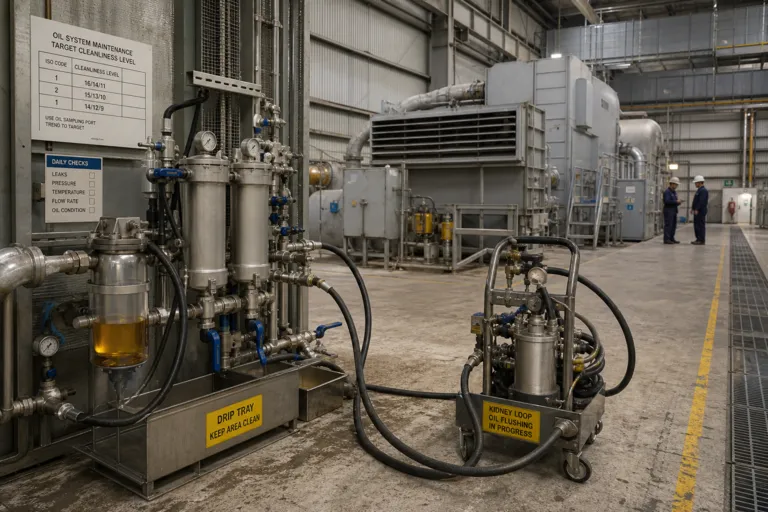
Across turbine-oil and power-lubricant discussions, deposit formation and oxidation resistance come up repeatedly. Credence Research describes the turbine oil market expanding because industries require high-performance oils with thermal stability, oxidation resistance, and minimal deposit formation, which can enhance equipment life and reduce maintenance costs. It also projects the turbine oil market to grow from USD 614 million in 2024 to USD 1,103.2 million by 2032, at a CAGR of 7.6% (global). Meanwhile, a power-lubricants analysis highlights oxidation stability enhancements exceeding 90% resistance thresholds and replacement cycles extending by 15%–20%. In practice, these claims raise expectations: if oils are chosen for deposit control, then turbine oil flushing and varnish removal in the Middle East becomes a logical companion service when plant teams want cleaner systems, smoother commissioning, and more predictable oil-life outcomes.
Adjacent maintenance markets reinforce the broader story that “cleaning” is not a small add-on anymore. Verified Market Reports values the Engine Fast Flush Market at USD 2.1 billion in 2025 and estimates it reaches USD 3.5 billion by 2034, exhibiting a CAGR of 6.0% from 2026–2034. While that market is not turbine-specific, the same source says evolving designs create niches where deposits and contaminants accumulate, and traditional cleaning methods can be inadequate, prompting demand for specialized fast-acting flush products to remove stubborn deposits rapidly. DataIntelo likewise frames oil system cleaning as addressing sludge and varnish accumulation, and notes service providers investing in advanced flushing equipment and eco-friendly cleaning agents. For Middle East power operators and contractors, these themes translate into a clearer business case for dedicated flushing and varnish-removal offerings tied to outage windows, commissioning schedules, and condition-based maintenance plans.
To compete in this niche, suppliers and contractors need to align technical execution with the same drivers shaping lubricant purchasing. Credence Research lists base-oil price volatility and dependency on petrochemical supply chains as restraints, while Market Research Future mentions Middle East conflict-related disruptions and price volatility in feedstocks in its broader coverage. That backdrop can increase scrutiny on how quickly assets return to service and how effectively contamination and deposits are controlled. Positioning a flushing program around measurable outcomes—such as extending replacement cycles discussed in power-lubricants analysis, or supporting the deposit-minimization expectations embedded in high-performance oil specifications—helps convert flushing from an emergency response into a planned reliability service. In this way, the Middle East market’s growing turbine-oil footprint can support a parallel rise in specialized turbine oil flushing and varnish-removal work.
Why is turbine oil flushing and varnish removal gaining attention in the Middle East power sector?
What figures point to the Middle East and Africa’s relevance in turbine oil demand?
How do high-performance lubricants relate to flushing services?
What do the sources say about deposit formation in turbine oil selection?