
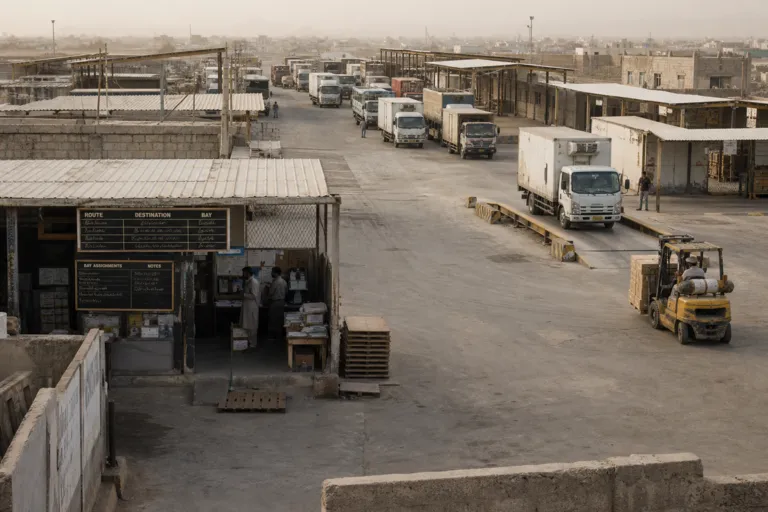
The Yemen lubricants market sits inside a wider Middle East lubricants system, but it operates under very different on-the-ground conditions. Market research focused on Yemen describes governance fragmentation, localized distribution, and supply corridors that “shift by quarter,” plus dual-currency pricing that complicates procurement and channel control. The same Yemen-focused research notes that conventional desk research can miss volumes because supply may be “routed through informal channels.” For lubricant suppliers, that reality changes the playbook. Relationship-driven distribution, corridor mapping, and local partner qualification become as important as pricing and brand, especially when access varies across routes such as Aden and Hodeidah corridors mentioned in broader Yemen commercial examples.
Regional context helps explain why supply can remain contested even when demand fundamentals exist. Mordor Intelligence values the Middle East lubricants market at 2.87 billion liters in 2025, estimating growth from 2.95 billion liters in 2026 to 3.36 billion liters by 2031 at a 2.66% CAGR (2026-2031). Within that total, base oil and product mix matter for what ends up available to Yemen through formal and informal channels. In 2025, mineral oils accounted for a 69.58% share of the Middle East market, while engine oils held a 37.32% revenue share. Automotive and other transportation represented 45.02% of the Middle East end-use in 2025, a reminder that vehicle fleets and logistics equipment remain major lubricant pull factors across the region.
Fragmented Supply Meets Humanitarian-Style Logistics
In Yemen, fragmented supply conditions overlap with logistics patterns that resemble humanitarian procurement realities more than stable retail expansion. Yemen-focused research highlights that pharmaceuticals and medical consumables move through both commercial channels and humanitarian procurement managed by WHO, UNICEF, and ICRC; while that reference is not about lubricants directly, it illustrates how mixed-channel routing can become normal when formal systems strain. It also points to persistent generator and inverter replacement demand tied to grid instability, which has indirect relevance to lubricants because generators, pumps, and fleet equipment depend on reliable fluids and maintenance cycles. The same research argues that firms building distributor relationships and mapping the installed base during the difficult period can hold a “structural advantage when conditions normalize.”
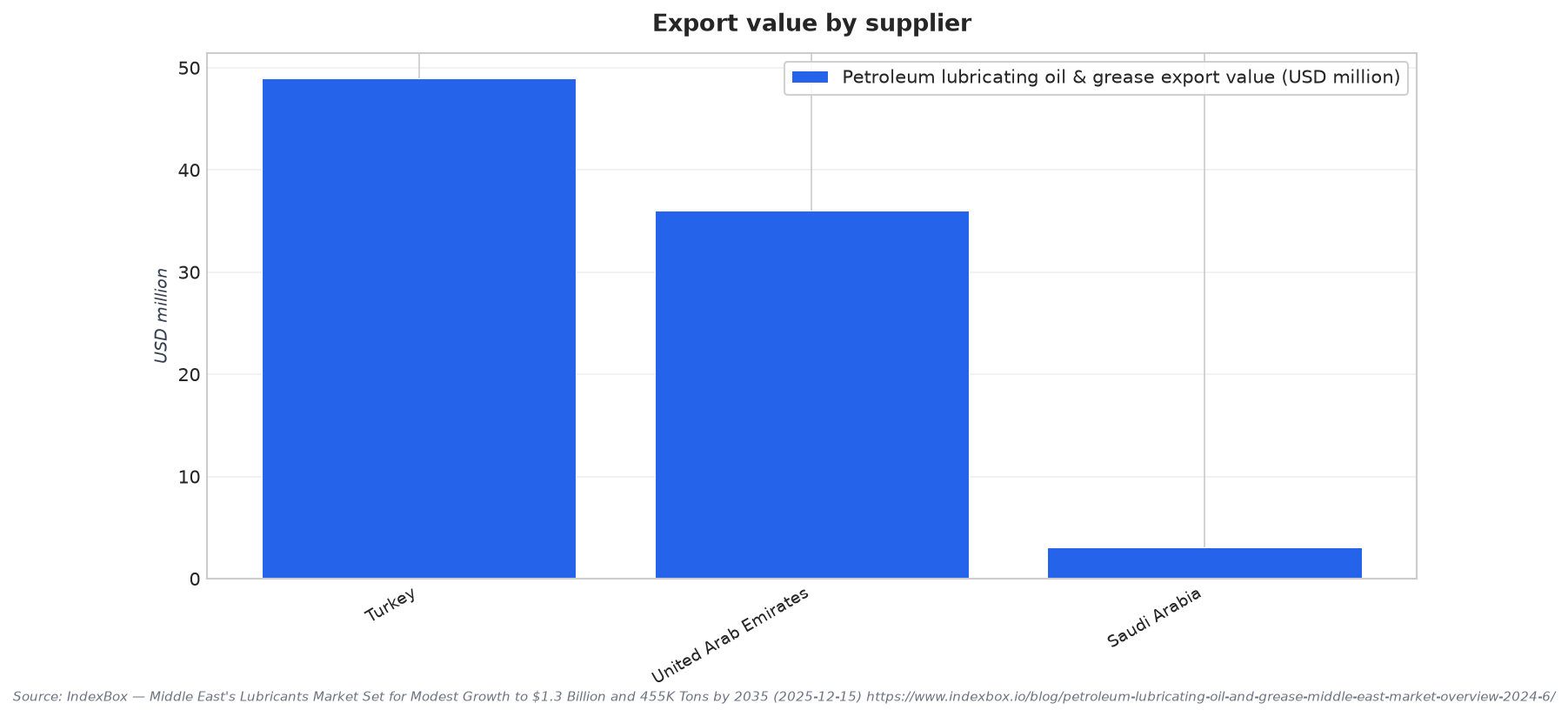
Trade and pricing signals across the Middle East reinforce why Yemen’s market can feel exposed to external shocks. IndexBox reports that in 2024, Middle East purchases abroad of petroleum lubricating oil and grease decreased by -3.5% to 63K tons, the second consecutive year of decline after two years of growth. For export pricing, IndexBox shows wide variation among top suppliers: Turkey at $5,389 per ton versus Saudi Arabia at $1,469 per ton. These are regional figures, not Yemen-only numbers, but they indicate how origin, route, and supplier choice can swing landed costs. IndexBox also notes that, in value terms, Turkey ($243M), Iran ($150M), and Israel ($121M) were the largest petroleum lubricating oil and grease markets in the Middle East, with a combined 46% share of the total market.
Long-term reconstruction potential in Yemen connects to the same industrial and infrastructure themes driving lubricant demand elsewhere in the Middle East. IndexBox describes the Middle East industrial lubricants market as linked to heavy industry and infrastructure development, with product types spanning hydraulic fluids, gear oils, compressor oils, turbine oils, metalworking fluids, and greases. Mordor Intelligence adds that transmission and hydraulic fluids are expected to advance at a 3.01% CAGR between 2026-2031 in the Middle East, while power generation is the fastest-growing end-user at a 3.09% CAGR to 2031. Those growth lanes matter for Yemen’s eventual normalization: reconstruction typically raises demand for construction machinery fluids, power-related lubricants, and broader industrial grades, but winning will depend on supply resilience in a fragmented, shifting-corridor environment.
What makes lubricant supply in Yemen harder to measure than in other markets?
How big is the wider Middle East lubricants market that surrounds Yemen’s trade routes?
Which lubricant segments are growing fastest in the Middle East, and why does that matter for Yemen?
What do regional trade signals say about supply tightness and pricing risk?
How should companies approach the Yemen lubricants market during instability?