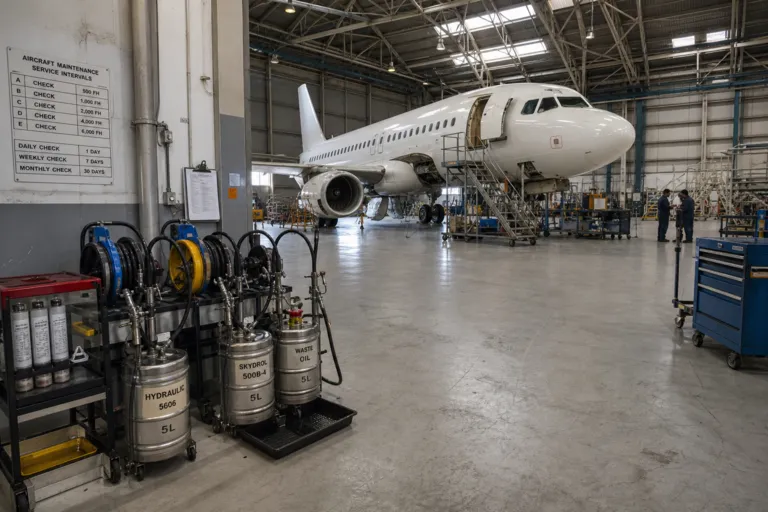
Maintenance growth in the Gulf is not just about hangar space and tooling. It also drives repeat purchasing of consumables, including hydraulic fluids and aviation greases used across landing gear and airframe systems. In global lubricant demand, the replacement cycle is structural: Mordor Intelligence links aviation lubricant growth to recurring replacement across engines, hydraulic systems, landing gear, and airframe systems. It also notes that long product qualification cycles limit switching once a lubricant is approved for a platform or engine family, tightening the connection between MRO planning and supply continuity. In this context, the keyword topic—aviation MRO hydraulic fluid Gulf—maps to a practical procurement question: as hubs expand and shop visits rise, how do hydraulic fluid and grease needs scale with maintenance throughput?
Global market figures show why MRO matters as a volume channel, even when the Gulf is the immediate focus. Mordor Intelligence estimates the aviation lubricants market grows from 21.80 million liters in 2025 to 23 million liters in 2026, reaching 30.20 million liters by 2031, with a 5.60% CAGR over 2026–2031. It also reports the aftermarket held 72.65% share in 2025, highlighting how maintenance demand dominates lubricant flow versus OEM fill. Within applications, Engine Systems captured 48.12% share in 2025, while Hydraulic Systems are forecast to grow at a 5.84% CAGR through 2031. These are global figures, but they frame why expanding MRO hubs can pull hydraulic fluids and greases along with the better-known engine oils.
Why Gulf Maintenance Hubs Translate into Fluid and Grease Pull-Through
Regionally, Middle East MRO dynamics point to rising maintenance activity tied to specific fleets and capability build-outs. MarkWide Research describes capacity expansion pressure in the GCC, noting aircraft mechanic and avionics technician shortages that can unwind expansion timelines at major facilities. It highlights Emirates Engineering anchoring wide-body overhaul volumes for A380 and 777 fleets in Dubai, Saudia Aerospace Engineering Industries sustaining component repair depth with in-house production of structural parts and landing gear sub-assemblies, and Etihad Airways Engineering competing on narrow-body line maintenance throughput at Abu Dhabi International Airport. It also cites new-generation engine entry—Pratt & Whitney GTF and Rolls-Royce Trent XWB inductions—expanding shop-visit demand for specialized tooling and clean-room overhaul capacity across Dubai and Abu Dhabi clusters. All of these maintenance touchpoints tend to include hydraulic system servicing and greasing routines, even when the primary work scope is engines or components.
Two additional global trendlines sharpen the outlook for Gulf procurement teams. First, IndexBox states that demand growth is strongest in Asia-Pacific and the Middle East, reflecting fleet expansion and MRO network development in those regions, and reinforces that lubricant consumption is closely tied to aircraft operational activity with MRO cycles dictating replacement volumes. Second, Mordor’s aircraft hydraulic systems report notes that condition-based monitoring coupled with superior filtration lets operators stretch fluid change cycles to 3,000–4,000 hours. That can reduce annual liters consumed, but it raises the performance bar for filtration and monitoring, and it changes how MRO shops plan inventory for fluid, filters, and compatibility-driven maintenance steps. Meanwhile, 360iResearch says the Middle East benefits from long-haul operations, large widebody fleets, and world-class aviation hubs in GCC countries, creating high consumption of turbine oils and maintenance fluids—context that supports a steady baseline for hydraulic fluids and greases as MRO capacity deepens.
For suppliers, the competitive story is not only about volume. Mordor Intelligence reports synthetic lubricants held 63.25% share in 2025, and it observes a move toward higher-performance synthetic formulations because newer engines and more demanding operating conditions emphasize thermal stability, deposit control, and compatibility with approved hardware. Fact.MR also ties MRO activity growth to recurring lubricant procurement demand and explicitly lists hydraulic fluids and aviation greases among products supported by global commercial fleet expansion. In the Gulf, where MRO hubs are building specialized capacity and working within strict airworthiness certification and component release standards, the practical implication is tighter specification management: once approvals are in place, qualification cycles and compliance considerations can keep hydraulic fluid and grease choices stable, even as maintenance throughput rises.
How does Gulf MRO expansion affect hydraulic fluid and grease demand?
What do global figures say about hydraulic systems within aviation lubricants?
Which Gulf hubs and players are highlighted in Middle East MRO development?
How can extended maintenance intervals change aviation MRO hydraulic fluid needs in the Gulf?
What is the outlook for aviation MRO hydraulic fluid demand in the Gulf compared with other regions?