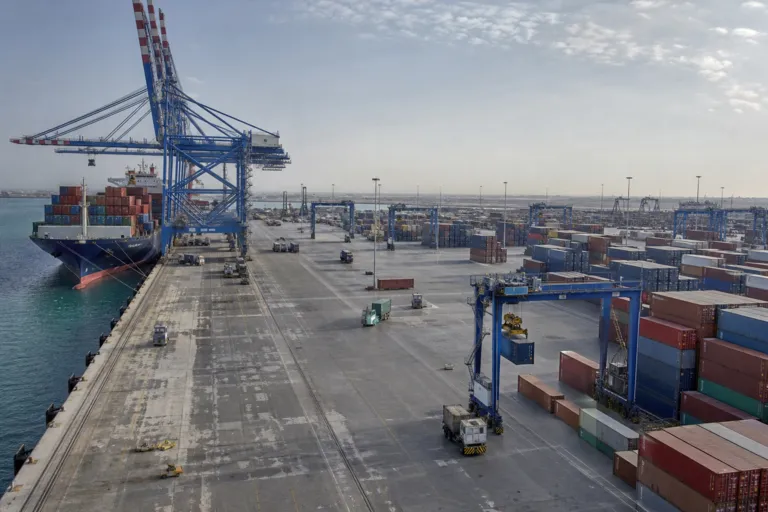
In 2026, shipping volatility in the Arabian Gulf and disruptions around the Strait of Hormuz pushed regional supply chains to seek workable alternatives. Reporting framed Saudi Arabia’s ports as an “alternative artery” for the region and for global trade, supported by advanced infrastructure and high operational capacity. This matters for industrial products as much as it does for energy, because lubricant and base oil supply depends on predictable vessel calls, resilient routing options, and ports that can keep cargo moving even when established lanes are pressured.
Jeddah Islamic Port strengthened its role as the Kingdom’s principal commercial gateway and the largest hub port on the Red Sea by adding two maritime shipping services in partnership with Maersk and Hapag-Lloyd. The services were named Maersk’s AE19 and Hapag-Lloyd’s SE4, with each route described as having a capacity of about 17,000 TEUs. Through these routes, Jeddah Islamic Port connects to nine major regional and international ports, including Tianjin Xingang, Qingdao, Ningbo, and Shanghai in China; Busan in South Korea; Tanjung Pelepas in Malaysia; and Singapore. The network also extends to hubs in the western and eastern Mediterranean and routes reaching South Africa via the Cape of Good Hope, improving flexibility for intercontinental cargo flows.
Why Yanbu Became the Red Sea Safety Valve for Energy-Linked Cargo
Yanbu’s ports gained attention as energy exporters adjusted routings toward the Red Sea. Reuters reporting cited that Saudi Aramco informed buyers of its Arab Light crude that some shipments would be loaded from Yanbu instead of Gulf terminals, reflecting confidence in Red Sea capacity and a move away from Gulf-lane volatility. King Fahd Industrial Port in Yanbu was described as the largest facility on the Red Sea for loading crude oil and petrochemical products, with a handling capacity of 210 million tonnes annually. For lubricant supply chains, these shifts matter because base oils and additives often travel alongside broader petrochemical cargo planning, and stable export corridors can support steadier inventory positioning across the GCC.
Port capability was also framed as a system, not a single terminal. The Saudi Ports Authority (Mawani) manages an integrated network that includes 290 berths equipped with advanced technology, supporting the flow of oil and essential goods. IndexBox described Jeddah Islamic Port as spanning about 12.5 square kilometers with 62 berths and handling over 130 million tonnes of cargo yearly, offering scale for diversified import and export programs. Taken together, Jeddah’s connectivity and Yanbu’s energy throughput give planners practical routing choices when designing Red Sea ports lubricant logistics for Saudi Arabia, especially when carriers shift between Suez-linked options and Cape of Good Hope alternatives.
Investment and modernization narratives also reinforced the ports’ gateway role. IMARC Group estimated the Saudi Arabia ports infrastructure market size reached USD 2.0 Billion in 2025 and is expected to reach USD 3.3 Billion by 2034, with a CAGR of 5.62% during 2026-2034. IMARC also noted that in December 2024, CMA CGM signed a memorandum of understanding with Saudi Arabia to develop port infrastructure and enhance logistics and multimodal services in the Red Sea region. In practical terms for GCC supply resilience in 2026, these moves supported a clearer message: Red Sea ports can be scaled and connected fast enough to help keep industrial supply lines, including lubricants, responsive under geopolitical stress.
What new shipping services were added at Jeddah Islamic Port?
Which international ports does Jeddah connect to through the new routes?
How large is King Fahd Industrial Port in Yanbu for crude and petrochemical loading?
How does Saudi Arabia’s port network support supply chain resilience?
How do Red Sea ports support lubricant logistics in Saudi Arabia during disruptions?