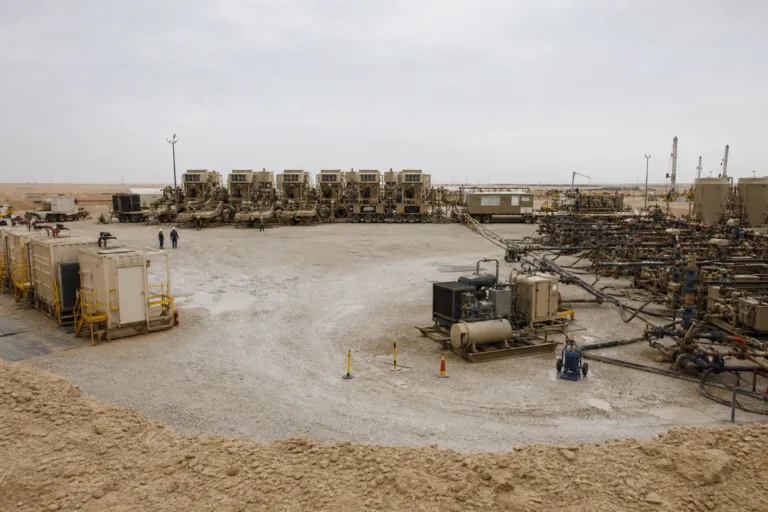
Saudi Arabia is shifting gas supply away from oil-linked associated gas toward non-associated and unconventional sources led by Saudi Aramco and the Jafurah basin. The Jafurah unconventional field in the Eastern Province is described as the most significant gas development project in the Kingdom’s current portfolio, and its development involves horizontal drilling and hydraulic fracturing applied at massive scale across a large gas-bearing formation. This kind of buildout is lubricant-intensive because it expands the operating hours and duty cycles of equipment used to drill, fracture, and move gas through processing and pipeline systems. At the market level, Saudi Arabia’s lubricants market was valued at USD 1,502.5 million in 2025 and is projected to reach USD 1,749.5 million by 2030, reflecting a 3.09% CAGR, with industrial expansion and diversification initiatives cited as key drivers.
The industrial lubricant context matters because unconventional gas projects tend to create demand beyond engines alone. Separate market reporting sizes Saudi Arabia’s industrial lubricants market at USD 663.8 million in 2025, with an outlook to USD 837.5 million by 2034 at a 2.62% growth rate for 2026–2034. The same source links structural growth to Vision 2030 industrial diversification and specifically notes that large-scale projects such as the Jafurah Gas Project are expected to significantly increase gas production capacity by the end of the decade. That expectation frames why operators, contractors, and suppliers track compressor oils, hydraulic fluids, and greases alongside broader industrial uptime needs. It also aligns with a market view that industrial users increasingly prioritize longer equipment life, energy efficiency, and condition-based maintenance.
What Compressor and Fracturing Fleets Mean for Lubricant Planning
Jafurah’s role in the gas strategy is tied to domestic power generation, petrochemical feedstock, desalination, and industrial demand, with a stated goal of reducing direct oil burning in the Kingdom’s energy system. March 2026 reporting also highlights major progress at Jafurah alongside the Tanajib Gas Plant, describing a boost to raw gas processing capacity that supports downstream industrial gas supply for petrochemical and manufacturing sectors. For lubricant demand, this points to a wider equipment chain than the wellsite alone, including rotating machinery and supporting assets that must run reliably across long operating windows. Within this context, the keyword topic of Jafurah gas field lubricants becomes a procurement and specification challenge: supply needs to match harsh operating environments and continuous-duty equipment expectations while meeting the broader industrial reliability targets that diversification policies are trying to enable.
Saudi Arabia’s lubricant demand fundamentals are not solely upstream-driven, and that influences how suppliers scale blending, distribution, and product mix. One market view places the Saudi lubricants market at USD 1,340 million in 2025 and projects expansion to USD 1,798 million by 2032, equal to a 4.29% CAGR, with value growth expected to modestly exceed volume growth as synthetic and semi-synthetic lubricants command higher realized value per liter. The same source states Saudi Arabia had more than 15.8 million registered vehicles at end-2024, up 6.9% year on year, supporting recurring demand and reinforcing distribution strength. On the supply side, it notes Luberef operates 1.3 million MT of annual base-oil capacity across Yanbu and Jeddah, and that feedstock access supports export-capable manufacturing economics. This backdrop can help buffer project-driven swings while still enabling specialized industrial product lines needed by compressors and heavy equipment.
Location and scale also shape sourcing decisions. Wood Mackenzie describes the Jafurah Basin as located east of Ghawar in Saudi Arabia’s Eastern Province, around 300 kilometres south of Dammam, which helps explain why the Eastern region is often associated with oil, gas, and heavy-industry demand. Meanwhile, gas supply is moved through the Master Gas System, the Kingdom’s pipeline infrastructure transporting natural gas from production fields to processing plants and end consumers across Saudi Arabia. As unconventional activity broadens beyond Jafurah, the same gas overview notes Saudi Aramco is exploring additional unconventional resources, including tight gas reservoirs in the Rub’ al Khali and other basins, with techniques requiring adaptation for desert operations and specific geology. For lubricant stakeholders, the implication is that compressor and heavy equipment lubrication demand is not a one-off event, but part of an expanding operational footprint tied to diversification-linked industrial consumption.
Why does Jafurah’s unconventional development matter for lubricant demand?
What are the key Saudi market figures that frame industrial lubricant growth?
How do compressors and processing capacity connect to lubricant planning?
What supply-side capabilities are cited for Saudi base oils?
Where is Jafurah located, and why does that matter for operations?