
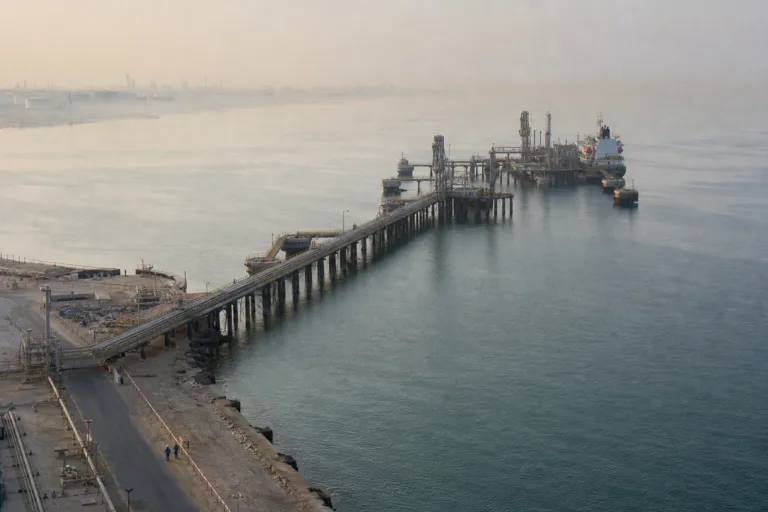
Bahrain’s Bapco Energies declared force majeure across its group operations after an attack on the Sitra refinery complex. Argus described the Sitra refinery as 405,000 b/d and said it was hit by Iranian drone strikes in the early hours of Monday in the Sitra area. Reuters, in separate reporting, cited the Sitra refinery at 380,000 bpd and noted it buys Saudi crude via a pipeline between the two countries. Bapco said domestic fuel supplies remain secure and that contingency plans are in place to ensure continued deliveries to the local market without disruption, even as contractual export obligations may be suspended under force majeure.
The export exposure matters because Sitra sits at the center of Bahrain’s petroleum products export business. Fuels and Lubes Asia reported that the Sitra refinery processes crude into ultra-low sulphur diesel, jet fuel, naphtha, and base oils, with over 80% of output exported to international markets. Reuters also characterized Bapco as a major exporter of fuels including diesel, jet fuel and naphtha to countries in the Middle East and Asia. While Bapco’s notice did not specifically identify base oils as a product category, Fuels and Lubes Asia said the declaration covers all group operations, including Sitra’s Group III base oil production and export operations.
Why Sitra’s Group III Base Oils Matter for Premium Blends
For premium lubricant blenders, the key issue is the concentration of higher-end base oil supply. Fuels and Lubes Asia described Bapco’s Lube Base Oil unit at Sitra as a significant supplier to lubricant blenders across Asia, Europe, and North America, and said the supply interruption is expected to tighten an already constrained global Group III base oil market. A separate market note by Sanyang Petroleum, citing Argus Media, linked Asia-Pacific Group III price moves through early April 2026 to a ten-day stretch in March when three refineries with significant Group III and Group III+ capacity were hit during the opening weeks of the Israel-US-Iran conflict.
Sanyang Petroleum reported that Bapco declared force majeure across all group operations after a drone strike hit Sitra, adding that Sitra had completed a USD 7.3 billion modernisation programme in 2023 that lifted capacity to 380,000 barrels a day and added significant Group III and Group III+ production. The same source said Bapco is one of the world’s larger Group III exporters, with more than 80% of its output normally sold overseas. In that framing, the Sitra disruption landed alongside other regional hits: Sanyang Petroleum said a 10 March drone strike prompted ADNOC to shut refining operations at the Ruwais industrial complex, and that an 18 March strike damaged one processing train at Shell’s Pearl GTL plant, where Shell put the repair timeline for that train at around a year.
Beyond base oils, the broader regional conflict backdrop is intensifying the risk premium that buyers and traders must navigate. Argus said the war began on 28 February and, by the tenth day, had triggered attacks on energy infrastructure across the Mideast Gulf, including Saudi Arabia’s 550,000 b/d Ras Tanura refinery being targeted twice and drones aimed at Saudi Aramco’s 1mn b/d Shaybah oil field being intercepted. Argus also reported impacts on LNG facilities in Qatar and fuel storage tanks in the UAE and Oman, adding that these concerns have pushed crude prices higher in recent sessions. In that environment, buyers tracking Bapco Group III base oil Sitra flows are watching for how long export-side disruption persists versus Bapco’s stated ability to keep domestic supplies secure.
Why did Bapco declare force majeure on Sitra operations?
What capacity is reported for Bahrain’s Sitra refinery?
Does the force majeure include Group III base oil exports from Sitra?
How export-dependent is Sitra’s product slate?
Why do premium lubricant blenders care about Sitra disruptions?