
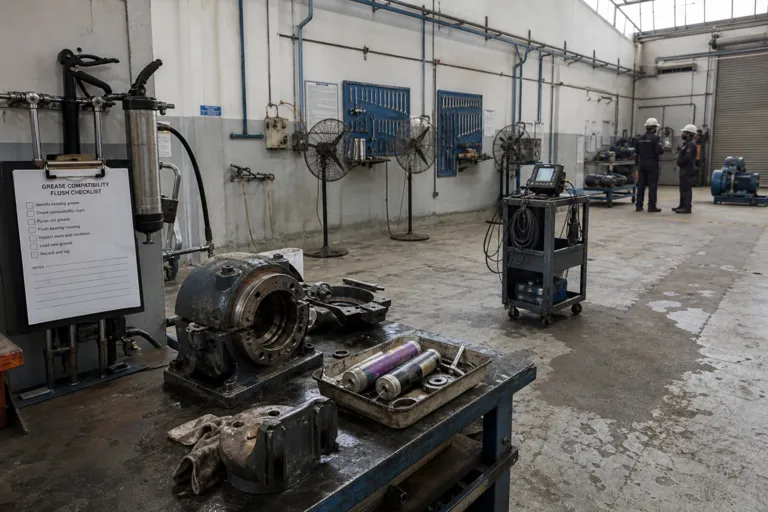
Supplier changeovers are a common trigger for avoidable lubrication problems in rotating equipment. The risk is not that one grease is “bad,” but that two greases that each work well alone can perform poorly when mixed inside a bearing or reservoir. Grease is a semi-solid system made from base oil, thickener, and additives. Sources note the base oil is usually about 70 to 95 percent of the formulation, while the thickener is typically around 5 to 20 percent. When a plant tops up, relubes, or converts equipment during a supplier switch, the new grease almost always meets residual old grease. If those thickener networks clash, the structure meant to hold oil in place can stop doing its job, and the plant ends up investigating a bearing failure that began as a routine lubrication task.
In most compatibility failures, the thickener matrix is the root problem, not the base oil. Multiple sources emphasize that incompatible thickener systems can degrade the network that traps and releases oil, causing the mixture to soften, harden, or separate. When that matrix breaks down, oil can separate and the contact zone can starve. This is also why failures can be misdiagnosed: one source describes how the damage can build gradually, and the connection to the grease change is often lost by the time the bearing fails. In a real-world European example, an Italian bottling operation switched H1 food-grade grease suppliers on price. Both products were properly certified for incidental food contact and fit for purpose, but the thickener chemistries differed. Over the following six months, the plant replaced more than thirty bearings across the line before linking the failures to the switch.
What Mixing Looks Like in the Field—and Why Charts Aren’t Enough
Compatibility charts are useful first-pass filters, but sources warn they cannot guarantee performance for a specific product pair. Thickener chemistry matters, yet base-oil viscosity and additive systems can shift outcomes, and even similar thickener families can occasionally be incompatible because of additive interactions. Several sources point to lithium and polyurea as a pairing that must be verified. One source calls polyurea “the sharpest example,” describing how mixing polyurea with a lithium grease in the same housing can soften sharply within a short time of restart, before a scheduled inspection would catch it. Another source highlights that “polyurea” is a chemical class, not a single fixed formulation, so some polyurea products may be compatible with lithium or lithium complex while others are flatly incompatible. This is why relying only on thickener names can lead to a false sense of safety.
Operationally, GCC sites can manage grease compatibility supplier changeover risk by treating conversion as a controlled maintenance job, not an inventory substitution. Watch for warning signs after a product change, cross-contamination, or top-up: softening or thinning with leakage where the old grease stayed put, hardening that impairs distribution, excessive oil separation, or a grainy and nonuniform texture. Temperature rise or new noise after relubrication should trigger an investigation of what was added, while also checking for overgreasing, wrong quantity, contamination, and mechanical causes. Importantly, sources stress these are warning signs, not a field compatibility test. For confirmation, ASTM D6185 is cited as the standard practice for evaluating binary grease mixtures. If mixing cannot be avoided in the field, sources recommend a full purge or a clean repack to remove the old product rather than creating an uncontrolled blend.
Standardization still matters, and one source notes that reducing a plant from ten grease specifications to three can be genuinely worth doing because it lowers inventory, mistakes, and training complexity. But that same step deliberately introduces new grease into positions that contain something else, which is exactly when incompatibility failures can occur. The practical safeguard is to plan the conversion sequence: identify what is currently in service, avoid “similar-looking” substitutions during maintenance windows, and require product-pair verification rather than assuming compatibility from a label, color, or NLGI grade. Supplier data and ASTM D6185 testing provide a safer basis than generic charts alone. Done this way, changeovers can achieve simplification without trading it for hard-to-diagnose bearing failures weeks later.
Why do bearings fail after a grease supplier switch even if both greases are good products?
What are common warning signs of grease incompatibility after a changeover or top-up?
Are lithium and polyurea greases always incompatible?
How can GCC plants reduce grease compatibility supplier changeover risk during conversions?
Can a compatibility chart replace testing for a specific grease pair?