
GCC lubricant suppliers operate inside a market shaped by rising vehicle ownership, expanding maintenance activity, and fast-moving routes to market. In Saudi Arabia, GASTAT reported 15.8 Mn registered vehicles in use by the end of 2024, up 6.9% from 2023. Packaging indicators also show why execution discipline matters at the point of sale: in the GCC lubricant packaging market, bottles are projected to hold 38.6% share in 2026, and engine oil is projected at 58.4% share in 2026. Those mixes amplify the need for consistent availability, on-shelf visibility, and product integrity across workshops, service stations, and retailers, not just shipment volume into a distributor’s warehouse.
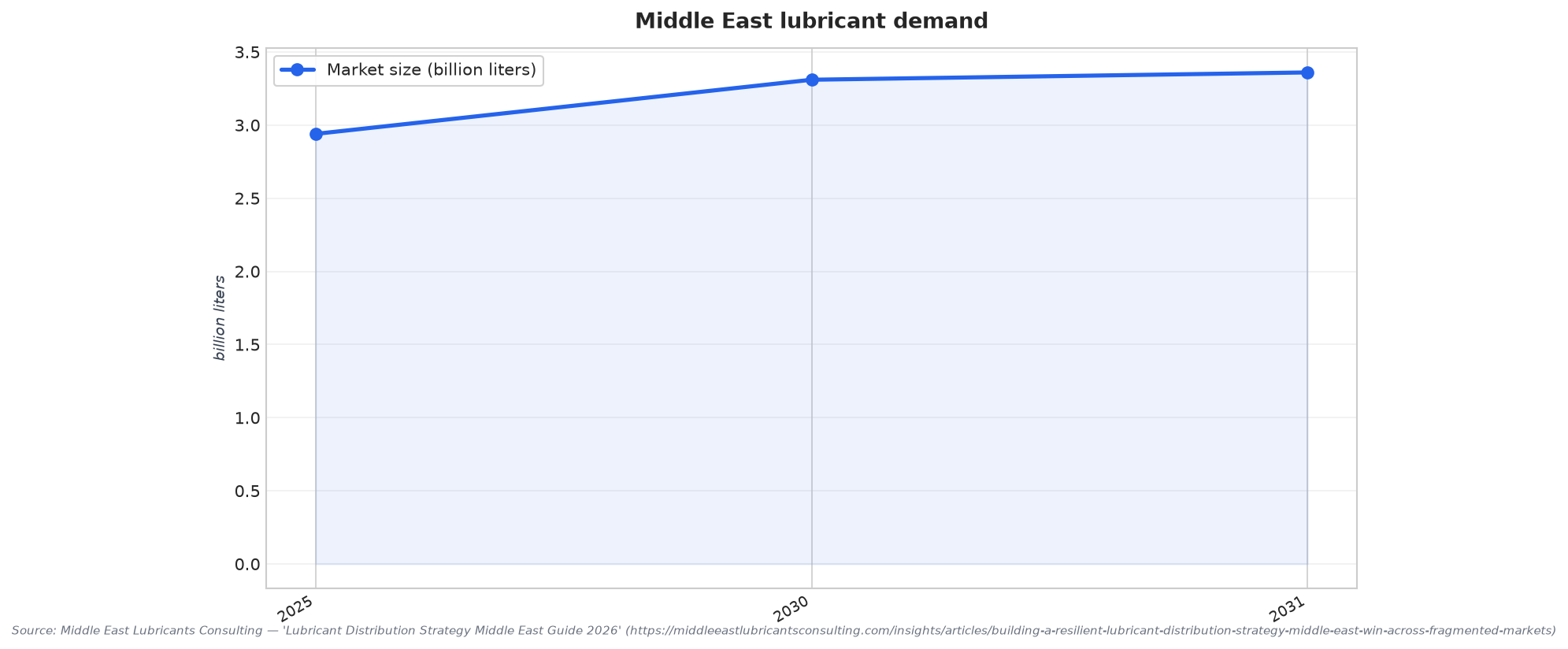
Volume can also mislead when demand is fragmented and growth rates differ by geography and segment. One Middle East outlook projects lubricants growing from 2.94 billion liters in 2025 to 3.31 billion liters by 2030, a 2.43% CAGR. Another estimates 2.87 billion liters in 2025, rising to 3.36 billion liters by 2031 at a 2.66% CAGR. Within that same regional context, Saudi Arabia led with 37.21% of the Middle East lubricants market share in 2025, while the UAE is described as the fastest-growing geography at a 3.21% CAGR through 2031. With that variability, a distributor can “hit volume” while underperforming on coverage, service reliability, or program adoption in the territories that matter most.
The KPI Scorecard Categories That Make Distributor Comparisons Fair
A practical approach is a weighted distributor health scorecard. Channelplay notes that effective scorecards weight metrics based on strategic importance, because not all KPIs deserve equal influence in the overall health assessment. It also emphasizes that no single KPI tells the complete story, and that a balanced framework should combine sales outcomes with operational execution, market coverage, and program engagement. For lubricant suppliers, this creates a usable structure: keep volume and revenue as outcome measures, then add coverage metrics to show penetration breadth, operational indicators to assess reliability, and engagement metrics to separate loyalty or program participation from general business performance. The goal is apples-to-apples comparison across distributors while still reflecting multi-dimensional performance.
Data discipline is what makes scorecards actionable at scale. Channelplay points out that manual metric tracking becomes impractical beyond small networks, and that distributor management systems can automate data collection, calculation, and reporting by connecting sales systems, CRM, loyalty platforms, and financial systems. NetSuite adds why this matters in complex distribution environments: fragmented data sources across internal teams can prevent consistent reporting standards, while retailer and distributor variability complicates efforts to standardize KPIs. For GCC lubricant suppliers, the practical implication is to define the scorecard first, then centralize reporting rules so each distributor is judged on consistent definitions, refresh cycles, and evidence, rather than ad-hoc spreadsheets.
Finally, tie the scorecard back to what wins in-market. The Middle East distribution guide highlights intensifying competition beyond price, with value-added services like lubrication management and condition monitoring becoming differentiators. That is a signal to include execution KPIs that prove readiness to deliver those services consistently, not only to sell product. Packaging details reinforce why retail execution belongs in the discussion: the GCC lubricant packaging market analysis notes that bottles are preferred for controlled pouring and easier shelf handling, and it cites ADNOC Distribution’s Voyager bottle design using a tamper-proof, non-refillable shroud closure to strengthen product integrity and consumer confidence across GCC retail channels. A scorecard that goes beyond volume makes those realities measurable and manageable.
Why should GCC lubricant suppliers go beyond volume when measuring distributor performance?
What categories should be included in a distributor health scorecard?
How do automation and systems improve distributor KPI tracking?
What GCC and Middle East figures support the need for tighter distributor execution?
How should a supplier frame lubricant distributor performance KPIs in the GCC?