

Aviation lubricants and greases are specialized formulations that support aircraft performance and safety. They include liquid lubricants made from base oils and additives, and semi-solid greases made with thickening agents. These products are used in engines, landing gear, and flight control systems. They are designed to handle extreme temperatures from -65°F to 400°F and to reduce wear while helping prevent corrosion.
Sustainability pressure is rising alongside aviation growth. One market outlook valued the global aviation lubricants and greases market at USD 2504 million in 2024 and projected it to reach USD 3449 million by 2032, at a 4.9% CAGR. A separate aerospace lubricant report valued the global market at USD 911.66 million in 2025 and projected USD 1231.74 million by 2034, at a 3.4% CAGR. These numbers describe different market framings, but they both indicate continued expansion as fleets grow and maintenance demand increases.
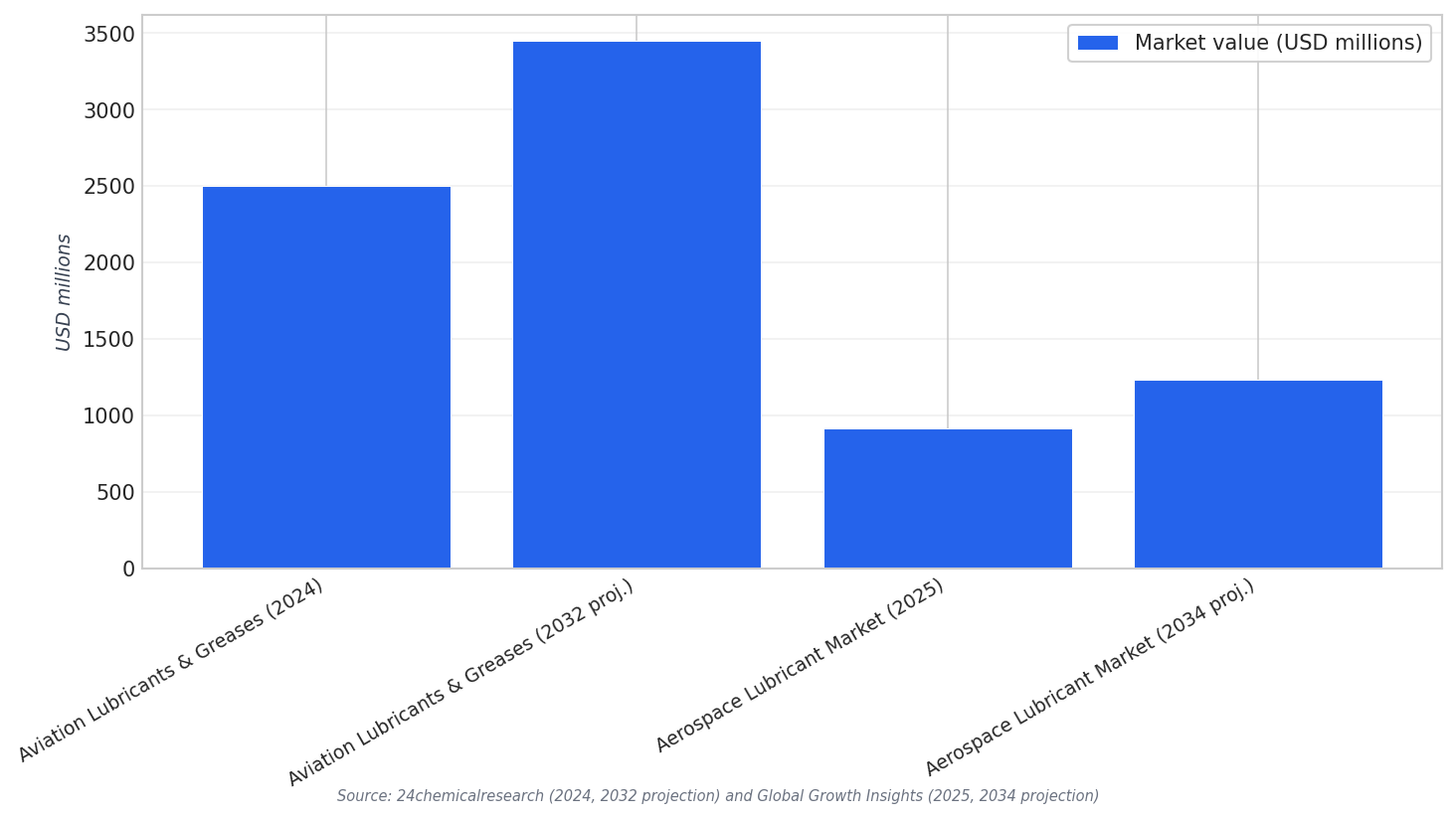
Within this growth story, environmental direction is becoming clearer. An aviation-focused overview notes that modern aviation lubricants are being developed to minimize environmental impact by reducing toxicity, improving biodegradability, and extending oil change intervals to reduce waste. Market coverage also describes bio-based formulations alongside mineral oil-based and synthetic types, and highlights environmental regulation pressure, including challenges around PFAS-containing formulations that are prompting R&D in eco-friendly alternatives.
What “Bio-Based” Can Mean for Turbine Oils and Greases
Research on bio-based lubricants links sustainability to functional performance, but also to real constraints. A comprehensive review describes bio-based lubricants as gaining prominence because of inherent biodegradability and low ecotoxicity, while noting adoption challenges such as oxidative and thermal instability, cold-flow behavior, and cost competitiveness in high-performance uses. It also states that trimethylolpropane esters are adopted in aviation turbine oils due to high flash points and low volatility. This is a concrete example of how bio-derived chemistry can fit turbine oil requirements when properties align.
Low-toxicity additive design is another pathway that can complement biodegradable aviation lubricants. In a ScienceDaily summary of work reported in ACS Sustainable Chemistry & Engineering, ionic-liquid additives, when added to base oils, showed 50% less friction and a tenfold decrease in equipment wear compared with a commercially available gear oil, while meeting federal standards for environmental toxicity and biodegradability. The same report describes toxicity screening where some additives caused 100% mortality within one to three days after exposure, while the team’s final short-chain ammonium phosphate and phosphonium phosphate ionic-liquid designs resulted in 90–100% survival after seven days and were found to be highly biodegradable compared to standard lubricant additives. While this work is described for water power turbines, it illustrates the broader direction of pairing performance with lower environmental impact.
Commercial momentum is also tied to fleet growth and sustainability roadmaps. One outlook reports that the global commercial aviation fleet is expected to grow by 33% to exceed 36,000 aircraft by 2033, which would raise demand for turbine engine oils, hydraulic fluids, greases, and synthetic lubricants used in routine servicing. The same source states that bio-based aviation oils, produced from renewable and plant-derived feedstock, are gaining popularity due to biodegradable and environmentally friendly nature, and that airlines aiming to reduce carbon footprints are adopting these lubricants as part of sustainability roadmaps. Together, the market projections and formulation research explain why sustainability is becoming a practical design constraint in aviation lubrication.
What are biodegradable aviation lubricants in this context?
How big is the aviation lubricants and greases market?
What temperature range do aviation lubricants and greases need to handle?
What bio-based chemistry is already used in aviation turbine oils?
What performance results were reported for eco-friendly additive research?