
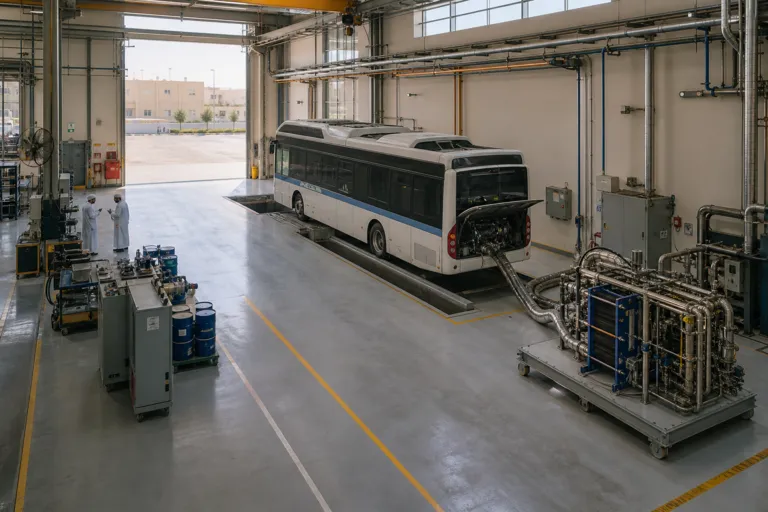
GCC fuel-cell mobility is moving from concept to fleet planning, especially for urban buses, taxis, and depot-based operations. A GCC-focused market source describes cities such as Riyadh and Doha exploring hydrogen-powered buses and taxis, alongside a projected 20% increase in public transport ridership “by future.” In the same source, only 25% of the population in major GCC cities is familiar with hydrogen’s benefits, which frames why fleet programs and visible demonstrations matter. It also estimates hydrogen infrastructure investment at around USD 2 billion for the GCC region “by future,” highlighting how much of the near-term effort is about buildout and operational confidence, not only vehicle procurement.
Those fleet ambitions put pressure on under-the-hood enabling systems. Thermal management is a central requirement for fuel-cell vehicles, and a dedicated market report states the hydrogen fuel cell vehicle cooling system market exceeded USD 328.3 million in 2024 and is expected to grow at a CAGR of 18.9% from 2025 to 2034. The same report lists key cooling components, including radiators, coolant pumps, heat exchangers, cooling fans, valves, and sensors. It also flags current trends such as the growing adoption of liquid and hybrid cooling systems, modular heat exchangers, AI-enabled thermal management, and intelligent coolant circulation integrated into fuel cell and battery powertrains.
What Specialty Fluids Must Support in GCC Hydrogen Operations
In practical fleet terms, specialty lubricants and coolants are selected to serve the cooling architecture and the fuel-cell powertrain’s operating strategy. As modular cooling platforms roll out, the cooling-system report points to suppliers working on modular solutions that support multiple vehicle types and fuel cell architectures, aiming to reduce integration costs and shorten deployment timelines. For operators and maintenance teams, that direction implies tighter requirements for coolant circulation behavior and consistent thermal performance across platforms. In that context, discussions around hydrogen fuel cell vehicle lubricants in the GCC are really discussions about uptime: fluids that match pumps, valves, sensors, and heat exchangers, and that support the move toward smart coolant circulation integrated into fuel cell powertrains and battery modules.
Fuel-cell stack development adds another layer of requirements for how vehicles are designed and therefore how they are serviced. One market report states the automotive hydrogen fuel cell stack market size crossed USD 669.1 million and is expected to grow at a CAGR of 24.2% from 2025 to 2034. It also notes that the 100–250 kW power segment is notably expanding for medium-duty trucks and public transport buses, which aligns with the GCC’s interest in hydrogen buses described in the regional fleet source. As systems scale for buses and medium-duty use, thermal management hardware and the fluids that enable it become part of the core reliability equation for fleets that must run daily routes.
Global market growth forecasts also show why suppliers are investing in the ecosystem, even if GCC deployments are still maturing. One global estimate puts the hydrogen fuel cell vehicle market at USD 3.55 billion in 2025, projected to reach around USD 205.5 billion by 2035, with a 50.06% CAGR from 2026 to 2035. Another estimate places the market at USD 3.87 billion in 2025, growing at a 52.4% CAGR from 2026 to 2034, and says passenger vehicles dominated in 2025 with a 50.15% share, while private end users held 63.22%. For the GCC, the immediate takeaway is not that these global splits mirror local demand, but that a fast-growing global vehicle base is accelerating cooling-system innovation that GCC fleets can adopt as infrastructure and awareness rise.
Why do coolants matter so much for hydrogen fuel-cell vehicles?
What cooling-system components shape fluid requirements in fuel-cell vehicles?
How does GCC fleet planning influence specialty fluid demand?
What do market forecasts imply for hydrogen fuel cell vehicle lubricants in the GCC?