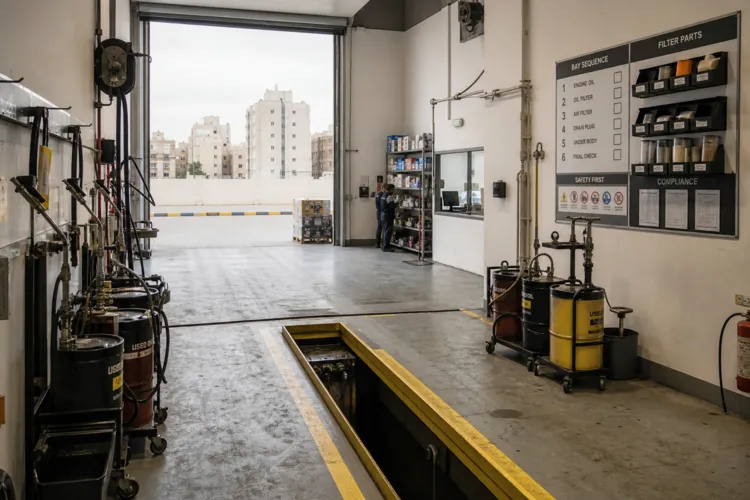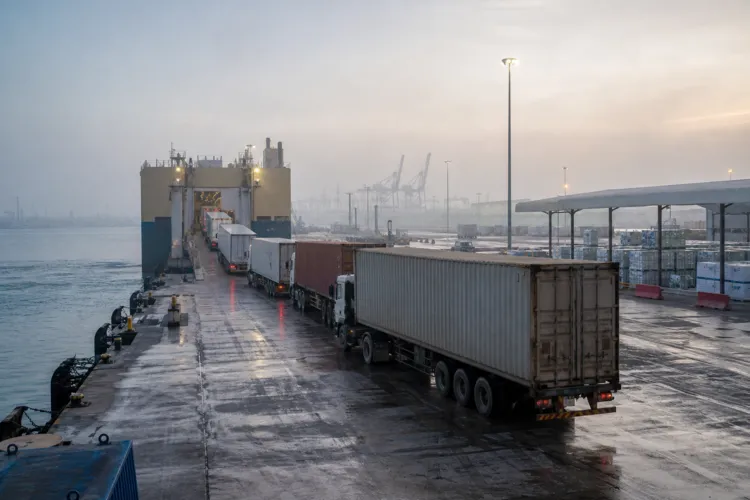

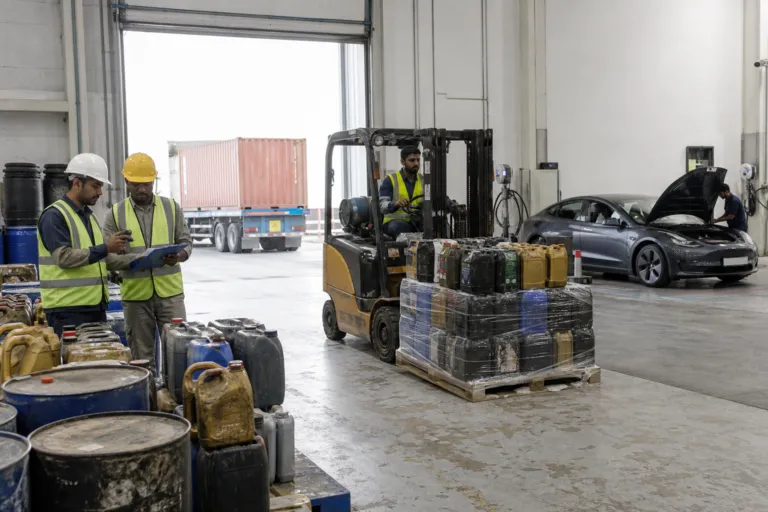
The UAE lubricants market is shaped by production, blending, distribution, and consumption across automotive and industrial uses. It includes engine oils, transmission fluids, hydraulic oils, greases, and specialty fluids that reduce friction and extend machinery and vehicle lifespan. The market runs through domestic blending facilities, regional distribution hubs, and strong import-export linkages supported by the UAE’s strategic logistics infrastructure.
In volume terms, recent industry estimates expect the UAE lubricants market to reach approximately 172.58 million liters in 2025. Using a projected trajectory of around 4.8% CAGR, it implies about 213.64 million liters by 2032. Demand remains closely tied to transportation activity, industrial operations, construction growth, and energy sector performance, with the market characterized by high consumption of automotive lubricants.
Re-Export Advantage Meets a Changing Product Mix
The UAE’s role as a logistics-led distribution hub supports strong import-export linkages in lubricants. At the same time, the product mix is being pushed upward. A Ken Research release describes a market value around USD 1B and highlights a “structural move to premium grades,” with “synthetics and semi-synthetics” holding an above-regional share within MENA. This sets up a clear premiumization story for suppliers that can win on brand, quality assurance, and channel execution.
Competitive positioning also reflects that shift. Mordor Intelligence lists the top five UAE lubricants companies as ADNOC, ENOC, Shell, BP, and ExxonMobil. The same source notes buyer concerns about reliably supplying premium synthetics and documenting authenticity when counterfeits circulate through informal channels. It also points to product updates aligned with newer API categories and Euro 5 vehicle import rules.
Company actions underline premium and operational themes. Mordor Intelligence states ENOC’s lubricants and grease facility in Jebel Ali now runs entirely on solar energy, based on a November 2023 update. It also describes ADNOC’s push into premium low-viscosity grades, referencing a 2025 dealer event that introduced SQ grade 0W20 and 5W30 variants. These details fit a market where buyers increasingly value technical credibility, steady supply, and compliance-aligned specifications.
EV adoption adds a disruptive layer. Ken Research states that rising electric vehicle adoption in Dubai is steadily reducing reliance on internal combustion engines, shrinking demand for conventional engine oils. It also says suppliers will need to expand into EV-compatible fluids, including gearbox oils, thermal management fluids, and battery-cooling agents. Alongside EV disruption, the same source notes pressure on traditional Group I oils and low-grade mineral lubricants, and highlights buyer prioritization of low-SAPS and low-viscosity oils aligned with EU-VI equivalent norms, plus interest in bio-based blends that align with environmental mandates.
What is the outlook for the UAE lubricants market through 2032?
Which companies are leading players in the UAE lubricants market?
How is EV adoption affecting lubricant demand in Dubai?
What does premiumization mean in the UAE lubricants market?
What are buyers prioritizing in the UAE lubricants market today?