
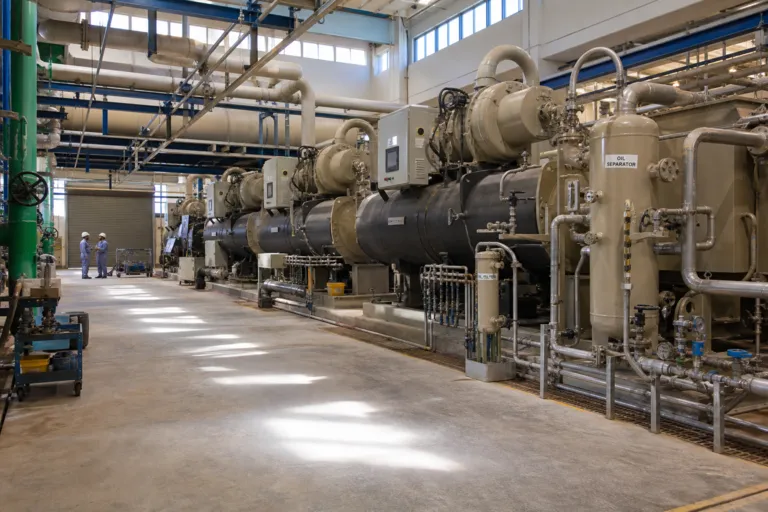
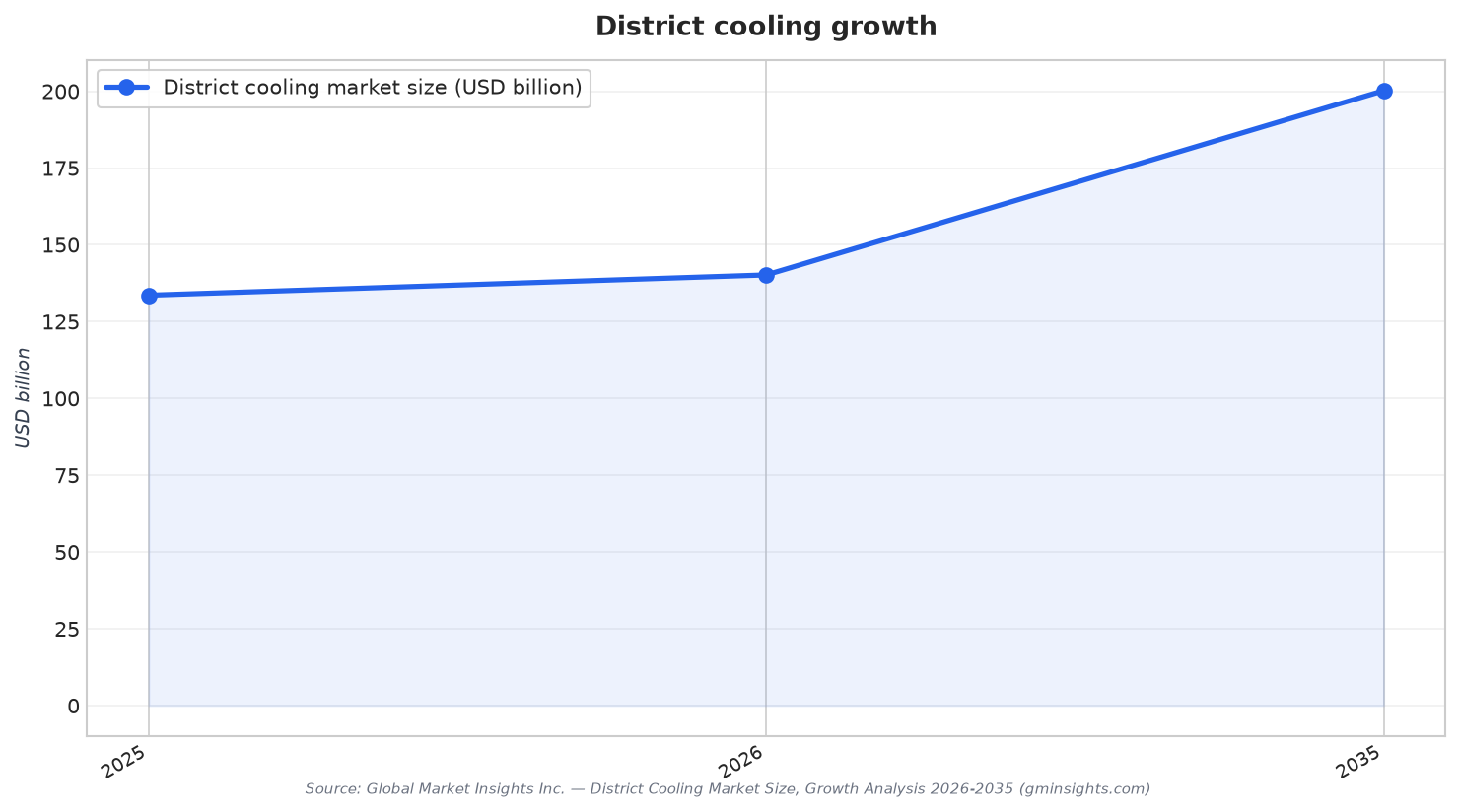
District cooling is scaling as a mainstream answer for dense urban areas that want to optimize space and reduce operational costs. Globally, the district cooling market was estimated at USD 133.6 billion in 2025, and Global Market Insights projects it to reach USD 140.2 billion in 2026 and USD 200.2 billion by 2035, at a CAGR of 4%. MarketResearchFuture separately frames the sector as a “transformative phase,” noting centralized systems hold the largest share because they can serve a vast network of buildings efficiently. In the Gulf, that city-scale buildout translates into rising attention on the mechanical realities inside chiller plants, including the oils that keep compressors operating reliably.
Chiller demand provides another lens on why lubricants become strategically important as networks grow. Grand View Research values the global chillers market at $10.8 billion in 2025 and projects growth from $11.2 billion in 2026 to $15.6 billion by 2033, at a 4.9% CAGR. It also describes the Middle East and Africa chiller market as growing, with GCC countries such as Saudi Arabia and the UAE highlighted as key drivers due to booming construction and extreme weather conditions. As that installed base expands across commercial real estate, healthcare, manufacturing, and data centers, operators face more assets to maintain, more service cycles to plan, and more opportunities for lubricant decisions to affect availability and operating discipline.
From Retrofit Cycles to Oil Choices in Central Plants
IndexBox links the modernization cycle directly to district energy projects and refrigerant transition dynamics. Its HVAC centrifugal compressors analysis states that growth is steady and focused on high-efficiency, low-GWP refrigerant solutions for commercial retrofits, district energy projects, and industrial applications, with demand concentrated in the GCC driven by large-scale district cooling projects, new commercial and hospitality developments, and data center investments. The same source notes advancements such as magnetic bearings and oil-free designs, alongside an emphasis on reliability and lifecycle cost. For buyers focused on district cooling lubricants in the Gulf, this means oil demand can shift in two directions at once: expanding conventional fleets still require rigorous oil management, while certain new compressor designs may change lubricant usage patterns within future chiller plant specifications.
In the UAE, growth signals are explicit. Bonafide Research expects the United Arab Emirates chiller market to grow at more than 8.50% CAGR from 2024 to 2029, citing drivers such as tourism and hospitality demand, Dubai development projects including those associated with Expo 2020, and rising demand for data centres that need high-capacity cooling. It also flags practical barriers that ripple into maintenance and consumables planning: the initial high cost of installing sophisticated chillers and the need for a sufficiently skilled workforce to install, maintain, and operate them. In practice, more sophisticated chiller technology and tighter operating expectations raise the value of disciplined service routines, where compressor oil handling, monitoring, and changeouts become part of sustaining performance.
Equipment mix also shapes lubricant requirements, because compressor types and chiller architectures vary in how they are deployed and serviced. Grand View Research reports that water-cooled chillers held 59.4% share in 2025, commercial applications held 48.9% share, and screw chillers by compressor type accounted for 50.0% in 2025 (global figures). It also notes scroll chillers are designed to be compatible with refrigerants such as R-407C, R-134a, and R-410A. Alongside these market signals, IndexBox’s industrial chillers outlook highlights that tightening refrigerant regulations are driving replacement of older units, and that IoT-enabled chillers with advanced controls for predictive maintenance are expected to become standard. In the Gulf’s district cooling buildout, that combination points to lubricant demand that is not just “more oil,” but oil demand increasingly tied to retrofit decisions, compressor technology, and predictive maintenance practices.
What is the projected growth path for the global district cooling market?
Why does GCC district cooling growth affect chiller and compressor oil needs?
What chiller market figures help frame maintenance demand alongside district cooling expansion?
How fast is the UAE chiller market expected to grow, and what is driving it?
Which chiller and compressor segments dominate in the available market breakdowns?