
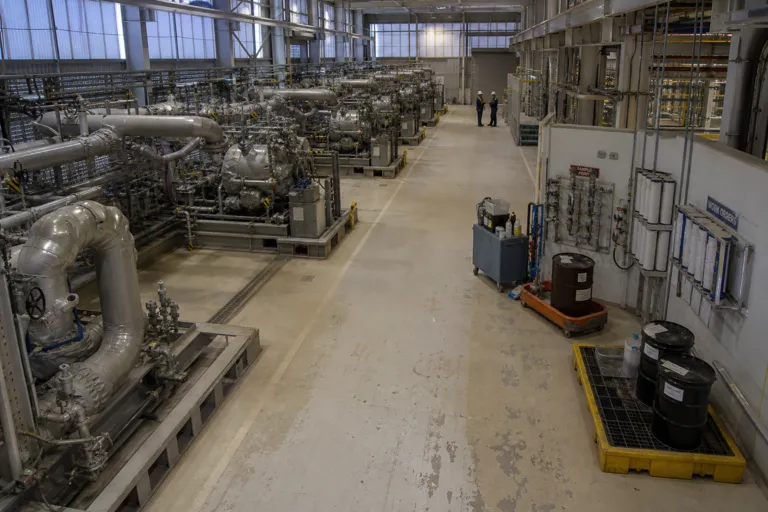
Gulf CCUS megaprojects are being framed as “hubs” rather than one-off installations, and that matters for lubricants. IndexBox describes the global oil and gas CCS market as moving from a niche compliance tool to a central pillar of industrial decarbonization, with scaling transport and storage networks becoming part of the story. In practice, hub buildouts increase the number of compression trains and operating hours needed to move captured CO2 into transport and storage systems. That is the operational context behind carbon capture compressor lubricants in the Middle East: as projects mature, lubricant demand becomes less about occasional top-ups and more about continuous reliability under high-pressure service.
Global project momentum is also the clearest indicator of how quickly compressor supply chains and maintenance programs could tighten. GlobalData reports that 42 CCUS projects started operations over the course of 2025, yet it also tracks over 650 projects aiming to start operations between 2026 and 2030 based on announcements. MarketIntelo adds another lens: in 2025 alone, over 45 large-scale CCUS projects were either operational or under advanced development globally, representing combined annual capture capacity exceeding 50 million tonnes of CO2. MarketIntelo also warns about supply chain constraints, explicitly flagging high-pressure compressors as a potential bottleneck as scaling accelerates.
Why CO2 Compression Intensity Drives Oil Selection and Buying Discipline
Compression is not an optional accessory in many CCUS designs; it is a core unit operation that influences uptime and operating costs. IndexBox highlights natural gas processing as a cornerstone of CCS because it can involve retrofitting existing plants with compression and dehydration units for already-captured CO2 streams. That retrofit pattern points to a practical procurement reality: operators can standardize lubricant specifications across fleets, but they also need to account for changing duty cycles when capture and injection run closer to baseload. IndexBox also notes “more disciplined procurement behavior” as the market enters 2026, a phrase that fits lubricant categories where qualification, drain intervals, and vendor approvals can shape both costs and risk.
CCUS linked to enhanced oil recovery (EOR) adds another pressure point for compression and, by extension, lubrication planning. Data Bridge Market Research values the global CCUS-EOR market at USD 5.20 billion in 2025 and projects it will reach USD 12.87 billion by 2033, growing at a CAGR of 12% from 2026 to 2033. It also states that North America dominated the global CCUS-EOR market with the largest revenue share in 2025, supported by infrastructure and investments in CO2 injection methods in mature fields. While that is not Gulf-specific data, it is a clear example of how EOR-linked CCUS can scale quickly when policy and infrastructure align—conditions Gulf developers will weigh as they build megaprojects.
Policy-driven scaling in the U.S. further illustrates how quickly compressor-heavy CCUS activity can ramp, which can tighten specialty equipment and service markets that are often global. Straits Research sizes the United States carbon capture and storage market at USD 5.12 billion in 2025 and projects growth from USD 5.71 billion in 2026 to USD 13.75 billion by 2034, at a CAGR of 11.6% during 2026–2034. It also cites U.S. incentives and funding signals, including a 45Q tax credit offering up to USD 85 per ton of CO2 captured, and DOE commitment of USD 2.3 billion for direct air capture hubs. For Gulf operators thinking ahead, the takeaway is indirect but relevant: as global build cycles accelerate, lubricant suppliers and OEM-approved formulations may see higher qualification workloads, making early specification alignment a practical hedge.
Why do CCUS hubs tend to increase compressor oil demand?
What do announced CCUS projects suggest about near-term equipment pressure?
How does natural gas processing connect to CO2 compression requirements?
What is the growth outlook for CCUS-EOR, and why does it matter for compression?
What should Middle East teams consider when planning carbon capture compressor lubricants?