
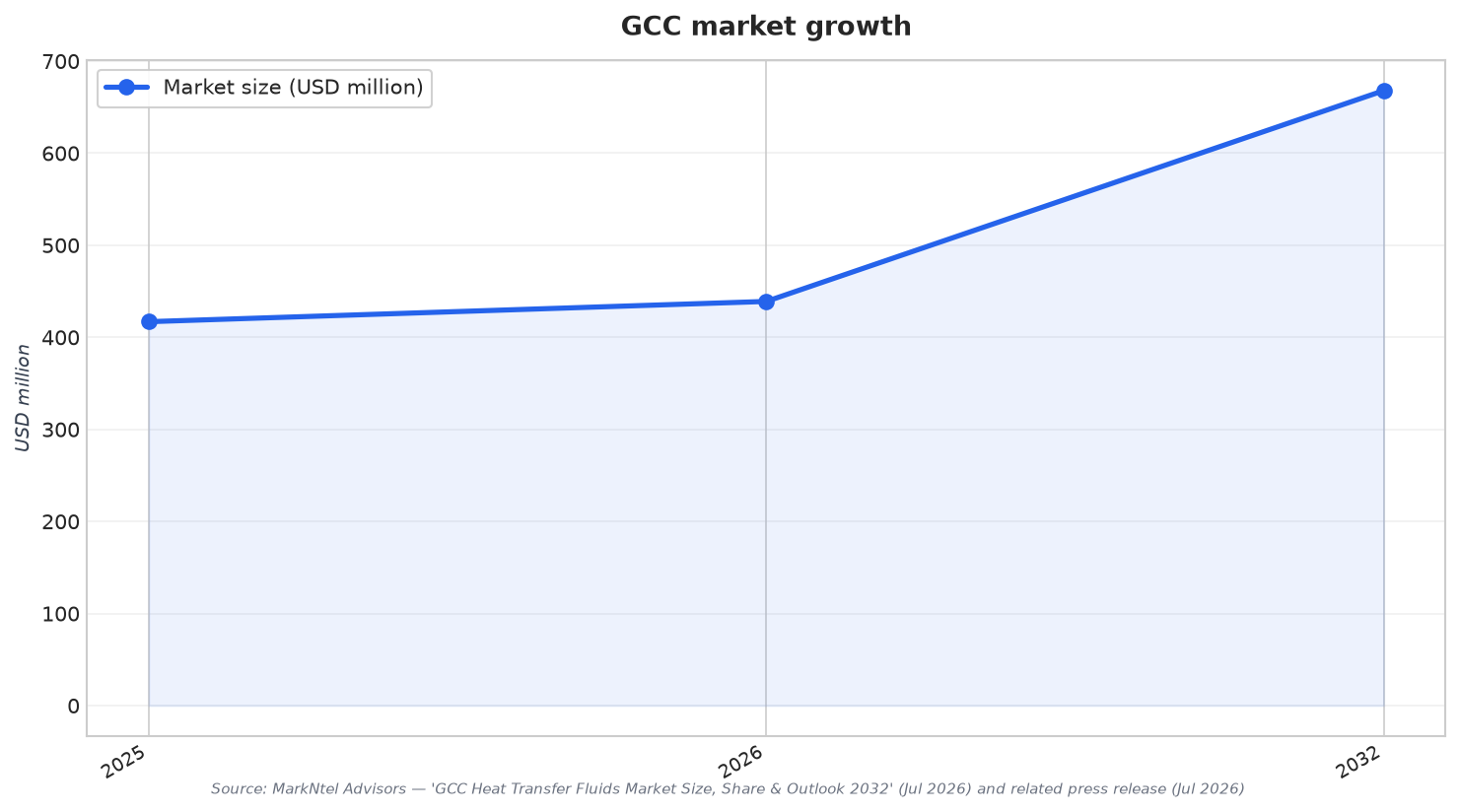
For developers and operators planning CSP projects in the Gulf, the heat transfer fluid selection is a system-level decision. In the GCC heat transfer fluids market, MarkNtel Advisors values the market at USD 417 million in 2025 and USD 439 million in 2026, with a projection of USD 668 million by 2032 and a 6.15% CAGR for 2026–2032. The same source notes that CSP is one of the end-user sectors included in this regional demand picture. In 2026, Saudi Arabia leads the GCC market with a 42% share, and the market remains fragmented, with the top five companies at about 30% share. These figures frame a procurement environment where multiple suppliers compete, but specifications still need to be precise for high-temperature CSP duty.
Specifications should start with the required operating range and the project’s thermal architecture. MarkNtel’s GCC segmentation includes low temperature (below 0°C), medium temperature (0°C–200°C), and high temperature (above 200°C), and it reports that medium-temperature fluids captured about 57% share in 2026. Product type also matters. Mineral oils are the largest product segment in the GCC, accounting for 42% in 2026, and the press release attributes that to cost-effectiveness, operational reliability, and compatibility with a large installed base across industries. For CSP, however, the selection conversation often shifts toward synthetic and specialty formulations, especially where demanding thermal conditions make oxidation resistance and longer operating life a priority, as described in the same GCC report summary.
Thermal Oils in CSP: Performance Specs That Drive Plant Output
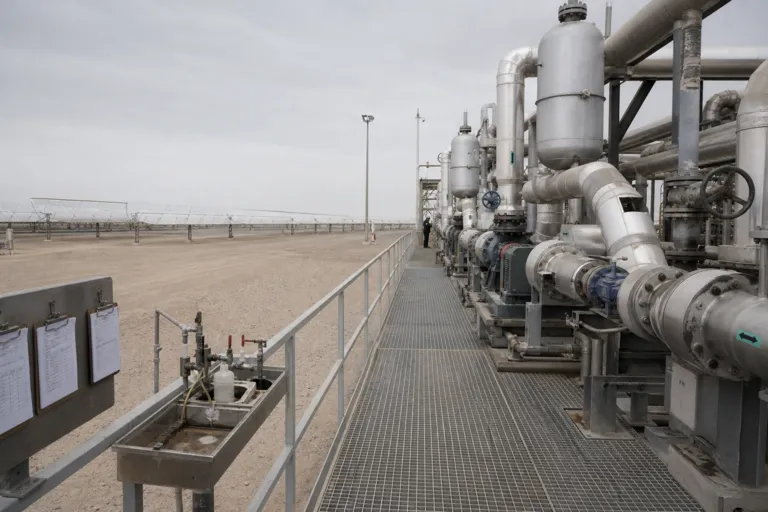
For parabolic trough CSP, synthetic organic thermal oils are described as the most widely deployed fluid class, with commercial formulations such as Therminol VP-1 (a eutectic mixture of diphenyl oxide and biphenyl) and Dowtherm A cited as dominating the market. Patsnap’s CSP-focused analysis also links fluid choice to parasitic loads. For a typical parabolic trough solar field with 500 meters of piping and a 4 m/s fluid velocity, pumping power for synthetic oil with viscosity 3 mPa·s at 300°C is approximated at 150–200 kW per MW of thermal capacity. Under the same example, molten salt with viscosity 4 mPa·s at 400°C is approximated at 180–220 kW per MW. The same source states parasitic power consumption directly reduces net system efficiency by 3–5%, so viscosity, temperature, and hydraulic design should be explicit in the specification set.
High-temperature CSP also intersects with storage strategy and capital planning. Patsnap notes that molten salt formulations have emerged as the preferred thermal fluid for high-temperature CSP applications and thermal energy storage systems. It also provides context on thermal oil procurement magnitude: typical costs for synthetic organic thermal oils range from $15–30 per liter, and it states that a 50 MW CSP plant may require 1,000–1,500 cubic meters of thermal oil. When drafting technical requirements for a heat transfer fluid concentrated solar power GCC project, these kinds of system-scale quantities and the impact of fluid properties on pumping losses should sit alongside practical requirements such as chemical compatibility, thermal stability, and low viscosity across the operating window.
Market context can support long-term supply planning, but it should be used carefully by geography. Globally, Polaris Market Research values the heat transfer fluids market at USD 11.59 billion in 2025 and projects a 4.9% CAGR from 2026 to 2034, while Market.us reports USD 10.1 billion in 2025 with an expectation of USD 19.8 billion in 2035 at a 7.0% CAGR. Market.us also cites Solar Compass research (2025) stating global CSP capacity exceeded 6 GW, with molten salts widely used as heat transfer fluids and thermal storage materials. Inside the GCC specifically, MarkNtel highlights supplier focus on higher-performance formulations, and that aligns with broader industry emphasis on improved stability, oxidation resistance, and longer operating life for demanding applications such as CSP and thermal energy storage.
What is the GCC heat transfer fluids market size and outlook through 2032?
Which product type leads the GCC heat transfer fluids market?
How do pumping power needs compare for synthetic oil vs molten salt in a parabolic trough example?
How much thermal oil might a 50 MW CSP plant require, and what cost range is cited?
How should buyers approach specifying heat transfer fluids for concentrated solar power in the GCC?