
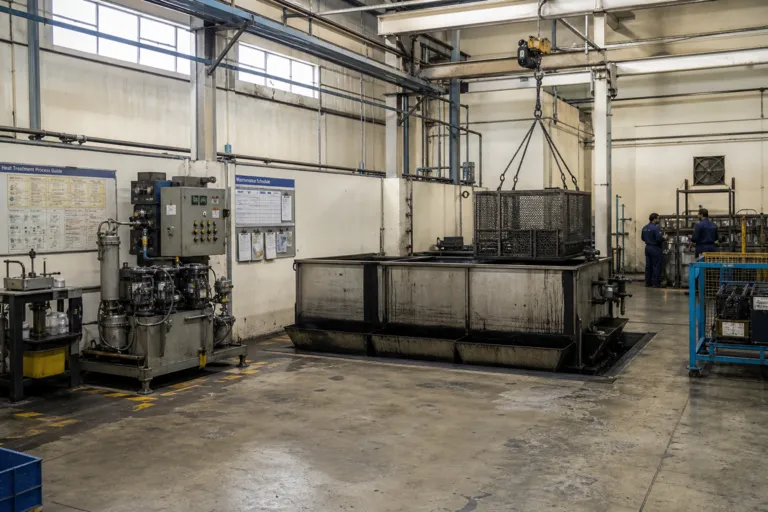
Quenching and heat-treatment oils are a specialized but indispensable part of modern metal processing. IndexBox describes quenching oils as the critical medium for controlled cooling in metallurgical heat treatment processes, where they determine final mechanical properties such as hardness, strength, and dimensional stability. Global demand is described as derived demand, tied to production volumes and technical requirements across heavy manufacturing, automotive production, aerospace manufacturing, and industrial machinery. This framing matters for buyers in the GCC because the oil selection, handling, and maintenance of quench systems must match the exact process window and end-use expectations, especially as heat treatment becomes more process-controlled and certification-driven.
Global market signals show why suppliers keep investing in quenching fluids, formulations, and service capability. GM Insights values the quenching fluids & salts market at USD 2.1 billion in 2025 and expects a CAGR of 5.2% from 2026 to 2035. In the same source, quenching oils held the largest market value at USD 1.2 billion in 2025, reflecting their widespread use across automotive, industrial machinery, and general manufacturing heat treatment processes. IndexBox’s outlook for the world quenching oils market projects a CAGR of approximately 3.2% from 2026 to 2035, with a market index reaching 137 by 2035 (2025=100). These figures are global context, but they underline the broader industrial momentum that also pulls GCC demand.
What’s Changing in GCC Heat Treatment: MRO Growth, Process Control, and Advanced Systems
In the GCC, one of the clearest quantified signals is on the equipment side. Mobility Foresights projects the GCC Industrial Heat Treatment Equipment MRO Services market to grow from USD 0.9 billion in 2025 to USD 1.7 billion by 2032, registering a CAGR of 8.5%. The same source links growth to end-use sectors including automotive component hardening, aerospace parts annealing, tool steel processing, and heavy engineering heat treatment in the GCC, with MRO coverage spanning industrial furnaces, atmosphere generation systems, quenching equipment, combustion systems, and temperature measurement and control infrastructure. It also notes strengthening workplace safety standards and broader adoption of vacuum furnaces and advanced technologies, including vacuum carburizing, gas quenching, and plasma nitriding systems. For quenching heat treatment oil GCC buyers, this points to tighter expectations around system uptime, repeatability, and documented control across the process chain.
Application mix also influences how quenching oils are specified and supported. MRFR states that, within the quenching oil market, heat treating holds the largest market share, while forging is the fastest-growing application as industries adopt advanced forging techniques to meet rising production demands. IndexBox adds that automotive is the single largest consumer, using quenching oils for components such as gears, shafts, springs, and engine parts, while also describing a broad end-use list that includes forging operations, gear manufacturing, bearing production, and tool and die manufacturing. In parallel, Data Insights Market notes that in metal heat treating services, Quenching/Tempering is projected to remain a dominant type. Together, these points reinforce why buyers often evaluate not only oil performance but also technical service and the ability to support changing application profiles.
Supplier landscape and technology direction provide another practical lens for procurement teams in the region. IndexBox describes a fragmented competitive landscape with large integrated players and specialized regional manufacturers, and names Idemitsu Kosan Co., Ltd. among major producers of heat treatment oils. GM Insights describes Chevron Corporation as a multinational American energy company based in the U.S.A. offering petroleum products and ingredients such as quenching oils and special fluids for industrial applications. On process routes, GM Insights highlights growing acceptance of molten salt quenching in precision heat treatment, describing salt baths as providing uniform, distortion-proof heat distribution and better cooling for extremely high-quality components. That shift does not replace oil quenching everywhere, but it raises the bar for consistency, reliability, and process fit when oil remains the preferred quenchant.
Why are quenching and heat-treatment oils so important in metal processing?
What is the projected growth of GCC industrial heat-treatment equipment MRO services?
What do global figures say about demand for quenching oils and related fluids?
How does forging affect demand for quenching oils?
What should buyers consider when selecting quenching heat treatment oil in the GCC?