
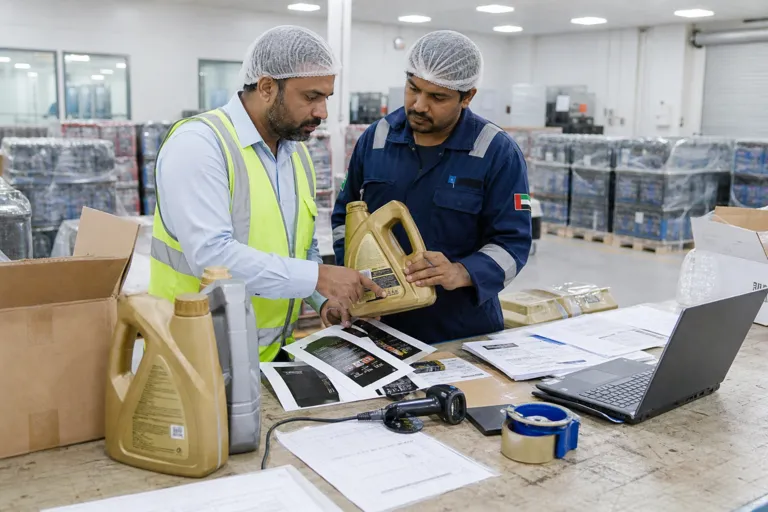
For companies selling lubricants across the Gulf, compliance is not only about product performance. It is also about labeling, language, and the right conformity pathway at the border. Most GCC countries require product labels in Arabic, including ingredients, origin country, expiration dates, and usage instructions. Saudi Arabia and the UAE enforce specific standards through SASO and ESMA respectively. This is the practical backdrop for GCC lubricant labeling standards, especially when a product moves across multiple GCC markets.
In Saudi Arabia, marking expectations depend on which standard applies. If a product must adhere to a standard prescribed by the Saudi Standards, Metrology and Quality Organization (SASO), the marking requirements should follow SASO labeling and marking requirements. If there is no applicable SASO standard but there is an applicable regional or international standard (for example, IEC, ISO, GSO, EN, ASTM), the marking requirements should adhere to the labeling and marking requirements of that applicable standard. When no applicable specific standard exists, or when the marking language is not specified, the marking language can be either Arabic or English. However, all markings pertaining to warnings and safety instructions must be in Arabic or in Arabic and English, and instruction manuals or pamphlets must be in Arabic or in both Arabic and English.
Saudi shipment markings also include logistics and origin details that often affect packaging artwork and outer cases. All containers should be marked with the gross weight and with either the initials or the name of the consignee. If a consignment includes two or more containers, they should be numbered consecutively. Containers reportedly should be marked showing the country of manufacture (for example, “Made in USA”). These are not lubricant-specific points, but they influence how a lubricant shipment is presented and checked on arrival.
How GSO Standards and the G-Mark Affect Cross-GCC Readiness
When a product falls under regulated categories, the GCC framework can shift from “label content” to “proof of conformity.” The Gulf Standardization Organization (GSO) is the regional body responsible for developing and maintaining the technical framework that governs product safety in GCC member states. A central pillar of this framework is the GSO certification process, which culminates in the issuance of the G mark, described as a mandatory conformity symbol that must be prominently displayed on regulated products. The GSO has identified specific categories where a GSO certificate is mandatory for sale, including children’s toys and low-voltage electrical equipment (LVD). While lubricants are not listed in these sources as a mandatory G-Mark category, the rule logic matters: if a lubricant product is tied to an applicable GSO standard, Saudi marking rules point you back to the applicable standard’s labeling and marking requirements.
GSO also operates process infrastructure that matters for documentation teams. GSO has established the Electronic Conformity Certification Scheme (ECCS) to facilitate certification procedures, enhance the quality of services, shorten review time, and create detailed data for stakeholders. GSO decisions referenced in the sources include adopting a common GCC Conformity Certificate based on relevant Gulf Standards for new motor vehicles and tyres on October 12th, 2004, with the GSO Certification Scheme verified and approved since January 1st, 2005. These examples show how GCC-wide conformity programs get formalized and then operationalized in digital workflows.
Operationally, logistics and distribution plans can amplify labeling risk. The GCC Customs Union allows goods to move between Saudi Arabia, the UAE, Kuwait, Qatar, Bahrain, and Oman with reduced customs friction, though implementation varies in practice. Many teams centralize inventory because a single warehouse in Dubai can serve most GCC markets with 1 to 3 day ground delivery. That model can work well, but it also means labeling and documentation choices made for one entry point can echo across the region. To reduce delays, treat GCC lubricant labeling standards as a coordinated program: align language for warnings and instructions, preserve country-of-origin markings on containers, and map whether SASO, ESMA, or an applicable GSO standard is the controlling reference for your specific product line.
What do GCC lubricant labeling standards require for language in Saudi Arabia?
When does Saudi Arabia follow SASO labeling versus another standard?
What is the G-Mark in the GCC conformity system?
Which product categories are listed as mandatory for GSO certification in the sources?
What container markings are noted for shipments to Saudi Arabia?