
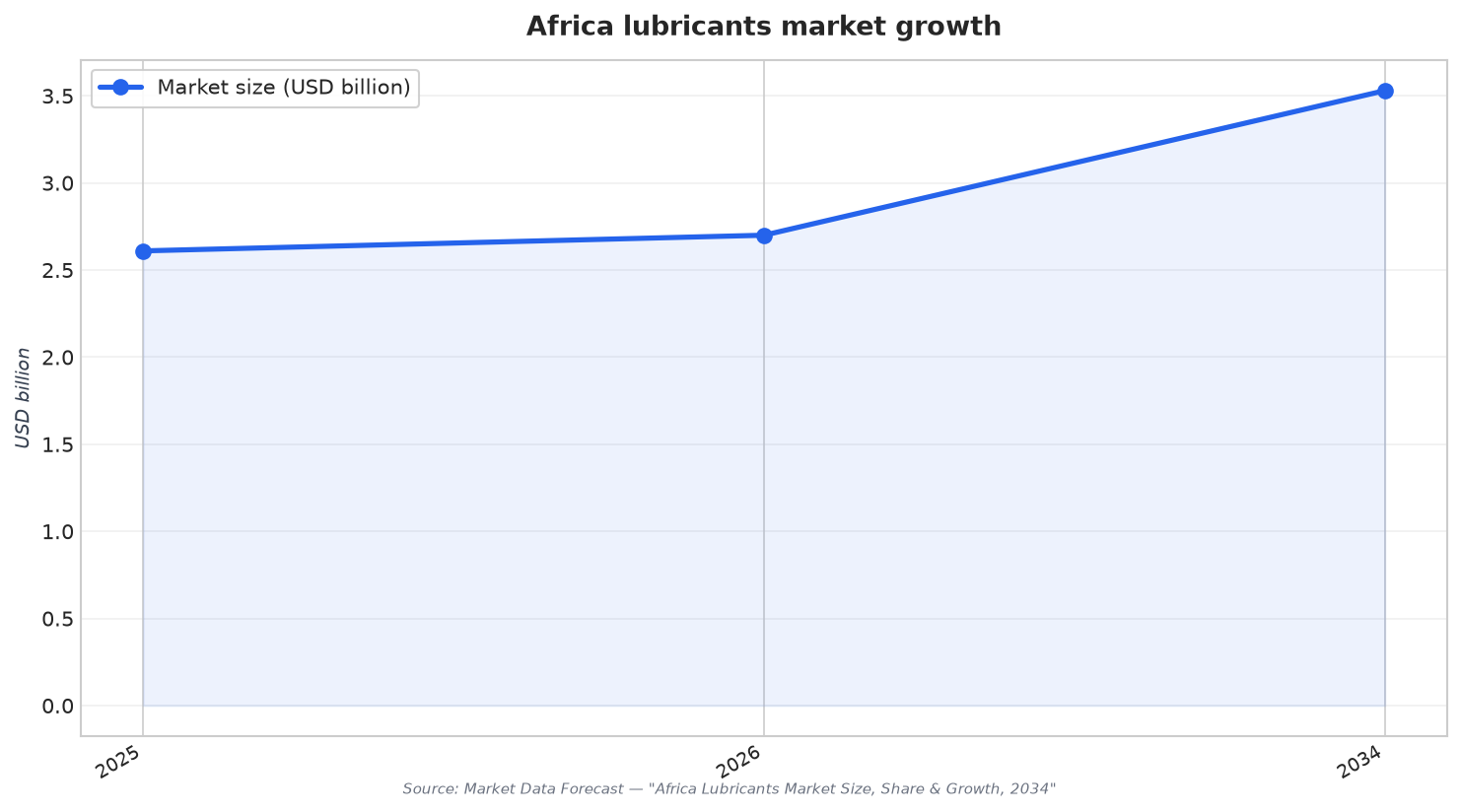
The Tunisia lubricants market sits within a North African ecosystem where automotive maintenance cycles and import flows often shape availability, pricing, and product mix. At the continental level, the African lubricants market was valued at USD 2.61 billion in 2025, was estimated at USD 2.70 billion in 2026, and was projected to reach USD 3.53 billion by 2034, with a 3.43% CAGR from 2026 to 2034. This wider baseline matters because North Africa is explicitly cited as a key regional growth area in Africa-wide analysis, and because Tunisia’s supply and demand conditions can be influenced by shared channels, regional blending, and cross-border sourcing.
For the automotive channel that typically anchors lubricant turnover, Africa-focused data indicates a steady expansion trajectory. The Africa automotive lubricants market was estimated at 1.58 billion liters in 2026, up from 1.54 billion liters in 2025, and projected at 1.81 billion liters by 2031, implying a 2.74% CAGR over 2026–2031. Passenger vehicles accounted for 51.88% of total lubricants in 2025 across Africa, while commercial engines represented 24.92% in 2025 and were expected to reach 27.15% by 2031. These shares provide practical context for Tunisia’s aftermarket priorities, because rising freight and work-vehicle utilization tends to concentrate demand in heavy-duty engine oils and related drivetrain fluids.
Aftermarket Growth Signals: What Regional and Global Mix Data Suggest
Across global lubricants, automotive end use was the largest single category in 2025, capturing a 55.95% share, and engine oils led product demand with 51.10% revenue share in the same year. In the separate global automotive lubricants dataset, engine oil held 58.24% revenue share in 2025, and greases were forecast to grow fastest at a 4.12% CAGR through 2031. While these are global figures, they help interpret why workshop-led aftermarket activity often remains resilient: engine oil dominates spend, and secondary categories such as greases can outgrow as fleets age and operating conditions intensify.
Product quality migration is another theme that can shape buying patterns in Tunisia through imported specifications and OEM-linked service practices. Globally, mineral-oil products accounted for 65.85% of lubricant market size in 2025, while bio-based grades were projected to expand at a 3.21% CAGR to 2031. By group, Group I held 42.15% share globally in 2025, but Group III synthetics were expected to be the fastest-growing at a 2.98% CAGR through 2031. In Africa, Group I oils were even more dominant, with 84.12% share in 2024, while Group II products were projected to grow at a 2.21% CAGR through 2030. For import-reliant North African markets, this split highlights the ongoing role of cost-driven Group I alongside incremental movement toward higher-performance base oils.
Import dynamics also intersect with competitive structure and supply risk. Africa-wide analysis describes a highly fragmented landscape, with global majors and regional blenders competing through localized production facilities, OEM partnerships, and eco-friendly innovation; cited companies include Royal Dutch Shell Plc, TotalEnergies SE, BP Plc (Castrol), Engen Petroleum Ltd., and others. Separately, the global lubricants outlook flags supply-chain risk for high-viscosity synthetic esters and highlights tightening environmental regulations and OEM viscosity downgrades. For Tunisia, the practical takeaway is that availability of premium synthetics can hinge on cross-border sourcing decisions, while aftermarket demand is still largely sustained by routine service needs where engine oils remain central.
What regional benchmarks help frame Tunisia’s lubricants outlook?
How fast is the Africa automotive lubricants market expected to grow to 2031?
Which lubricant category leads demand in global automotive lubricants data?
What does base-oil grouping imply for North African import dynamics?
What is the main way to describe Tunisia’s lubricants market position using the sources?