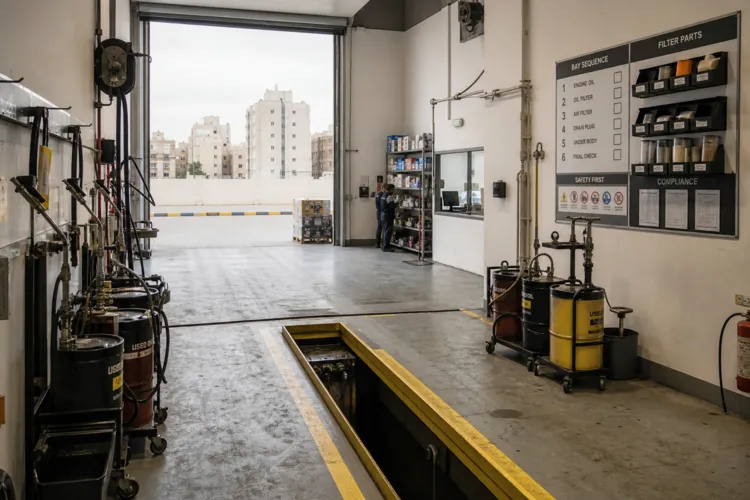


The UAE Net Zero 2050 direction is not only an environmental message. It is increasingly tied to industrial strategy and investment policy. One UAE-focused analysis notes that Net Zero 2050 and Operation 300bn now anchor most new investment policy. It frames the goal as cleaner factories and logistics networks that waste less. For the UAE Net Zero 2050 lubricants industry conversation, this context matters. Lubricants blenders sit between refineries, chemical inputs, packaging suppliers, and industrial end users. That position makes reporting and decarbonization a supply-chain issue as much as a site-efficiency issue.
Scope 3 reporting becomes a practical requirement when customers and regulators expect value-chain accountability. A manufacturing ESG case shows how one large buyer set a clear Scope 3 target: cut Scope 3 GHG emissions from Purchased Goods and Services by 42% against 2020 levels by 2030. It also targets net zero carbon emissions across its entire value chain by 2040, excluding optional Scope 3 categories under the Science Based Targets initiative Net Zero Standard. For lubricants blenders, this pattern translates into customer questionnaires, supplier scorecards, and the need to quantify emissions tied to base oils, additives, packaging, and third-party logistics. Even without a lubricants-specific mandate in the sources, buyer-led expectations are already explicit.
Blender Targets: Start with Site Efficiency and Industrial-Zone Programs
Blender targets often begin with what can be controlled inside the fence line. Industrial zones in the UAE are already highlighting incremental, measurable savings. RAKEZ reports it has reduced electricity use by nearly 1%, lowered water consumption by close to 2%, and cut streetlighting energy consumption by more than 60%. The same source points to water reuse and automated utility systems that limit waste and help firms maintain output during maintenance cycles or peak summer demand. For lubricants plants, this supports a near-term focus on energy efficiency, utilities optimization, and waste reduction, while broader value-chain work on Scope 3 matures.
Customer-driven decarbonization also shows up in the UAE’s wider policy direction and corporate responses. A UAE manufacturing story links national policies to shifting consumer behaviour, manufacturing standards, and corporate responsibility, including national single-use plastics regulations and Dubai’s Executive Council Resolution 124 of 2023. In parallel, Ras Al Khaimah aligned its Sustainability Strategy 2050 with the UAE Net Zero 2050 initiative. The same RAK strategy references that manufacturing accounts for roughly one-third of GDP, and that heavy industry is among the most emissions-intensive sectors. This reinforces why industrial customers may demand clearer emissions reporting from lubricant suppliers that support heavy equipment and manufacturing uptime.
Decarbonization in customer supply chains can also come from adjacent infrastructure investments. One report describes a collaboration between ADNOC L&S and ABB to deploy solar energy at ABB’s facilities, projected to generate 700,000 kWh of renewable energy annually and avoid 340 tons of CO₂ emissions. The same item states the UAE seeks to reduce its carbon intensity by 25% by 2030 and increase renewable energy’s share to 30% by 2031. Lubricants blenders can interpret this as a signal: customers may increasingly favor suppliers that can document lower-carbon operations and logistics choices, because their own targets depend on it.
Finally, Scope 3 readiness improves when sectors build shared tools and benchmarks. A commodity-sector example outside the UAE describes an MoU that includes capacity-building in greenhouse gas management, an industry-specific emissions-tracking and calculation tool, and sectoral benchmarking, with more than 50 member companies engaged in early-stage programs. For the UAE Net Zero 2050 lubricants industry, the takeaway is operational. Start by aligning blender KPIs with industrial-zone efficiency programs. Then build supplier data requests that match customer categories like Purchased Goods and Services. Over time, shared calculation approaches and benchmarking can reduce friction and speed up credible reporting.
What does “UAE Net Zero 2050 lubricants industry” mean in practice?
Why is Scope 3 reporting becoming important for lubricants blenders?
What near-term “blender targets” are supported by UAE examples?
How do customer and policy signals reinforce decarbonization expectations?
Which UAE renewable and carbon signals may affect industrial supplier selection?