

The EU’s Carbon Border Adjustment Mechanism (CBAM) shifted into its definitive phase on 1 January 2026. During the transitional phase from 1 October 2023 to 31 December 2025, importers had to report emissions but did not pay charges. From 2026, financial obligations for importers are being rolled out over a nine-year period. CBAM is designed as a mirror of the EU Emissions Trading System (EU ETS), pushing an EU-equivalent carbon price onto imports of certain emissions-intensive goods. Even when base oils and finished lubricants are not explicitly listed in the sources as covered products, this architecture matters for Middle East exporters because it changes how EU buyers evaluate embedded emissions, supply chain risk, and long-term procurement costs.
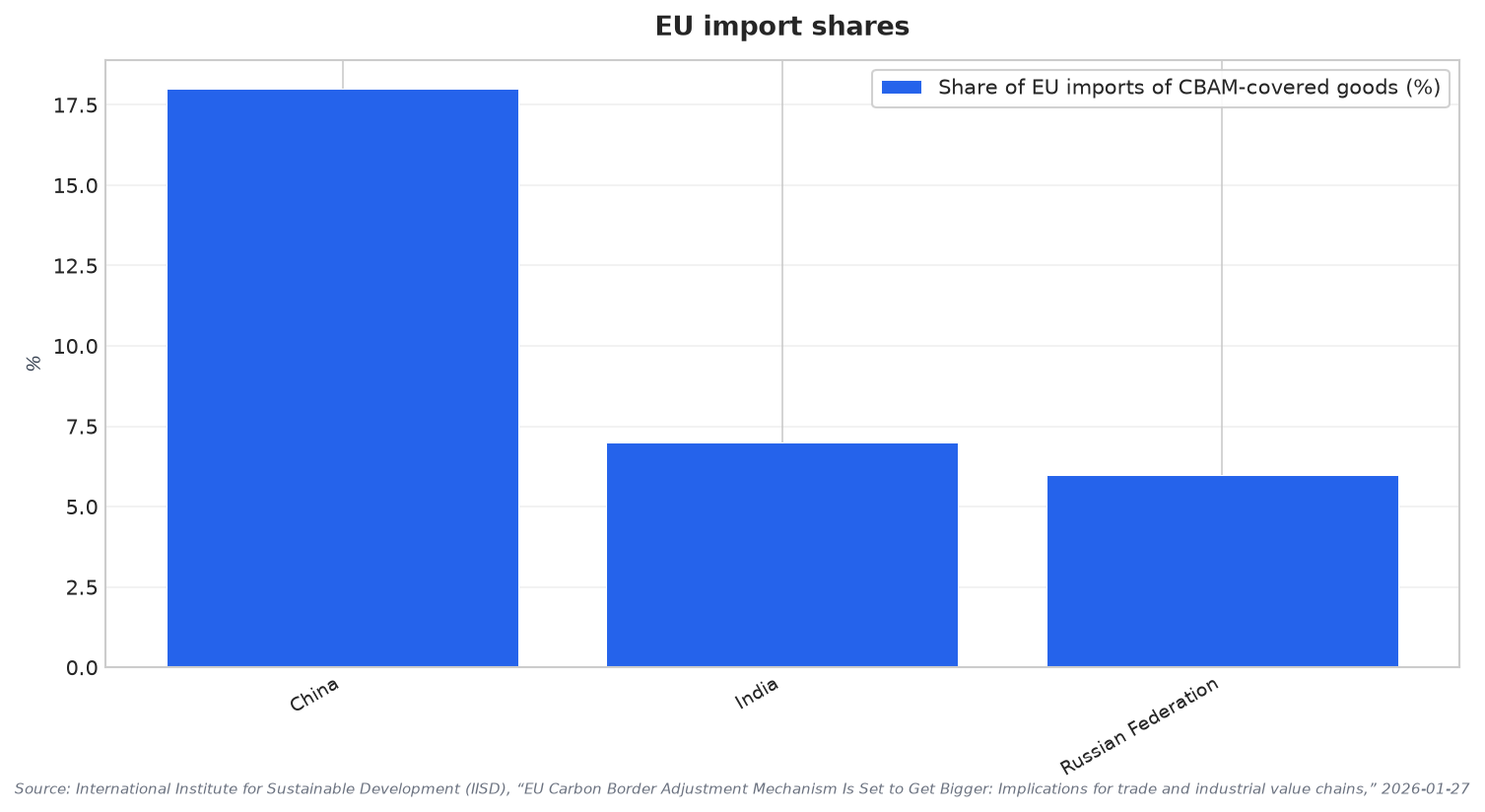
For Gulf Cooperation Council (GCC) economies, early evidence highlights that aluminium is the main impact channel, with exposure varying across Bahrain, Kuwait, Oman, Qatar, Saudi Arabia, and the UAE. Bahrain and the UAE are described as the most affected, both in absolute terms and relative to GDP, while Saudi Arabia and Oman have more limited exposure and Kuwait and Qatar are largely unaffected. Under current CBAM rules that consider only direct emissions for aluminium, the carbon intensities for primary aluminium made by GCC producers are similar to the EU and lower than key competitors China and India. That comparison is important for lubricant-related export economics because it signals a new competitive logic: emissions intensity can become a market-share lever, not only a compliance cost, depending on how rules evolve and how buyers rebalance suppliers.
Why CBAM Economics Can Spill Into Base Oil and Lubricant Export Strategy
CBAM’s design creates a direct cost pass-through at the EU border. One explainer notes that if a company imports specific carbon-intensive goods into the EU (steel, cement, aluminum, fertilizer, electricity, or hydrogen), it must calculate embedded emissions and then buy and surrender CBAM certificates priced equivalently to the EU ETS carbon price. Another source illustrates the variable nature of the cost by using a simple example where EU emissions allowances are assumed at €70 per tonne, while also stressing that allowance prices fluctuate. For Middle East base oil and lubricant exporters, the practical takeaway is commercial rather than legalistic: even if the product itself is outside today’s narrow list in these sources, EU customers may still price in CBAM-linked inputs, demand emissions data, and favor suppliers that can document lower embedded emissions across upstream materials and energy.
CBAM’s potential expansion is also part of the economics. A legally mandated review after the transitional phase is driving proposals to extend the mechanism beyond basic materials, responding to concerns that rising EU carbon prices could intensify downstream carbon leakage and avoidance strategies. An assessment cited by IISD and Frontier Economics simulating inclusion of the entire automotive value chain found the resulting impacts on trade flows and macroeconomic indicators would be very small, with percentage changes in gross national income and production remaining close to zero at the aggregate level. Still, the same IISD explainer notes carbon prices in the EU’s carbon market have increased markedly in recent years and are widely expected to rise further over the next decade. For exporters, this points to a world where compliance, documentation, and procurement decisions tighten even if economy-wide effects appear limited in models.
Trade patterns around energy-linked products offer another clue for Middle East exporters assessing the CBAM impact on Middle East lubricant exports. IISD reports that the United States leads EU imports of refined oil products with 15%, followed by India, Qatar, and Saudi Arabia at around 10% each. Separately, the World Bank’s exposure work finds that while individual high-emissions sectors could lose market share in the EU, overall economic exposure to CBAM charges is small in most cases, and for most middle and low-income countries economic exposure is less than 0.1 percent of GDP (based on embodied carbon payments after CBAM is fully phased in, expected in 2034). For lubricant and base oil businesses, this mix implies two simultaneous realities: country-level exposure can look modest, while specific export niches tied to carbon-priced inputs or customers’ reporting demands can still face meaningful commercial pressure.
When did CBAM move from reporting to financial obligations in the EU?
Which GCC countries are described as most affected by CBAM in early evidence?
How does CBAM set the cost importers pay at the EU border?
What does the sources’ refined oil products data imply for Gulf-linked export exposure?
How could the CBAM impact on Middle East lubricant exports show up even if lubricants are not listed as covered goods in these sources?