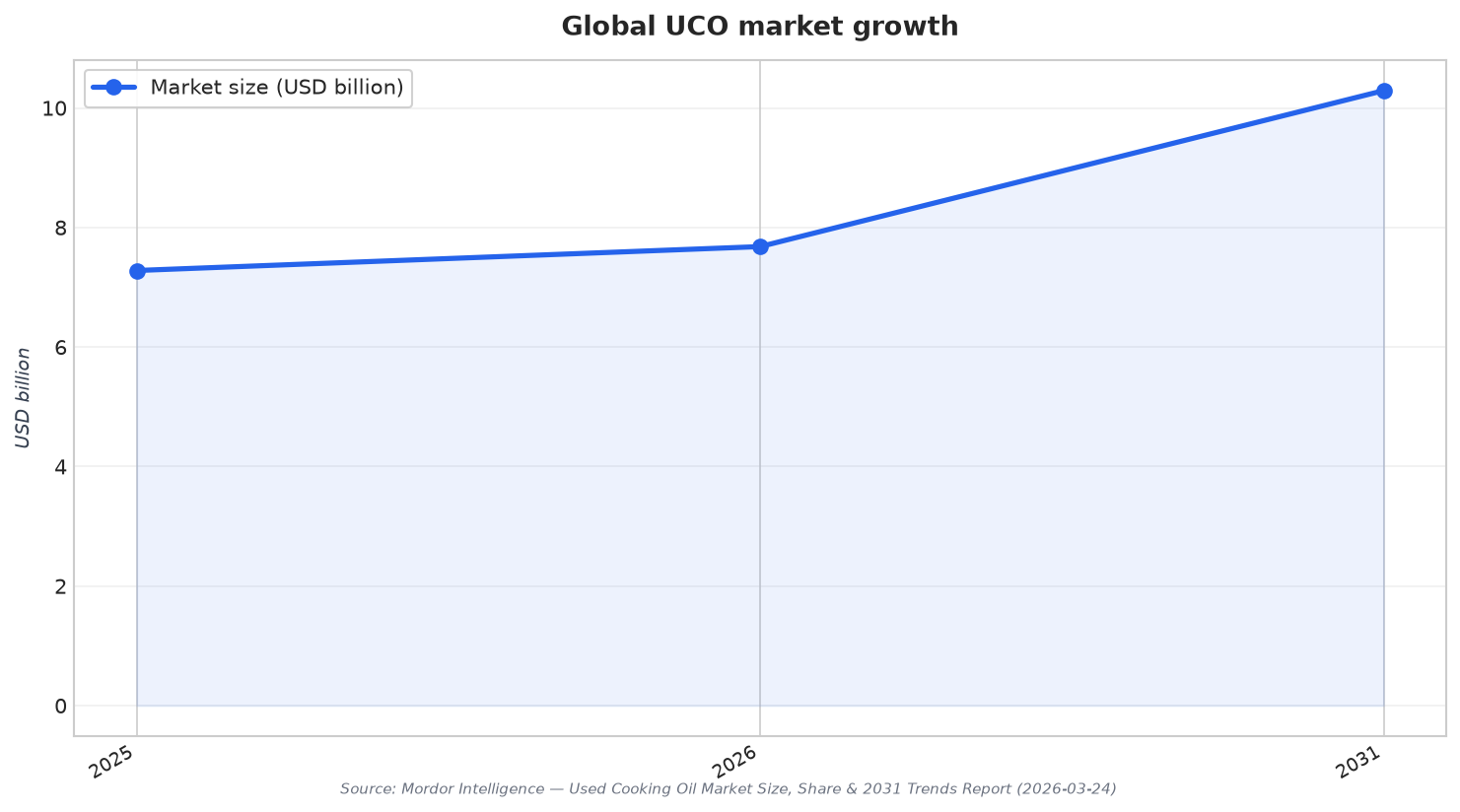
Used cooking oil (UCO) is increasingly treated as a strategic input, not a disposal cost. Mordor Intelligence values the global UCO market at USD 7.28 billion in 2025 and estimates growth from USD 7.68 billion in 2026 to USD 10.29 billion by 2031, at a 6.03% CAGR. This demand pull is linked to mandates and blending timelines that push airlines and refiners into multi-year offtake agreements, which can tighten feedstock availability. For the UAE, the opportunity is not only about fuels. It also sits in higher-value downstream products, including lubricant and chemical inputs that start with better collection, better filtration, and better traceability.
For any “used cooking oil base oil UAE” discussion, the first bottleneck is supply quality and formal recovery. Globally, HoReCa is the dominant source, with Mordor Intelligence placing its 2025 share at 63.92%, while household kitchens are projected to expand at a 6.89% CAGR through 2031. Mordor also flags a 30–40% recovery gap that municipalities try to address via curbside household collection. These collection realities matter because UCO is not a uniform commodity. Stellar Market Research notes impurities must be removed before transesterification because high impurity levels reduce biodiesel quality and can block certain uses, such as animal feed, due to safety risks. The same logic applies to premium industrial pathways that demand consistent specifications and documented custody.
Why Base-Stock Ambitions Compete With Fuel Pull
Today’s largest UCO demand center is still fuels. Mordor Intelligence reports biodiesel and HVO accounted for 78.65% of the UCO market size in 2025. That concentration can crowd out alternative uses unless local systems reward upgrading and segregation. Market Research Future adds that surfactant and lubricant formulators facing bio-content disclosure requirements are qualifying waste-derived fatty acids for personal-care and industrial applications, where realised values exceed fuel-grade netbacks by USD 140–260 per tonne. That spread is the economic argument for processing steps that create “fit-for-purpose” streams for industrial base stocks and lubricant precursors, rather than sending all volumes into fuel pools.
In the UAE, near-term signals point to accelerating demand for traceable, certifiable waste oils. GM Insights projects the UAE used cooking oil market will reach USD 180 million by 2035 and grow at a 9.7% CAGR from 2026–2035, while stressing that development depends on scalable, structured recovery programs. Market Research Future also states UAE authorities set a 1% SAF requirement for departing flights from 2031, and that Emirates has run demonstration flights on fully blended fuel. Even though this aviation requirement targets fuel, it can indirectly raise the value of audited supply chains. Those same chains are a prerequisite for any regional, bio-based base-oil pathway that needs reliable feedstock documentation and consistent quality.
Turning fryer waste into industrial base-stock feed is, therefore, less about a single “breakthrough” and more about building auditable infrastructure. Market Research Future describes sensor-equipped containers that generate fill-rate, temperature, and quality telemetry, and notes that subscription analytics layered onto collection contracts can carry 55–70% gross margins. Mordor Intelligence also points to collectors using IoT sensors and blockchain for custody to improve yields and audit readiness. For the UAE, those models can make the collection layer investable and verifiable, enabling processors to reserve higher-spec fractions for chemical and lubricant value chains while still serving biodiesel, HVO, and SAF demand. The prize is a regional positioning built on certification-ready feedstock, not just raw volume.
How big is the UAE used cooking oil market expected to become by 2035?
What share of used cooking oil demand is currently tied to biodiesel and HVO?
Why does traceability matter for a used cooking oil base-oil pathway in the UAE?
What policy signal could tighten demand for certified waste oils linked to aviation?
Where does most used cooking oil come from today?