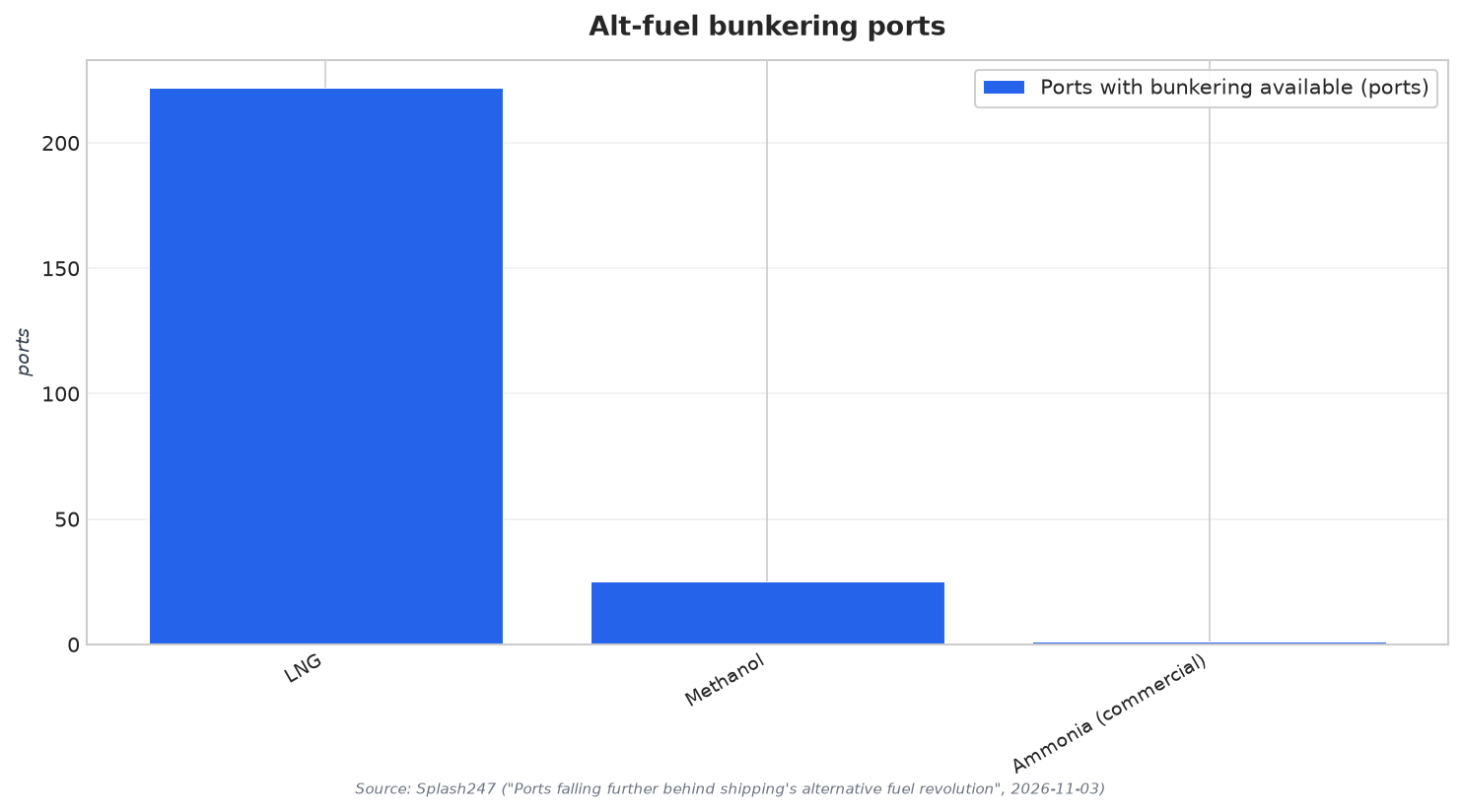
Orders for alternative-fuel-capable ships are rising, but ports are not keeping pace. Lloyd’s Register counted 1,942 alternative-fuel-capable ships on order at the start of 2026, representing 47% of global orderbook tonnage. The same reporting noted LNG bunkering availability at 222 ports worldwide, while methanol bunkering was available at 25 ports and commercial ammonia bunkering had been recorded at only one port by the September research cut-off. For Gulf bunkering hubs, that imbalance matters because readiness must be built long before the first ship arrives, and fuel logistics, safety systems, and berthing plans will shape what services ships can reliably buy alongside fuel.
Methanol is often framed as a faster-to-deploy option because it can be bunkered as a liquid and can use adapted petroleum infrastructure, and it is compatible with modified conventional engines. A review of alternative maritime fuels also flags operational constraints that ports and suppliers must absorb, including methanol’s low flash point of 10.8–12.2 °C and its high vapour pressure at ambient temperature, which require enhanced ventilation and fire suppression systems. That same review notes methanol shows no long-term aquatic toxicity and its rapid diffusivity in water prevents bioaccumulation. For Gulf hubs planning services around these fuels, the cylinder oil challenge sits inside this broader operational redesign: ships will arrive expecting stable, repeatable operations, not just availability of fuel.
Why the Fuel Rollout Creates a Lubricants Pressure Point
The adoption curve is not uniform across fuels. Lloyd’s Register counted 385 methanol-capable and 45 ammonia-capable vessels on order, yet the supply network remains thin, especially for ammonia. The report also cited 61.8m tonnes of announced low-carbon methanol production capacity, while only 6m to 12m tonnes of renewable capacity is expected to become operational by the end of 2031, underscoring the gap between announcements and deliverable supply. This “last mile” problem—specialised bunker vessels, licensing, emergency arrangements, and berth availability—forces Gulf hubs to coordinate multiple readiness tracks. In parallel, ships and engine builders are exploring optionality: gCaptain reported that Maersk’s methanol-fuelled Laura Maersk completed a full trial on 100 per cent ethanol and confirmed it could be burned without compromising engine performance.
Regulation adds another layer of urgency and uncertainty that can ripple into engine-operating choices and lubricant planning. DataM Intelligence reports the IMO Net-Zero Framework approved at MEPC 83 in April 2025 introduces a new fuel standard and a global GHG pricing mechanism for large ocean-going ships above 5,000 gross tonnage, which account for around 85% of international shipping CO2 emissions. That push is already steering procurement conversations toward VLSFO, MGO, LNG, biofuel blends, methanol, and future ammonia pathways. For context on today’s LNG maturity, the same source reports bunkering available in 222 ports, with 62 dedicated bunker vessels reported in 2026, and around 800 LNG-capable vessels in service with 600 more on order.
For Gulf-facing trade, economics and supply signals will influence what fuels show up first—and therefore what cylinder oil support becomes most urgent. A gCaptain report describes a WinGD and Envision Energy study on the China-to-Australia route using a real ammonia bunker price of USD 710 per tonne from Envision’s Jinzhou facility; at that price, the companies calculated ammonia-fuelled bulk carriers and container ships could undercut equivalent VLSFO-powered vessels on operating cost over the first compliance period of the IMO framework. On the supply side in the United States, Research and Markets notes methanol and ammonia remain pre-commercial yet have more than USD 3 billion in announced capacity along the Gulf Coast, signaling potential reshuffling after 2028. For Gulf bunkering hubs, aligning methanol ammonia marine engine lubricants support with uneven fuel availability becomes part of staying competitive as ship orders outpace port buildout.
How many ports can bunker methanol and ammonia today?
How big is the alternative-fuel ship order pipeline entering 2026?
What safety-related properties of methanol matter for bunkering operations?
What do announced methanol supply figures say about the near-term market gap?
What is the key planning issue for methanol and ammonia marine engine lubricants in Gulf hubs?