
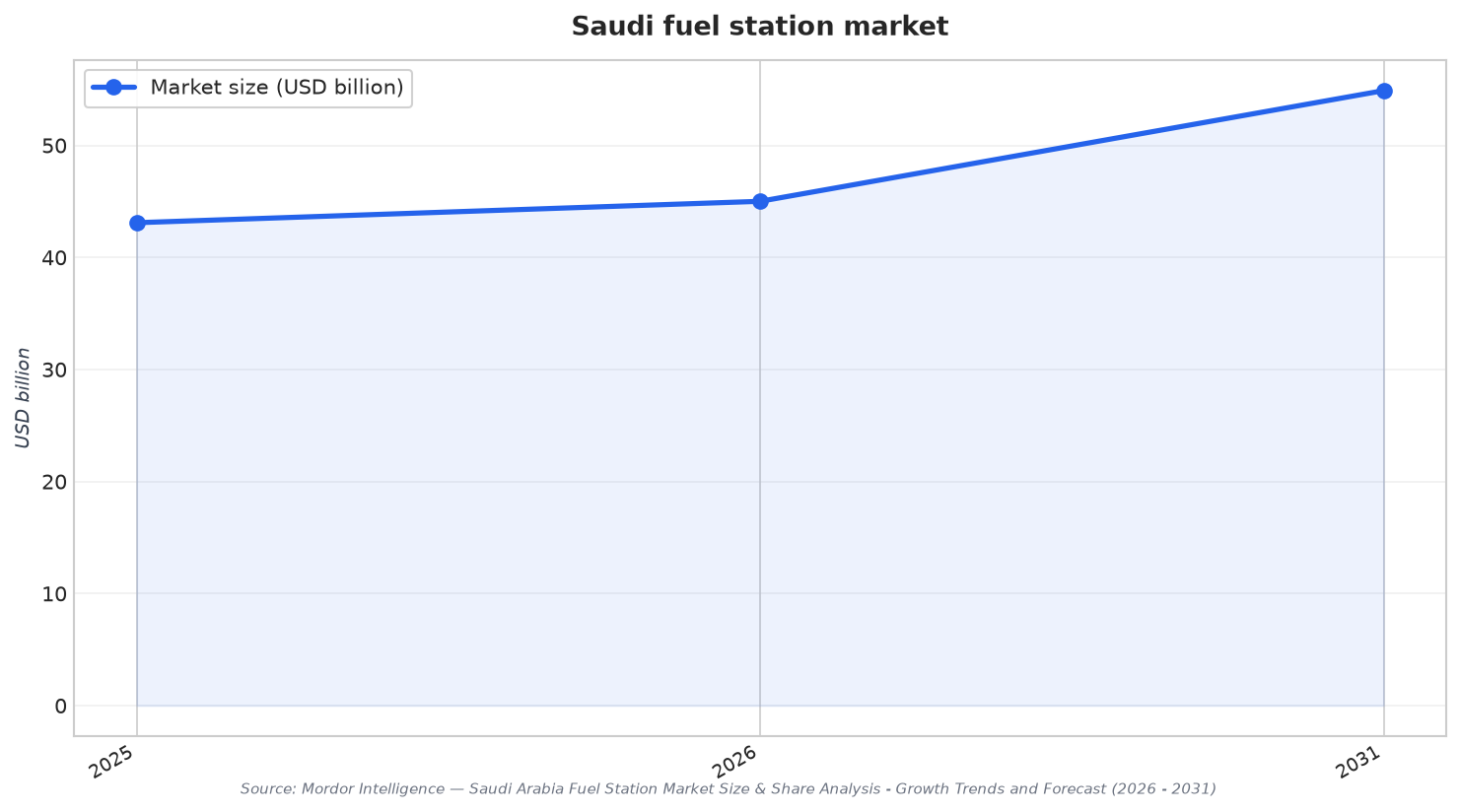
Fuel station operators in Saudi Arabia are under pressure to find profit pools beyond the pump. Mordor Intelligence projects the Saudi Arabia fuel station market at USD 43.10 billion in 2025, USD 45.01 billion in 2026, and USD 54.89 billion by 2031, with a 4.05% CAGR from 2026 to 2031. The same source notes that Aramco’s monthly price caps leave only 5–8 halalas per-liter gross margin, which tilts operator focus toward convenience retail, quick-service restaurants, and loyalty programs. In that context, oil-change bays and related lubricant sales can fit the broader shift toward multi-service mobility sites, especially as the national vehicle parc expands.
Demand fundamentals are also pushing operators to improve service density and throughput. New-vehicle registrations in Saudi Arabia jumped 16.8% in 2024, expanding the national parc to 15.8 million units, according to Mordor Intelligence. Gasoline remains central to traffic capture, leading with a 55.1% share of the Saudi fuel station market in 2025, while fuel-and-convenience-store formats captured 51.5% of revenue in 2025. Traditional full-service sites still held a 49.9% share in 2025, which signals a large installed base that can be retrofitted with additional vehicle services rather than rebuilt from scratch. This is where fuel station lubricant retail in Saudi Arabia becomes a practical adjacency to protect site economics.
Why Oil-Change Bays Fit the Multi-Energy Upgrade Cycle
The service mix is expanding at the same time that forecourts are being redesigned for new mobility needs. Mordor Intelligence reports that multi-energy hubs integrating EV and hydrogen dispensing are forecast to grow at a 20.7% CAGR to 2031, and that alternative fuels are projected to post 25.3% CAGR through 2031. Expert Market Research also describes operators adding convenience stores, quick service food, EV charging, and hydrogen pilots, and cites ENOWA’s first heavy duty hydrogen station in January 2025 and EV charging expansion in July 2025 via a partnership with EVIQ. When capital is already allocated to modernization, adding oil-change bays can be positioned as another “high-frequency” service that benefits from existing traffic and payment infrastructure upgrades.
Competition is also intensifying in ways that favor branded services and differentiated formats. Mordor Intelligence states that SASCO, Aldrees, Petromin, the Aramco–TotalEnergies Sahel venture, and NAFT (now folded into SASCO) collectively controlled roughly 25–30% of the Saudi market in 2025, indicating a moderately fragmented field. Expert Market Research similarly notes that Aldrees, SASCO, Petromin, Wafi Energy (Shell brand), TotalEnergies, and the Aramco TotalEnergies Sahel venture together hold around a quarter of total share, with ADNOC Distribution scaling from a UAE base. With fuel price less of a lever, operators can use on-site maintenance and lubricant offers to create repeat visits and strengthen brand preference, especially at high-traffic formats such as highway service plazas, forecast by Mordor Intelligence to expand at a 6.2% CAGR over 2026–2031.
The UAE shows how integrated station networks can formalize lubricants as a forecourt channel rather than a secondary add-on. Mordor Intelligence estimates the UAE lubricants market at 172.54 million liters in 2026, growing at a 3.54% CAGR to 205.18 million liters by 2031, and says ADNOC Distribution, ENOC, and Emarat collectively control about 63% of retail and commercial outlets through integrated fuel stations and blending plants. The same source reports that ADNOC Distribution expanded its oil-change network to 230 service points by mid-2025. MarkWide Research adds that ENOC’s retail network exceeds 100 stations across Dubai and the northern emirates. For Saudi operators modernizing forecourts, these UAE examples reinforce a clear lesson: expanding oil-change bays can be a concrete, network-driven method to grow lubricant pull-through while broader mobility services scale.
Why are Saudi fuel stations looking beyond fuel sales for growth?
What demand signals support more vehicle services at Saudi stations?
How fast are multi-energy hubs and alternative fuels growing in Saudi Arabia?
What UAE proof points show fuel stations can scale oil-change bays as lubricant channels?
What does the fuel station lubricant retail topic in Saudi Arabia mean in practice?