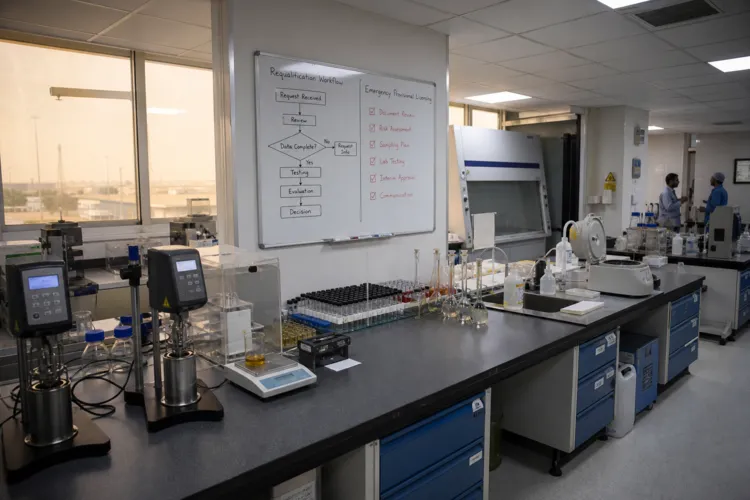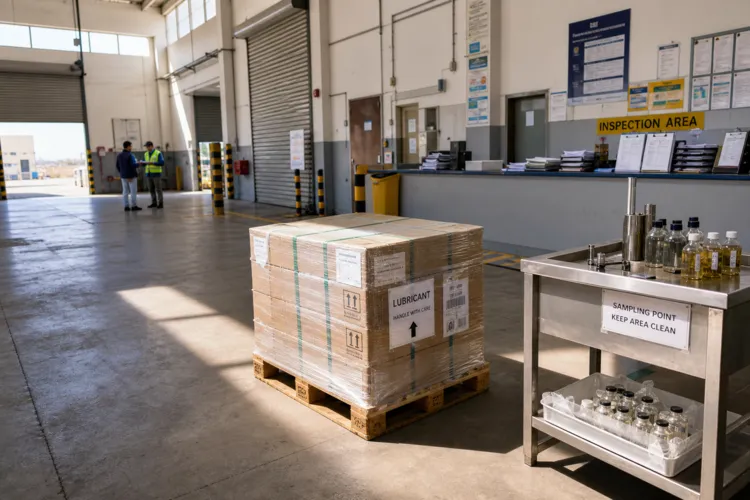

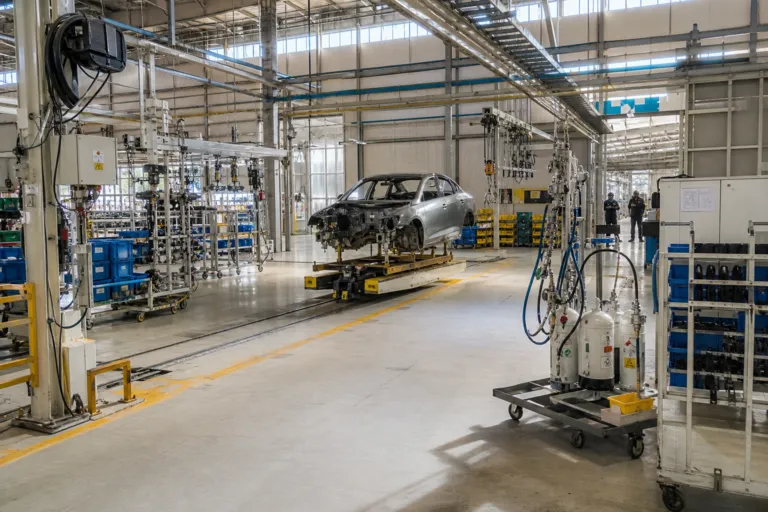
Ceer Motors unveiled its EXOBOT electric sedan and SUV on Sept. 21 in King Abdullah Economic City, positioning the vehicles as the first from Saudi Arabia’s first homegrown car brand. Several sources emphasize that the models were designed and engineered in Saudi Arabia and will be built at Ceer’s plant in King Abdullah Economic City, north of Jeddah. Production timing is also becoming clearer: Ceer has said deliveries are planned for March 2027, and another report cites series production starting in January 2027. For local suppliers tied to EV readiness, including those tracking Ceer EV fluids in Saudi Arabia, the launch is a practical marker: a domestic factory pipeline, a published start window, and a ramp that will need stable inputs, processes, and compliance to meet “Made in Saudi Arabia” expectations.
The broader significance is that Ceer is not framed as a one-off vehicle program. Ceer is a joint venture between PIF and Foxconn, launched in November 2022, and it has communicated a portfolio approach: seven models planned over the next five years, with a planned portfolio of seven models by 2030 according to Ceer’s own statement. The mandate is also described as building an indigenous industrial ecosystem, not simply importing finished goods. This matters for adjacent categories that scale with production and ownership, because localized manufacturing tends to pull local procurement closer to the line. One report adds that Ceer is building a dedicated production complex at King Abdullah Economic City and plans to locate component suppliers nearby, reinforcing the idea that vendor proximity and readiness could be a competitive advantage as the program moves from unveiling to volume output.
What EXOBOT’s Timelines and Scale Mean for Local Suppliers
Suppliers calibrate to throughput, and Ceer’s published targets provide concrete planning anchors. Ceer’s manufacturing complex is being developed for annual production of up to 170,000 vehicles, and one projection says the project is expected to create about 30,000 direct and indirect jobs, while another report cites 35,000 direct and indirect jobs by 2034 if targets are met. Ceer is also projected to add US$8 billion to Saudi GDP by 2034, according to one source. For local EV support categories, this type of scale and job creation is a signal that procurement is likely to professionalize quickly, with tighter vendor qualification and more structured demand forecasts. It also elevates the importance of local service ecosystems as deliveries begin in March 2027 and the lineup expands beyond the initial premium halo models.
Product positioning shapes how the supply base prepares. EXOBOT is presented as high-powered and premium: top trims are cited at 1,111 horsepower, with a stated 670-km range and 0–100 km/h in 2.1 seconds in one report, while another report describes an SUV spec set including an 800-volt architecture and charging from 10% to 80% in 30 minutes. These performance claims matter because premium vehicles can intensify expectations for consistency, traceability, and aftersales reliability. At the same time, Saudi Arabia’s EV market context is dynamic. One report notes Lucid’s sales in Saudi Arabia fell 57% in the first seven months of 2026 while BYD’s rose 369%, and it also notes PIF holds about 58% of Lucid. For local suppliers, Ceer’s positioning as a domestic OEM alongside a competitive market backdrop underscores the need to be agile on quality systems and responsive on lead times as consumer trust and adoption are still described as early-stage and dependent on charging, price, and trust.
Finally, localization targets indicate a long runway for supplier participation. Ceer has said it aims to make almost half the components of its cars locally by 2034, and it is building at King Abdullah Economic City with explicit mention of component suppliers being located nearby. That combination suggests a strategic pull toward localized inputs and localized know-how, rather than relying solely on imports. For businesses supporting Ceer’s EV rollout—whether tied to manufacturing operations, fleet readiness, or aftersales—this is the moment to align internal capabilities with a Saudi-based production cadence that starts in early 2027 and expands through a seven-model plan. Ceer’s debut is not just a model reveal; it is a procurement and ecosystem signal to anyone planning to supply the vehicles as they move from prototypes and unveiling events to customer deliveries.
When will Ceer start production and deliveries for EXOBOT?
How large is Ceer’s planned manufacturing scale in King Abdullah Economic City?
What localization goal has Ceer set for components?
What does Ceer’s launch imply for Ceer EV fluids and other local EV support suppliers in Saudi Arabia?
How is the Saudi EV market shifting around Ceer’s debut?