
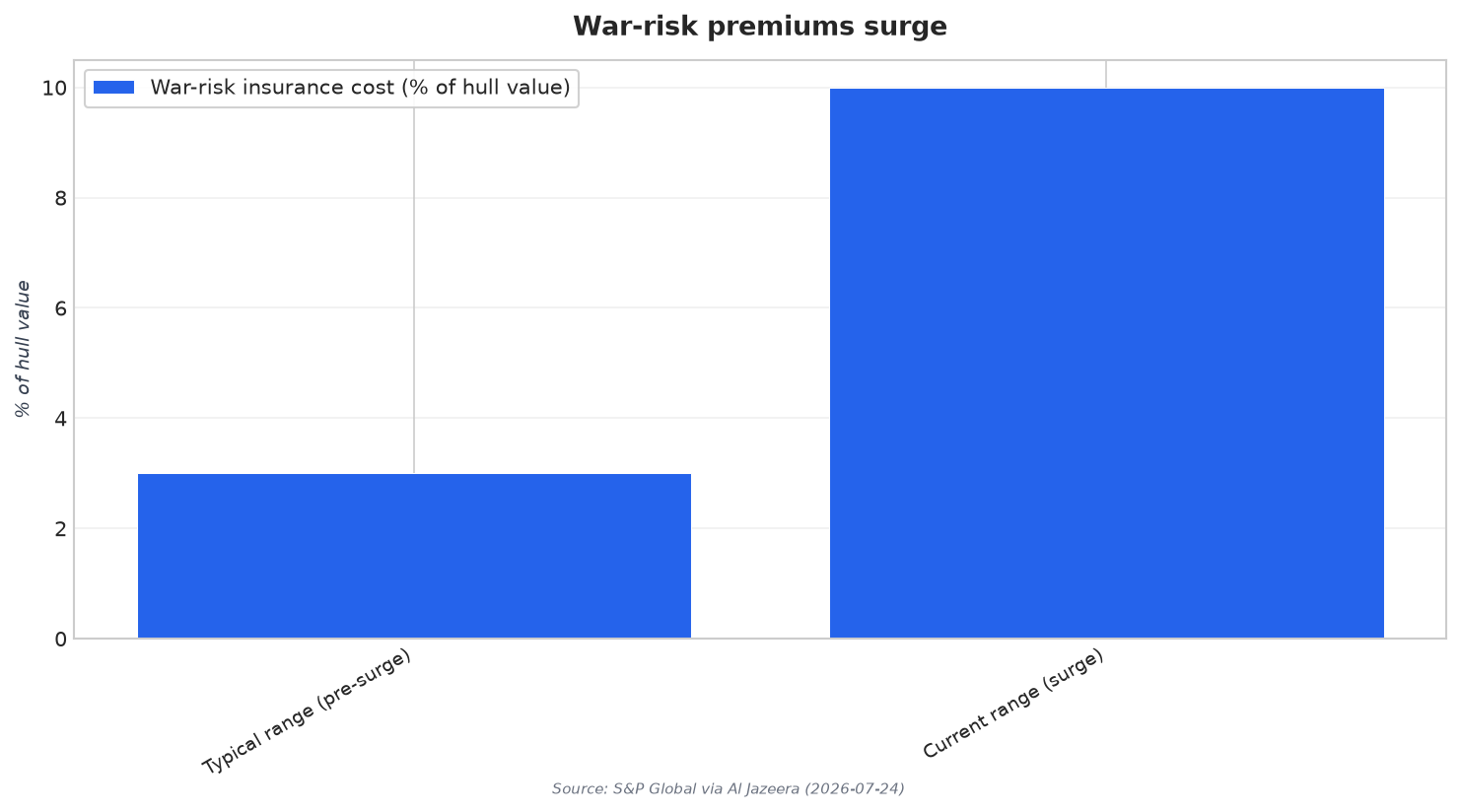
For Gulf importers and exporters shipping lubricant cargo, the jump in marine cover is no longer an abstract risk discussion. It is showing up in quotes, sailing decisions, and delivery promises. Reporting cited by S&P Global via Al Jazeera said marine insurance premiums for ships traversing the Strait of Hormuz surged as insurers grew reluctant to cover voyages that became more prone to attack. In that same reporting, war-risk insurance costs in Hormuz that used to be between 1% and 3% of a ship’s hull value rose to between 7.5% and 10% of hull value. Al Jazeera also noted insurance rates through Hormuz were four times the five-year average, and traffic fell sharply during the conflict, reaching as few as two tankers a day at the height of the war on Iran.
The underwriting pressure is not limited to pricing. The Guardian reported that several leading mutual marine insurers said they were cancelling war risk cover for ships operating in Iranian waters, as well as the Gulf and adjacent waters, with effect from 5 March, even as mutual P&I cover offered by the clubs was described as unaffected. Marsh’s marine leadership in the same report said insurance rates could go up by 50% to 100%, or even more, moving from 0.25% to 0.5% or 1% of the value of the insured asset, and compared this with a rating of 5% after Russia’s invasion of Ukraine in 2022 for ships going into Odesa. When cover is cancelled or re-priced at short notice, lubricant shippers can be forced into last-minute rerouting, delayed loadings, or accepting higher surcharges embedded in freight invoices.
Where the Real Cost Hides: Hull, Cargo, and Exclusions
A practical way to manage soaring costs is to separate what is happening to the ship from what is happening to the goods. GCC Freight explains that marine insurance is a stack of covers, and that a ship can be fully insured while your cargo remains uninsured because hull cover protects the owner, not the cargo interest. It also notes that a standard marine cargo policy under Institute Cargo Clauses (A) explicitly excludes war, capture, mines, and strikes under Clause 6, which is why peace-time cargo insurance can look cheap until a corridor is listed as high risk. To close the gap, the cargo-side extension is commonly written under the Institute War Clauses (Cargo) 1/1/82, covering loss or damage from war, civil war, hostile acts, capture or seizure, and derelict mines or torpedoes.
Cost transmission matters as much as coverage form. GCC Freight highlights that war-risk pricing often references hull value, not cargo value, and gives a simple illustration: a 0.5% hull rate on a vessel worth 100 million USD equals 500,000 USD per transit, which is why owners pass part of the cost to cargo via surcharges. For cargo owners, it says war risk premiums are quoted on cargo value and in the current market commonly land in the range of a few hundredths of one percent up to around 0.1% for listed areas, depending on route, commodity, and insurer appetite; on a shipment insured for 100,000 USD, it suggests roughly 20 to 100 USD. It also warns that quotes can be short-lived, with underwriters limiting quotes to 24 or 48 hours, which can make the war-related additions to your freight quote unstable during fast-moving events.
Finally, lubricant traders should connect route risk maps with how the market designates “listed” waters. GCC Freight says every container that leaves Shenzhen or Ningbo for Saudi Arabia or the UAE passes through at least one listed war risk area, and that the Red Sea, the Gulf of Aden, and the Strait of Hormuz sit on the Lloyd’s Joint War Committee list, which influences underwriter pricing per transit. Mordor Intelligence adds that the Joint War Committee expanded high-risk designations in 2025 to include additional waters around Bahrain, Djibouti, Kuwait, Oman, and Qatar, changing how the market priced Gulf-related voyages. Put together, the best defense for war risk insurance for lubricant cargo in the GCC is documentation discipline and policy clarity: confirm whether war exclusions apply, decide if Institute War Clauses are needed, and treat shipowner surcharges and cargo premium as different levers when budgeting and negotiating.
Why are war-risk premiums rising so fast around the Strait of Hormuz?
Can a vessel be insured while my lubricant cargo is still exposed?
What policy wording is commonly used to add cargo war cover?
How do war-risk costs show up on a GCC importer’s invoice?
What should GCC traders ask when arranging war risk insurance for lubricant cargo?