
The next frontier in e-fluids is not only about EV adoption. It is about operating reality. In the Middle East and Africa, desert duty cycles can expose battery packs to ambient air above 50 °C, and OEM programs in Riyadh and Dubai now require coolants with boiling points exceeding 170 °C and conductivity below 10 µS/cm. Those requirements start with thermal management, but they also set expectations for adjacent fluids that must live beside high-voltage components. That includes e-axles and reduction gears, where lubrication, cooling, and electrical compatibility increasingly intersect inside compact integrated drive units.
This push is arriving as the Middle East and Africa EV fluids market scales. Mordor Intelligence estimates the regional EV fluids market at USD 18.41 million in 2025 and expects it to reach USD 31.19 million by 2030, at a CAGR of 11.12% from 2025 to 2030. In the same dataset, coolants led with 42.17% share in 2024, while transmission fluids are forecast to expand at a 12.18% CAGR through 2030. The takeaway for formulators is clear. Cooling dominates today, but driveline and e-axle-related fluids are a fast-moving growth lane that will be shaped by heat, electrical safety expectations, and OEM co-engineering.
Why Integrated E-Drives Change the E-Axle Fluid Job Description
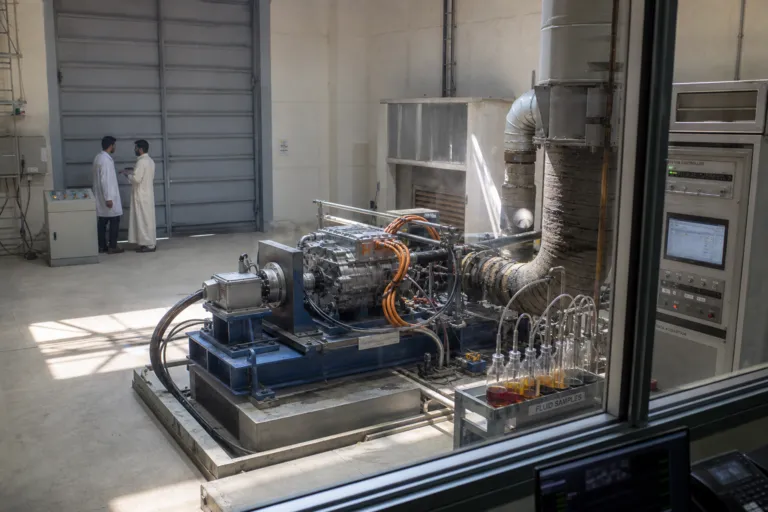
Globally, demand is shifting toward multifunctional fluids as integrated e-drive units combine motors, gearboxes, and power electronics. Fortune Business Insights describes rising adoption of integrated e-drive units as a driver for fluids that provide lubrication, cooling, and electrical compatibility, especially in high-performance and premium EVs. It also projects the e-transmission and e-axle fluids segment, which it calls the second-largest, to grow at a CAGR of 11.5% over its forecast period. For anyone developing an EV reduction-gearbox fluid for the Middle East, this integration matters because the fluid can be asked to serve multiple roles within tighter packaging, while still meeting electrical and thermal expectations that are becoming more explicit in hot-climate programs.
Regional production and platform shifts add more momentum. Mordor Intelligence links growth to rapid electrification mandates, a push for domestic battery production, and innovation in high-temperature thermal-management fluids. It also points to Saudi Arabia’s investment program, Morocco’s 20 GWh gigafactory, and the UAE’s 40 GWh cell plant as developments recasting the regional supply chain toward localization. At the same time, it notes advances in 800-V vehicle platforms, immersion-cooling technologies, and dielectric coolant chemistries that are redefining product specifications beyond conventional glycol blends. Even if these examples highlight coolants, the direction reinforces why e-axle and reduction-gear fluids must be designed for compatibility with evolving architectures and stricter electrical-safety thinking across the full EV fluid suite.
Competition and standard-setting are also tightening. Mordor Intelligence flags opportunities for suppliers that can co-engineer fluids with OEMs, ensure ultra-low conductivity, and navigate fragmented tariff regimes. It also warns that the absence of harmonized service-interval standards, high import duties on specialty base oils, and counterfeit penetration in some African channels can temper market expansion. Meanwhile, Fortune Business Insights notes that Tier-1 players leverage formulation expertise, global distribution, and long-standing OEM relationships, and are building EV-specific portfolios spanning battery thermal-management fluids, dielectric coolants, and e-axle lubricants aligned with changing EV architectures. In practice, success in this space is increasingly about proving performance and compatibility in OEM programs, not simply offering a generic transmission fluid.
What is driving demand for EV reduction gearbox fluid solutions in the Middle East?
How fast is the Middle East and Africa EV fluids market expected to grow?
Which product types lead today, and which are growing fastest in the region?
What does the global outlook say about e-axle and e-transmission fluids?