
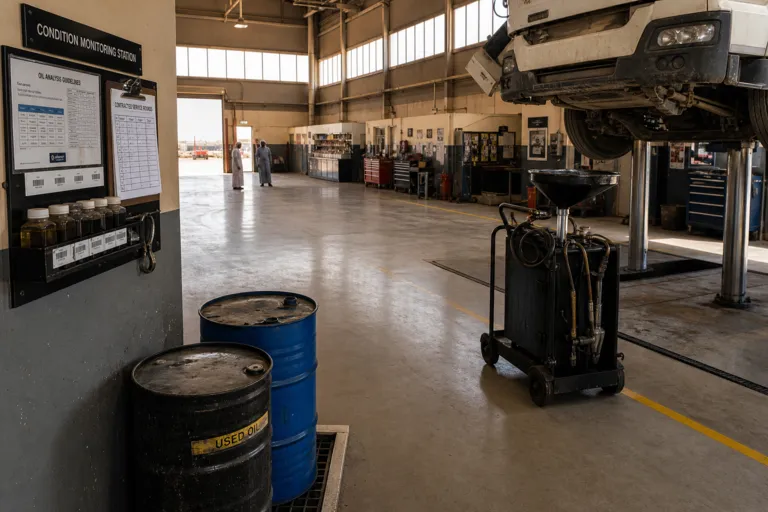
Middle East fleet operators are under pressure to manage lubrication with more discipline than a simple “buy-and-fill” approach. MarkWide Research notes that fleet operators reduce annual lubricant purchases despite higher per-unit prices, which strengthens the case for contracts that stabilize service scope and budgeting. The same source points to preventive maintenance subscriptions as a growing service layer that converts one-time lubricant sales into recurring revenue relationships across fleet operators and industrial plants. In practice, that means moving from irregular bulk orders to agreements that define fill rates, service cadence, and monitoring triggers—especially where uptime and workshop throughput matter.
There are already local signals that subscription and fill-rate contracts can work, at least in pilots. MarkWide Research reports that fleet operators in Jeddah and Abu Dhabi are piloting fixed-fee service contracts that bundle lubricants with condition monitoring. In Qatar, the same report says Doha fleet operators pilot predictive maintenance contracts that also bundle lubricants with condition monitoring, while Qatar Petroleum mandates supplier qualification through technical certification requirements. These details matter for service design: a subscription is easier to enforce when qualification, testing, and reporting are part of the deliverable, not optional add-ons negotiated after a failure.
What Makes the GCC a High-Potential Test Bed for Lubricant Contracts
The GCC automotive lubrication services market context supports a shift toward contracted services. MarkWide Research values the GCC Automotive Lubrication Services Market at $1.82 Billion in 2026, forecasting $2.92 Billion by 2035 at a 5.40% CAGR. The report also says fleet operators across Saudi Arabia and the UAE are expanding preventive maintenance contracts for commercial trucks as sulfur emission caps tighten under Gulf Standardization Organization (GSO) regulations. It adds that regulations mandate specific additive package certifications that legacy dispensing systems cannot verify, forcing capital expenditure on automated fluid management systems. Those compliance requirements naturally favor bundled contracts where the supplier owns process control and audit readiness.
Lubricant-as-a-Service also depends on analysis and monitoring capacity, not just oil supply. Verified Market Reports sizes the global Lubricant Analysis Service Market at USD 10.5 billion in 2025 and projects a 4.5% CAGR from 2026 to 2034. A related Verified Market Reports outlook on lubricating oil analysis says the market is expected to witness a surge in service-based models such as subscription analytics and remote monitoring that provide continuous value rather than one-off testing. It also describes procurement models shifting toward service-based contracts and subscription models. For Middle East fleets, this supports the idea that a fill-rate contract can be paired with recurring diagnostics, turning “oil changes” into a measurable reliability program.
Execution will come down to procurement structure, certification pathways, and supply relationships. MarkWide Research highlights that direct sales still include annual volume contracts negotiated between lubricant manufacturers and fleet operators, industrial plants, or power utilities, so subscriptions may need to coexist with classic volume deals. At the same time, Oman’s Duqm Special Economic Zone and Sohar Port expansion are attracting steel and aluminum smelting investments, and MarkWide Research notes greenfield facilities lack established supplier relationships—creating first-mover positioning potential for service-based lubrication contracts. For fleets evaluating a lubricant subscription model for fleets, the practical question is whether the provider can deliver qualified fluids, automated dispensing compliance, and condition monitoring as one accountable service line.
Are Middle East fleet operators already piloting Lubricant-as-a-Service contracts?
What GCC market signals support subscription and fill-rate lubrication contracts?
Why does condition monitoring matter in a lubricant subscription model for fleets?
What role do certification and dispensing systems play in GCC lubrication services?