
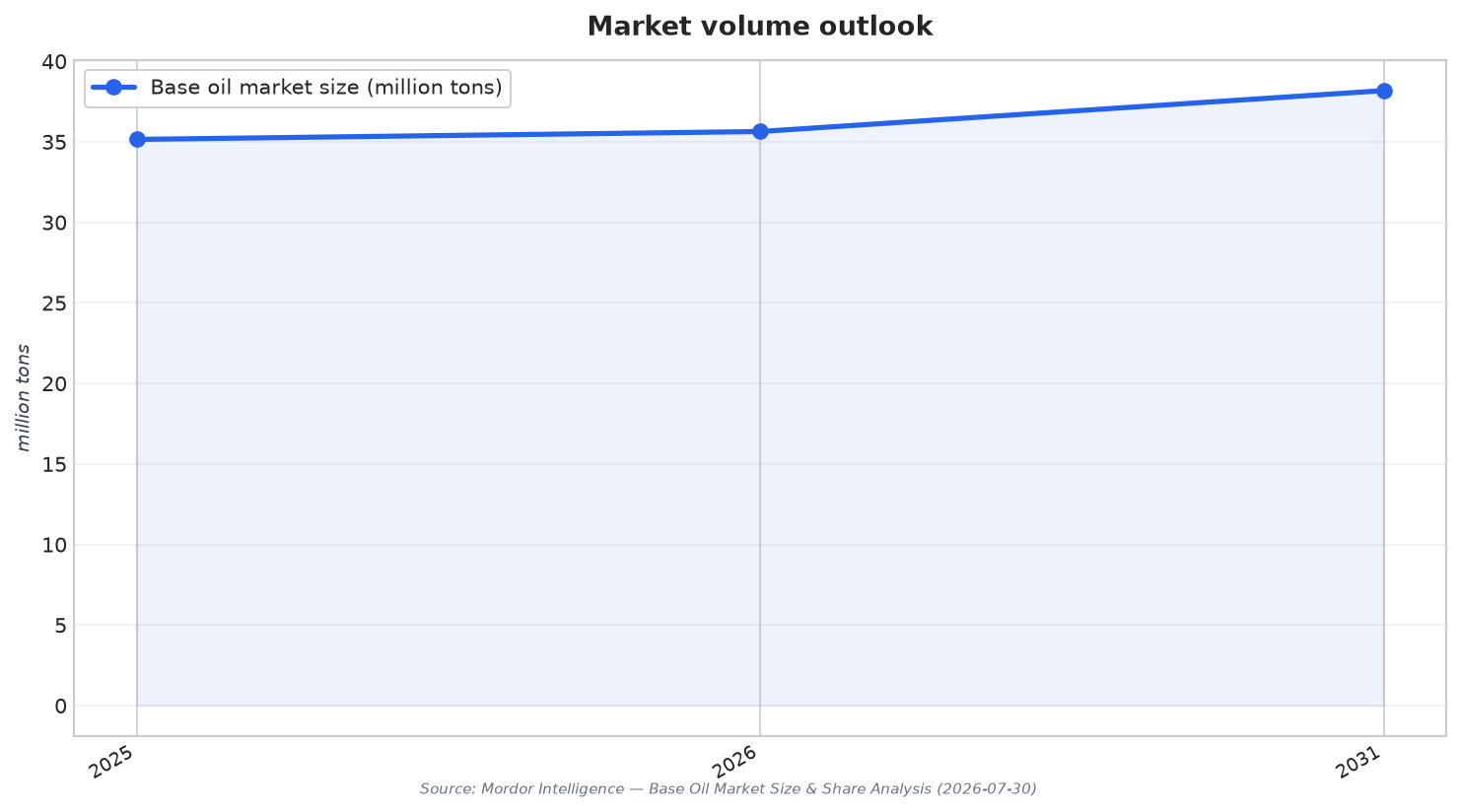
The global base oil market is growing, but the mix is changing. Mordor Intelligence expects total base oil volumes to rise from 35.15 million tons in 2025 to 35.64 million tons in 2026, reaching 38.18 million tons by 2031, with a 1.40% CAGR over 2026–2031. Inside that growth, the report highlights a structural migration from Group I toward higher-performance Group II and Group III. In 2025, Group II held 42.20% of global market share, and Group III is projected to post a 4.05% CAGR through 2031. For Middle East blenders, the message is not that Group I disappears overnight, but that product development and supply strategies are increasingly being designed around Group II/III availability and performance expectations.
Regional growth does not automatically protect Group I. Mordor Intelligence forecasts the Middle East and Africa as the fastest-growing geography, at a 3.33% CAGR between 2026 and 2031, even as the market shifts to more hydroprocessed grades. IndexBox adds that capacity additions have been concentrated in the Middle East and Asia-Pacific and have largely targeted Group II and Group III production, aligning with demand trends but sometimes creating regional oversupply scenarios. A separate market note published on openPR.com (DataHorizzon Research) describes capital reallocation toward Group II and Group III at the expense of legacy Group I production that is steadily being phased out or converted. Taken together, these signals frame the Group I base oil phase-out in the Middle East as a gradual but persistent direction of travel, shaped by investment choices and tightening quality requirements.
What Middle East Blenders Should Do Next
Blenders should treat formulation flexibility as a commercial capability, not a technical nice-to-have. IndexBox notes that within a blender’s formulation there is often flexibility to switch between Group II and Group III, or to use re-refined stocks, depending on price parity and performance requirements. That matters because competitive intensity is rising fastest in Group III, with capacity additions from Asian and Middle Eastern producers beginning to pressure pricing in markets previously dominated by North American and European supply, according to the openPR.com note. For blenders, that combination can create opportunity: qualify multiple base-stock slates, validate additive treat rates across acceptable Group II/III alternatives, and keep procurement options open so you can react when price parity shifts.
Blenders also need to align products with tightening specifications and disclosure expectations in the GCC. MarkWide Research says evolving national petroleum product regulations and carbon intensity disclosures will redefine base oil sourcing strategies and refinery upgrade timelines. It also states that extended drain intervals mandated by OEM specifications are compressing lubricant consumption volumes while elevating per-liter performance requirements across Saudi Arabia and the UAE. That “specification squeeze,” in MarkWide’s words, rewards suppliers with synthetic formulation capabilities and penalizes commodity blenders dependent on Group I base stocks. The practical response is to prioritize higher-performance formulations, increase the share of products designed around Group II/III and synthetic components where required, and build a compliant documentation trail that supports customer audits and disclosure-driven procurement.
Finally, sourcing risk management should be explicit, especially where local hydroprocessing is constrained and import exposure is high. MarkWide Research states that Middle East refiners lack sufficient hydrocracking capacity for synthetic-grade feedstocks and that blenders rely on Asian and European suppliers, exposing margins to freight rate volatility and currency fluctuation. At the same time, regional investments are pointing to more Group III+ supply: Grand View Research reports that in January 2026, Saudi Aramco and Luberef signed a memorandum of understanding to explore a new base oil plant at the Jazan Refinery in Saudi Arabia aimed at expanding Group III+ capacity. Meanwhile, IndexBox’s transformer-oil report reminds blenders that Luberef produces Group I base oils at Yanbu and Jeddah, but transformer-oil-grade specifications require additional hydrotreating and additive formulation. Blenders can respond by qualifying more suppliers, contracting with clearer price and freight terms, and targeting segments where upgraded processing and additives support defensible specifications.
Is the Group I base oil phase-out in the Middle East happening quickly?
Which base oil groups are gaining share globally?
What specific actions can blenders take to reduce formulation risk as Group I tightens?
What is changing in Saudi Arabia and the UAE that affects base oil choices?
What new Middle East investment points to more Group III+ supply?