
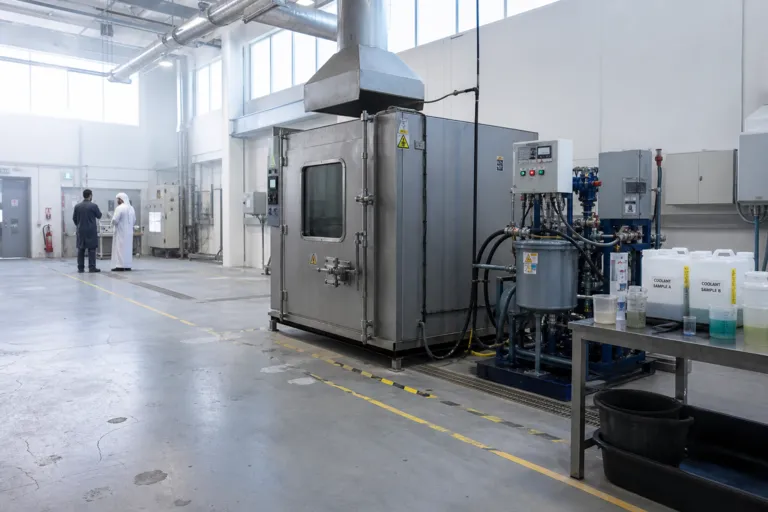
Worldwide, EV battery safety regulation is moving toward tougher proof, more testing, and clearer accountability. IndexBox points to expanding adoption of protocols such as UL 2580, IEC 62660, and GB/T 31485, alongside tightening trends like UN Global Technical Regulation No. 20 on electric vehicle safety, updates to IEC 62619 for industrial batteries, and the European Battery Regulation. This shift is also visible in the testing economy: the global Fire Propagation Test Chamber market was valued at approximately USD 340 million in 2025 and is projected to grow at a CAGR of 8–12% through 2035. In parallel, EV thermal management remains central, because the coolant is meant to keep lithium-ion cells within optimal temperature windows—typically 15–35°C in the IndexBox description of EV battery coolant.
For the GCC, this global tightening intersects with a local reality that temperate-market standards do not fully address. The GCC Edge describes summer temperatures exceeding 45°C, with parked vehicles absorbing direct solar load for hours, turning heat into the primary engineering constraint rather than range or charging speed. In that context, battery exposure is not marginal: the same source links prolonged heat exposure to safety, degradation rates, and system reliability, and notes that high heat accelerates chemical degradation inside lithium-ion cells, increases internal resistance, and raises the risk of thermal instability during charging. A coolant safety standard built for this environment must account for stationary heat soak and continuous thermal stress, not only typical drive-cycle assumptions.
Why Current Rules Are Not Enough for Desert-Use Coolant Safety
The GCC is already resetting the baseline for EV suitability through GSO 2698:2022, titled Technical Requirements for Electric Vehicles. The GCC Edge says it applies to all battery electric vehicles with top speeds exceeding 25 km/h that are manufactured or imported into GCC markets. While it references UNECE R100 and US FMVSS 305, it extends beyond them in critical areas, including a mandatory requirement for active thermal management systems capable of regulating battery temperature even when the vehicle is stationary. That direction supports the argument that coolant safety should be treated as its own compliance layer: the fluid sits inside the thermal management system, and in a 45°C-plus operating environment, the margin for error in electrical behavior, materials compatibility, and failure modes is narrower.
Other jurisdictions are also signaling that coolant properties are becoming a safety topic, not just a maintenance choice. Grand View Research reports that on 24 October 2023, the Chinese National Ministry of Transport indicated an intention to issue a new standard for water glycol-based coolants, requiring the use of a safety coolant in battery cooling loops. Tests conducted by its affiliated Research Institute On Highway (RIOH) pointed to the added value of coolants with much reduced, yet non-zero, electrical conductivity. Separately, Market.us notes that in September 2025, BASF introduced GLYSANTIN® ELECTRIFIED® low electrical conductivity coolants designed to improve safety and performance in EV battery systems. Together, these developments show that coolant specification is moving toward formal safety requirements, not only performance claims.
A GCC-specific coolant safety standard would also align with how safety oversight is being operationalized through testing. IndexBox notes that newer fire propagation chambers can test up to 50 cells simultaneously, and that this configuration shift is associated with average unit values that are 25–35% higher than traditional single-cell units. Even without claiming local market figures, the direction matters: as testing mandates expand globally, GCC regulators and labs can use a tailored coolant standard to define what must be validated under GCC heat realities, and how post-market checks should work for imported and locally prepared vehicles. The outcome is practical: clearer procurement criteria for OEMs and importers, stronger enforcement tools, and a safety framework that matches the region’s thermal constraint while still referencing international structures.
Why does the GCC need a dedicated EV coolant safety standard?
What GCC rule already pushes EVs toward stronger thermal management?
How are global battery-fire rules tightening, and why does it matter for coolant safety?
What evidence suggests coolant electrical properties are becoming a safety requirement?
What do tighter testing mandates imply for EV coolant standards in the GCC?