
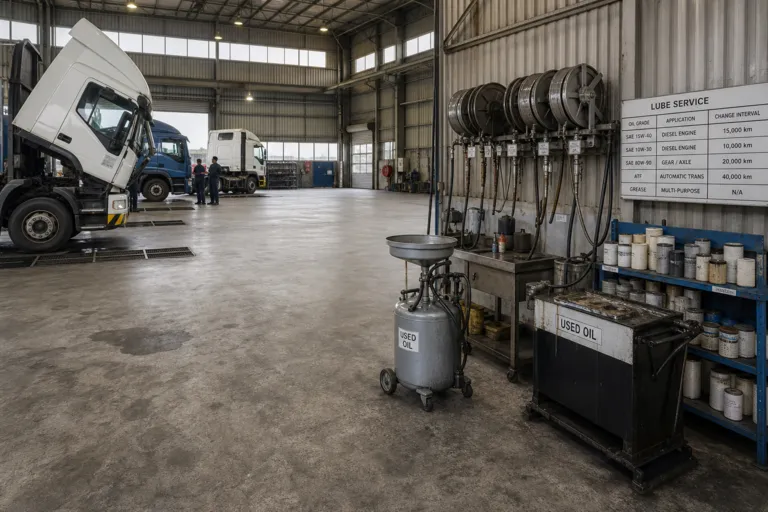
For fleet operators in the GCC, engine oil is no longer a simple maintenance line item. It is tied to how reliably vehicles run in high-heat conditions, how often they must be serviced, and how procurement teams prove compliance. In GCC service bays, synthetic lubricant formulations are consolidating share against mineral-based alternatives, and that shift is reshaping operator economics and contract requirements. Automotive lubrication services revolve around scheduled replacement and replenishment of friction-reducing fluids in powertrains and drivelines, typically aligned to SAE viscosity grades and OEM-specified service intervals measured in kilometers or engine hours. Engine oil changes remain the highest-frequency service touchpoint, which is why fleets and workshops focus heavily on product certification and repeatable process control.
Regulation is one reason the conversation has become more technical. In the GCC, GSO technical regulations and UAE ESMA specifications mandate lubricant performance certifications that filter access for uncertified providers. In Saudi Arabia, SASO enforcement of API SP and ILSAC GF-6 standards is accelerating equipment upgrades at independent workshops, pushing the market toward certified, high-performance oils. MarkWide Research also notes that fleet operators across Saudi Arabia and the UAE are compressing lubrication service intervals as GSO sulfur emission caps tighten. That combination—shortened intervals, stricter standards, and certification expectations—makes oil selection and service execution more important for uptime and for governance expectations tied to environmental frameworks.
Why Low-Viscosity, Low-Friction Oils Matter for Fleets
Low-viscosity engine oils and friction modifiers are increasingly positioned as practical tools for fuel-economy improvement. IndexBox highlights rising demand for fuel economy as a driver pushing adoption of low-viscosity engine oils and friction modifiers, alongside the proliferation of ultra-low viscosity grades such as 0W-16 and 0W-8 aimed at internal combustion engine efficiency. Technavio connects this to modern engine design, stating that using fuel-efficient lubricants to minimize internal friction has been shown to improve fuel economy by up to 3%. Technavio also cites that fleets adopting oils with superior shear stability and total base number retention have documented nearly a 4% improvement in fuel efficiency. For GCC maintenance managers, these figures are global context, but they clarify why lubricant specifications are moving toward engineered viscosity control and additive performance rather than basic oil selection.
This trend is also reinforced by how the global engine-oil market is evolving. Verified Market Research describes a significant shift toward synthetic and low-viscosity oils, driven by more stringent government regulations on carbon emissions and fuel economy, and by the need for better thermal stability and oxidation resistance in higher-temperature engine operation. Spherical Insights similarly links growth to stringent emission regulations and increasing adoption of synthetic and high-performance lubricants, including demand for extended-drain oils that improve fuel efficiency and engine longevity. For the specific topic of fuel economy engine oil fleet emissions GCC, the operational takeaway is that synthetic, low-friction oils are becoming the default pathway to align fleet maintenance with tightening specifications while keeping a direct focus on fuel spend.
In the GCC, the supply and service ecosystem is also adapting around fleets. MarkWide Research notes that fleet maintenance companies capture superior contract value through multi-vehicle lubrication schedules negotiated with logistics firms and rental companies, while quick service centers dominate passenger-car throughput. It also highlights how players position for bulk supply: Valvoline leverages its blending facility network to secure bulk supply agreements with fleet maintenance companies, and Gulf Oil Middle East anchors its position through backward integration into base oil trading across Jebel Ali and Dammam ports. At the same time, Q8 Oils competes via specialized high-temperature formulations engineered for desert operating conditions. As procurement criteria evolve and carbon-intensity disclosures under Gulf environmental frameworks gain attention, certified low-friction formulations can support both contract compliance and measurable operational discipline.
How can low-viscosity engine oils support fleet fuel economy?
Which lubricant standards are being enforced in Saudi Arabia that affect fleet oil choices?
What is pushing GCC fleets to adjust oil service practices?
How are suppliers and service networks responding to fleet demand in the GCC?
In the GCC context, what does the topic of fuel economy engine oil, fleet emissions, and compliance involve?