
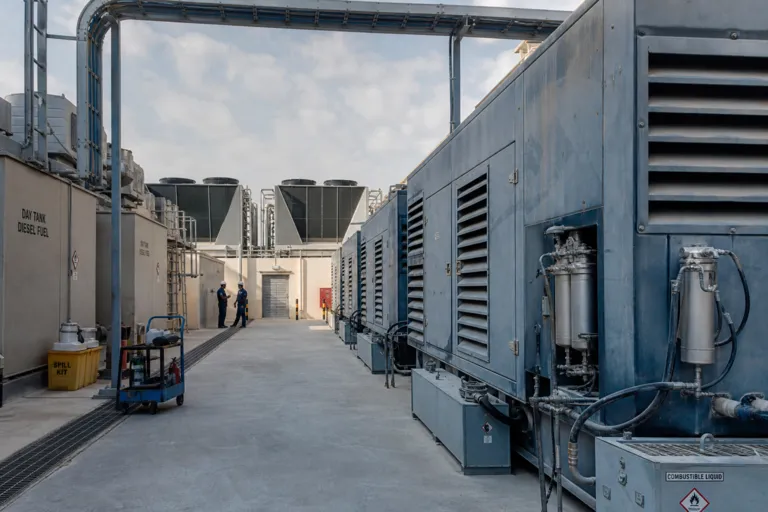
In Gulf data centers, the operational reality is simple: cloud services cannot tolerate long interruptions, and a full power cut-off can force a total restart with start-up issues, downtime, and loss of current or ongoing information, according to Grand View Research. That is why sites are supported by backup power via generators, which do not require an existing power supply to operate. This matters for maintenance planning, because any standby fleet that must start reliably has recurring service needs, including engine oil and other fluids. While local oil consumption volumes are not quantified in the sources, the generator-heavy design logic behind the keyword topic—data center backup generator engine oil Gulf—tracks closely with the market’s global direction.
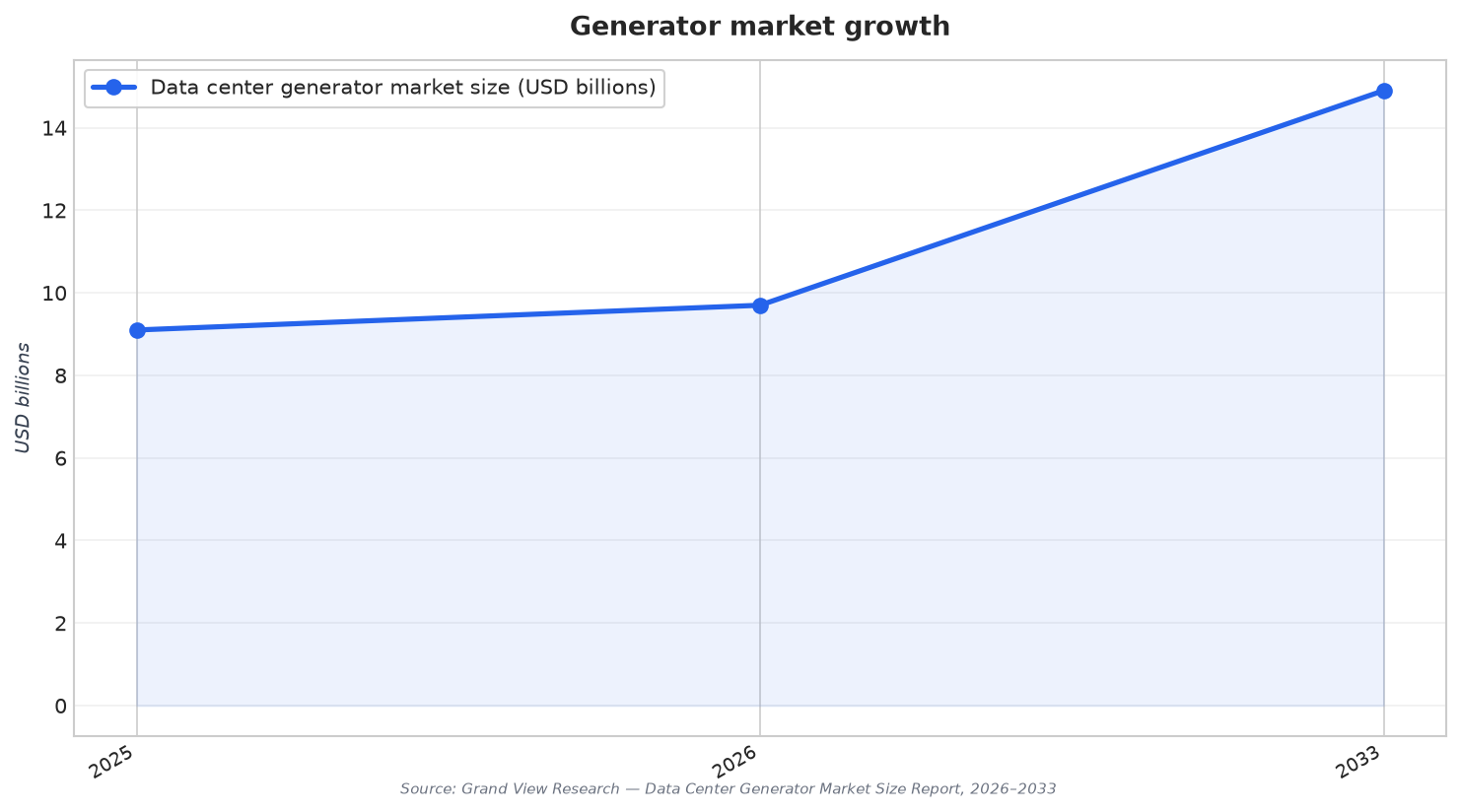
Globally, the data center generator market was valued at USD 9.1 billion in 2025 and is projected to grow from USD 9.7 billion in 2026 to USD 14.9 billion by 2033, at a CAGR of 6.3% (Grand View Research). Coherent Market Insights reports a similar trajectory, estimating USD 9.68 billion in 2026 and USD 14.85 billion by 2033, also at a 6.3% CAGR. These are global figures, not Gulf-specific, but they provide context for procurement and maintenance workloads in any region building cloud and AI capacity. In 2025, North America accounted for 38.0% of global revenue (Grand View Research), underscoring that many cited deployments and policies in the sources are outside the Gulf, and should be read as comparison rather than local measurement.
Why Diesel Dominance Keeps Fluids in the Conversation
Across the global installed base, diesel remains the anchor technology for standby power, which is directly relevant to engine oil and fluid demand. Grand View Research says the diesel segment led the market with over 75.0% revenue share in 2025. Coherent Market Insights projects diesel generators retain a 74.8% share in 2026, with an estimated 5.8% CAGR through 2033. Latitude Media adds operational context: diesel generators are ubiquitous as backup power for data centers, partly because diesel’s high energy density allows them to run for up to 96 hours using on-site fuel stored at the facility. Even short grid disturbances can trigger generator operation for hours, which increases the importance of disciplined maintenance cycles for oil, filters, and fluid systems, especially in mission-critical environments.
Generator sizing and architecture also shape how many engines must be maintained and how often they are exercised. Grand View Research states that generators under 1 MW accounted for around 45.0% of revenue in 2025, while Coherent Market Insights puts the under-1 MW share at 44.5% of global revenue in 2026 and projects a 5.4% CAGR for that segment during 2026–2033. On the operations side, Tier standards influence redundancy and fleet complexity: the Tier III segment exceeded 52.0% market share in 2025 (Grand View Research). For Gulf data center operators, these global patterns point to mixed fleets with multiple units and regular testing, which in turn reinforces the need to forecast consumables such as engine oil and other generator fluids alongside parts and service labor.
Beyond standby coverage, generators can be used strategically to reduce risk during wider grid stress. Latitude Media notes that data centers may switch to diesel to avoid minor disturbances in voltage or frequency that last seconds, but can leave a facility on generator power for hours. It also describes a demand response example in Virginia during a heatwave in June 2025, where Tier 2 diesel generators were used to participate in demand response, citing a report. These examples are not Gulf-specific, yet they matter for interpreting how operating hours can accumulate in real life—often outside of headline “outage” events. As global spending continues to rise, Gulf operators focusing on reliability can use these lessons to align maintenance planning, including engine oil and fluid management, with realistic run scenarios rather than assuming only rare emergencies.
Why do Gulf data centers rely so heavily on backup generators?
How large is the global data center generator market, according to the sources?
How dominant are diesel generators in data center backup power?
What does the keyword topic—data center backup generator engine oil Gulf—imply for maintenance planning?
How long can diesel generators run using on-site stored fuel, according to the sources?