
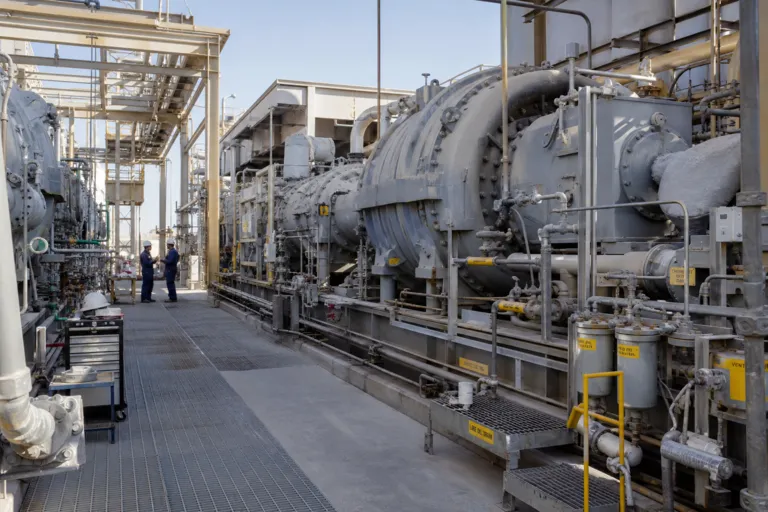
Qatar is pushing ahead with the North Field expansion even as disruptions have affected LNG output and exports. Euronews reported that US-based Baker Hughes won a “major” contract from QatarEnergy for the North Field West (NFW) project. The award covers critical equipment for two LNG “mega trains,” including six gas turbines and 12 centrifugal compressors, plus integrated power systems that are central to gas liquefaction. For lubricant suppliers, that equipment list matters because turbine, compressor, and gearbox lubrication sits directly on the reliability path for liquefaction trains and their supporting utilities.
Across the wider program, QatarEnergy’s North Field expansion is described in multiple sources as an effort to raise LNG production capacity from 77 million tonnes per year to 142 million tonnes per year once all phases are completed. Euronews adds that the NFW phase alone is expected to add around 16 million tonnes per year through two new production lines. Nexdigm similarly frames the North Field Expansion as increasing liquefaction capacity to 142 million tonnes per annum by 2030. This scale is the backdrop for demand planning around rotating equipment fluids, including compressor oils, turbine oils, and gear oils.
What the Expansion Means for Rotating Equipment Lubricants
The clearest direct driver for compressor lubricant consumption is the build-out of new liquefaction trains that use large centrifugal compressor strings and gas turbines. Custom Market Insights states that Qatar’s LNG facilities, “accounting for about 30% of the world’s LNG production capacity within QatarEnergy’s North Field LNG trains,” create “a massive demand for the most highly specialised” lubricants. The same source notes a product launch in March 2025: ExxonMobil introduced Mobil SHC Cibus LNG series, described as fully synthetic LNG refrigeration compressor oils for polyalkylene glycol (PAG) base oils, developed for “high pressure mixed refrigerant compressor trains” being installed in QatarEnergy’s North Field expansion and U.S. Gulf Coast LNG developments.
On performance targets, Custom Market Insights links lubricant specifications to extreme LNG operating conditions and maintenance strategy. It describes operating temperatures down to -160°C, compressor discharge temperatures above 150°C, and an “extended drain capability” based on a target of 24,000 hours of compressor inspection interval versus an “industry standard” of 12,000–18,000 hours. These figures frame why the market discussion is not only about volumes, but also about higher-value formulations for refrigeration compressor service and long run-time continuous-operation assets, where fewer oil changes can reduce the frequency of production curtailment.
Timing risk is part of demand forecasting for Qatar North Field expansion compressor lubricants because project schedules can move with regional events and procurement lead times. The IEA’s Global LNG Capacity Tracker states that construction at Qatar’s 43.5 bcm/yr North Field East expansion project was disrupted following military attacks on the Ras Laffan facility in March 2026, delaying expected start-up of the first of four liquefaction trains until at least the first half of 2027 from a previous target of end-2026. IEA also notes that Qatar’s North Field West expansion (22 bcm/yr) is approved but “not progressing towards normal commercial operation,” adding that no final investment decision or construction activity has been formally announced. These dynamics can shift lubricant commissioning and initial-fill demand, even when long-term capacity plans remain in place.
What rotating equipment in the North Field expansion directly drives lubricant demand?
How much LNG capacity growth is Qatar targeting with the North Field expansion?
What performance conditions are cited for refrigeration compressor oils connected to QatarEnergy’s expansion?
How do disruptions affect the outlook for Qatar North Field expansion compressor lubricants?