
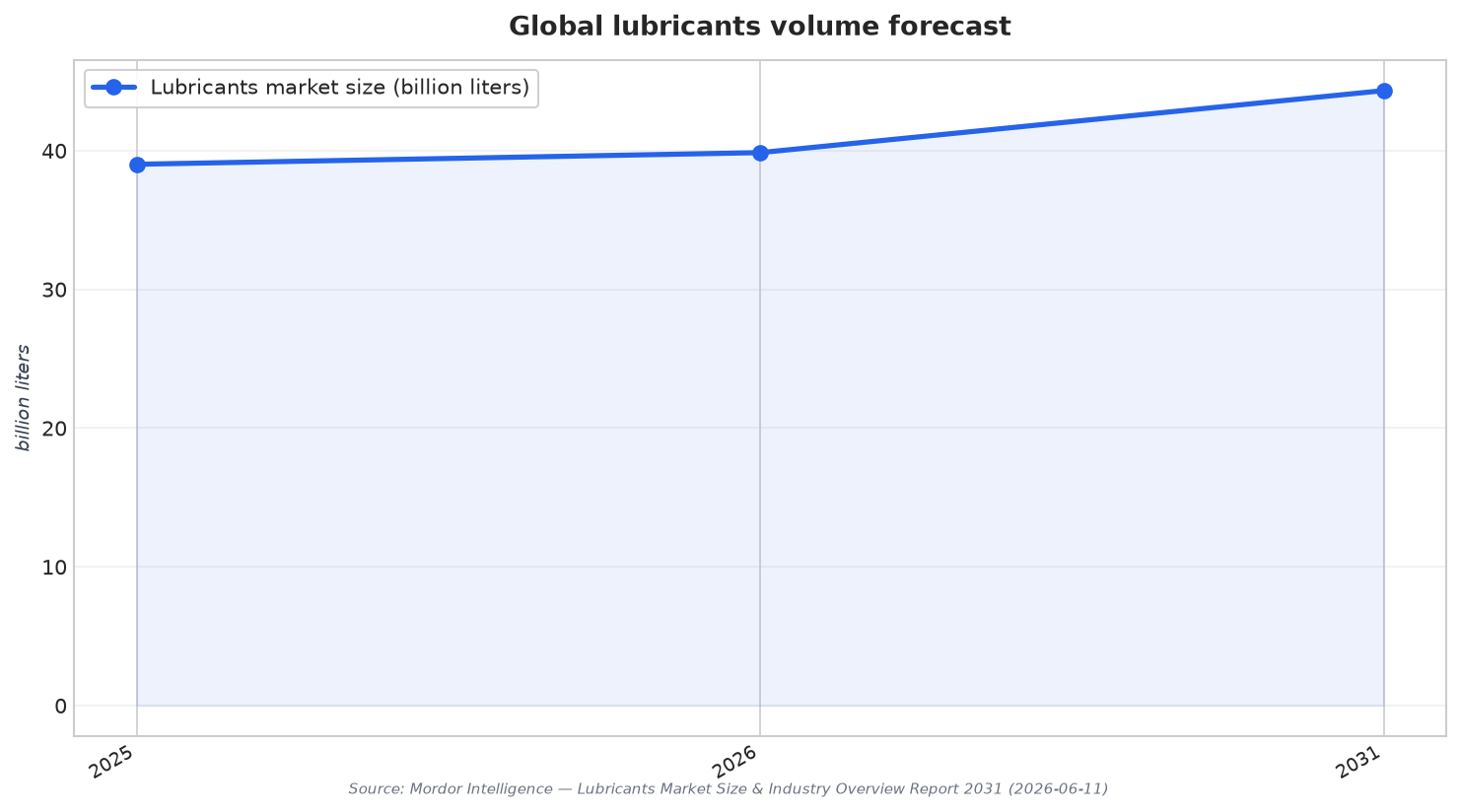
Planning for the Jordan lubricants market starts with what global demand patterns say about where volume and value concentrate. In the global lubricants market, 2026 volume is estimated at 39.86 billion liters, up from 39.02 billion liters in 2025, with projections reaching 44.33 billion liters by 2031, implying a 2.15% CAGR over 2026–2031. Within that global mix, mineral-oil products accounted for 65.85% of market size in 2025, while Group I held 42.15% share. At the same time, the fastest growth outlook sits with higher-quality options: Group III synthetics are tracked at a 2.98% CAGR through 2031, and bio-based grades at a 3.21% CAGR to 2031. These global shifts matter for Jordan-oriented import strategies because they influence what suppliers prioritize, and how quickly premium product slates expand.
Vehicles remain the largest lubricant consumption engine in global market breakdowns, which helps frame how a country-level vehicle parc can translate into steady replacement demand. Mordor Intelligence attributes 55.95% of 2025 lubricant market share by end-user industry to automotive, and identifies engine oils as the leading product type with 51.10% revenue in 2025. Other sources echo the same demand logic at a global scale. Grand View Research cites global automotive associations reporting over 80 million vehicles produced annually, and a worldwide vehicle fleet exceeding 1.4 billion units. Those figures are global, not Jordan-specific, but they illustrate why markets with expanding passenger and commercial vehicle activity often see consistent pull for engine oils and transmission fluids through regular maintenance cycles.
Power Generation Demand and What It Signals for Import Mix
Power generation is a second demand pillar that can influence which lubricant grades are imported and stocked, especially for high-utilization assets where downtime is costly. In Mordor Intelligence’s global outlook, power generation is the quickest-growing end-user industry segment, with a 2.88% CAGR through 2031. Market research commentary also ties lubricant growth to expanding end-use industries such as manufacturing, power generation, and construction. For the Middle East and Africa context, Mordor Intelligence notes the region records a 3.19% CAGR to 2031, linked to large-scale energy-infrastructure investments (regional context, not a Jordan figure). The implication for Jordan-focused buyers is practical: a larger role for power generation can widen the required basket beyond passenger-car engine oils into hydraulics, gears, compressors, and other industrial fluids that support reliability and energy efficiency in operating equipment.
Import opportunity also sits in the ongoing premiumization trend that suppliers are building around. Mordor Intelligence reports that demand is shifting from traditional mineral-oil grades toward higher-performance synthetics as environmental regulations tighten and OEMs pursue viscosity downgrades for fuel-economy gains. It also points to newer use cases, including wind-turbine gearboxes and electric-vehicle thermal management systems, which can create incremental revenue pools even as legacy internal combustion applications grow more slowly. In product segmentation, specialty “other” products (including EV thermal fluids) show a 2.64% CAGR outlook through 2031. Separately, Future Market Insights states automotive oil holds a 36.0% share in 2026 (global) and projects the lubricant market to reach USD 296.7 billion by 2036, at a 4.5% CAGR during 2026–2036. These signals support an import thesis focused on higher-spec formulations, approvals, and performance documentation, not only base-volume mineral grades.
A Jordan strategy should therefore connect vehicle-led replacement demand with power-generation-led reliability demand, while tracking the global tilt toward synthetics. Globally, the largest base-stock slice remains mineral oil at 65.85% in 2025, but faster growth is concentrated in Group III synthetics (2.98% CAGR through 2031) and bio-based grades (3.21% CAGR to 2031). At the same time, automotive remains the biggest end-use share (55.95% in 2025), and engine oil remains the largest product revenue pool (51.10% in 2025). For importers serving Jordan, that combination suggests a two-track portfolio: keep breadth in high-turn automotive engine oils, while developing a targeted industrial and power-generation slate designed for longer drain intervals, higher thermal stability, and more stringent performance expectations.
What are the biggest demand drivers shaping Jordan’s lubricants market strategy?
Why do engine oils matter so much when planning lubricant supply?
What evidence supports an import opportunity in higher-performance lubricants?
How does power generation change the lubricant product mix needed in-market?