
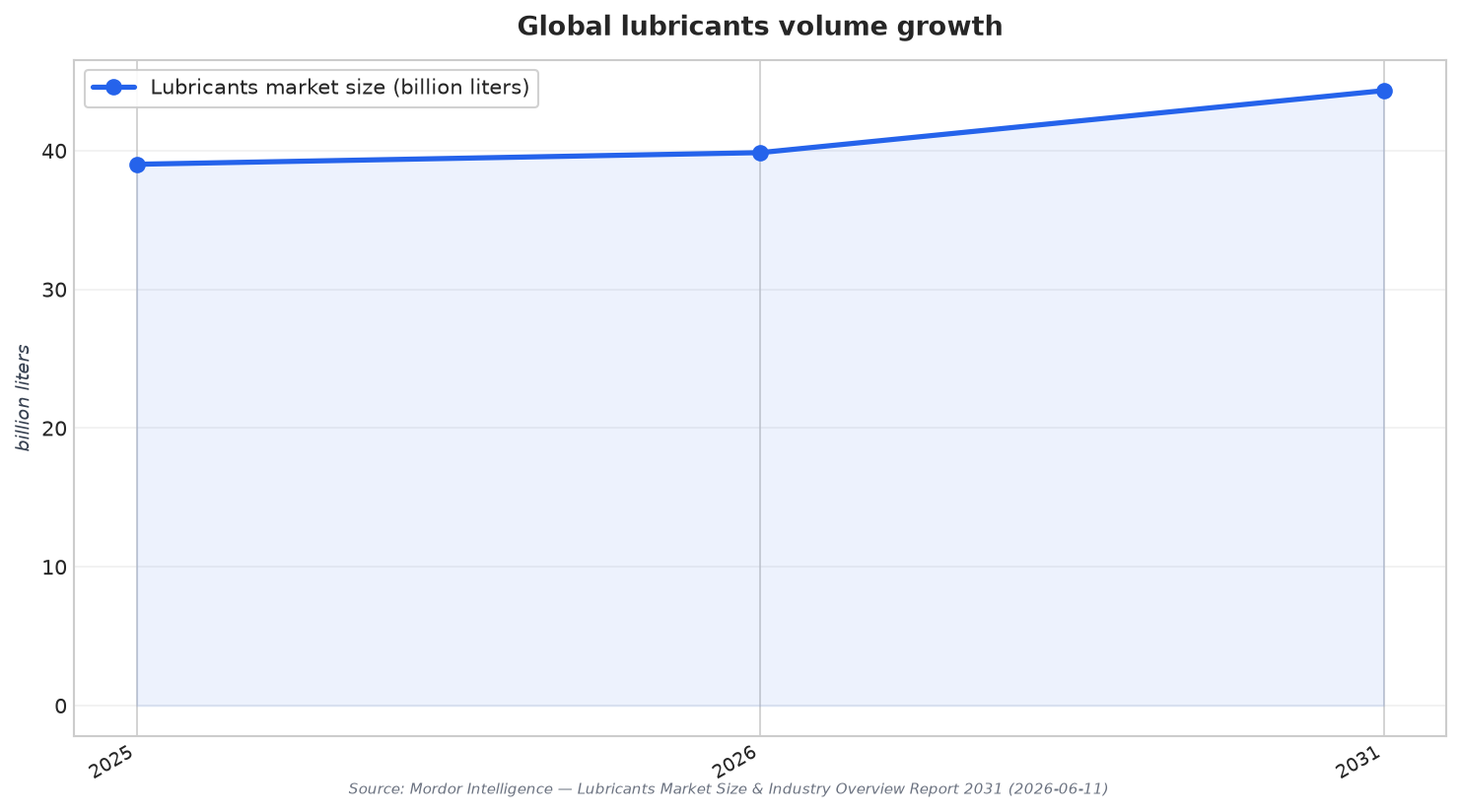
In any reconstruction cycle, lubricant availability becomes a practical constraint on how fast equipment can return to service. The global market backdrop is expanding: Mordor Intelligence estimates the global lubricants market at 39.02 billion liters in 2025 and 39.86 billion liters in 2026, with projections reaching 44.33 billion liters by 2031, reflecting a 2.15% CAGR over 2026–2031. Market Research Future separately frames the global lubricants market size at USD 133.0 billion in 2024. For Libya, these global figures are context, not a proxy. Still, they underline that suppliers are allocating capital, capacity, and attention toward markets where demand and logistics are more predictable.
Reconstruction demand also intersects with what lubricants are being demanded, not just how much. Mordor Intelligence describes a shift away from traditional mineral-oil grades toward higher-performance synthetics as regulations tighten and OEMs pursue viscosity downgrades for fuel economy. It also notes emerging applications such as wind-turbine gearboxes and electric-vehicle thermal management systems. In 2025, the same source reports engine oils leading by product type with 51.10% revenue share globally, and automotive as the largest end-user industry at 55.95%. For a Libya lubricants market reconstruction strategy, the implication is straightforward: the fastest path to restoring mobility and machinery depends on stable access to core engine oils, but product slates may need to evolve toward higher-performance formulations to match OEM and regulatory direction.
Re-Entering a Fragmented Supply Chain: Price, Quality, and Continuity Risks
Re-entry risk is amplified when the supply chain is fragmented and competition is intense. Market Data Forecast characterizes the Africa lubricants market as having a “highly fragmented” competitive landscape, with global majors, regional blenders, and independents competing via localized production, OEM partnerships, and eco-friendly innovation. The same publisher’s Middle East and Africa industrial lubricants outlook highlights “intense rivalry” that can pressure pricing and reduce profit margins, while also pointing to raw-material price volatility as a significant restraint. For Libya, that mix can translate into inconsistent supply, uneven quality controls, and short-term discounting that looks attractive until it disrupts long-term availability, technical support, and product authentication.
Regional growth expectations raise the stakes for sourcing decisions. Mordor Intelligence reports Asia-Pacific held a 45.10% share of the lubricants industry in 2025, while the Middle East and Africa region is forecast for the steepest 3.19% CAGR to 2031, linked to large-scale energy-infrastructure investment. Separately, Market Data Forecast values the Africa lubricants market at USD 2.61 billion in 2025, estimates USD 2.70 billion in 2026, and projects USD 3.53 billion by 2034, implying a 3.43% CAGR from 2026 to 2034. These are continental figures, but they support a practical point for Libya: as demand rises across the region, suppliers may prioritize contracted, lower-risk channels, making continuity planning and multi-sourcing more important than one-off purchases.
Technology and portfolio choices can also become supply risks. Mordor Intelligence reports that Group I held 42.15% share in 2025, while Group III synthetics are projected to be the fastest-growing at 2.98% CAGR through 2031; mineral-oil products accounted for 65.85% of market size in 2025, while bio-based grades are projected to expand at a 3.21% CAGR to 2031. It also flags supply-chain risk for high-viscosity synthetic esters. For reconstruction-focused buyers and returning suppliers, this means resilience is not only about volume. It is also about securing base stocks and additives, aligning specifications with OEM needs, and protecting service networks from sudden formulation shifts that can break interoperability across mixed fleets.
What is driving demand in Libya’s lubricants market during reconstruction?
Why is re-entering a fragmented lubricant supply chain risky?
How do global lubricant trends affect a Libya reconstruction strategy?
Which product and end-user segments matter most for planning supply?