
Desalination in the Middle East is expanding fast, and the Gulf sits at the center of the build-out. The Middle East desalination plants market was valued at USD 8,272 million in 2023 and is estimated to reach USD 15,541 million by 2030, with a CAGR of 10.0%. In 2024, installed capacity surpassed 52 million cubic meters per day, up from about 40 million cubic meters per day in 2020. GCC nations represent over 45% of global desalination capacity, with Saudi Arabia contributing around 20%. As capacity scales, operators also scale the basics that keep rotating equipment alive: pump oils and turbine oils.
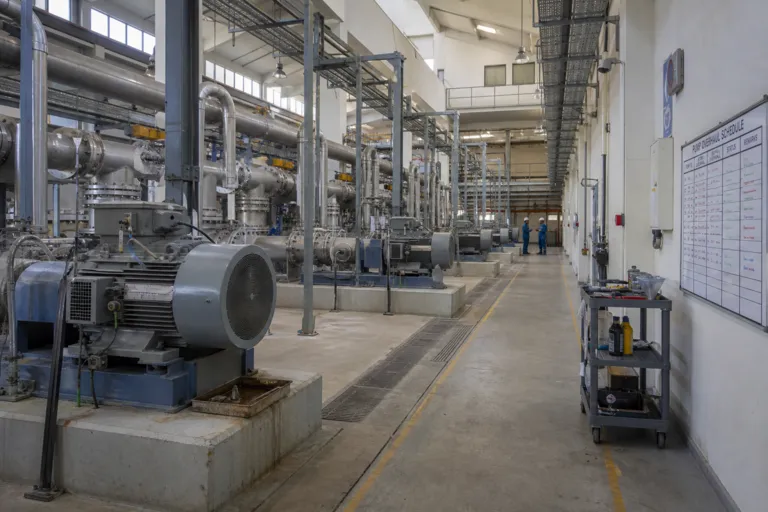
For procurement teams thinking about desalination plant lubricants in the Gulf, the near-term story is split between new RO builds and the upkeep of large, established assets. In Saudi Arabia, Ras Al Khair and Rabigh 3 are cited as facilities producing more than 1 million cubic meters per day each to serve refineries, industrial parks, and power stations. Across the UAE and Oman, RO now comprises over 60% of new desalination projects, driven by energy efficiency. Those RO trains lean on high-pressure RO feed pumps and seawater intake pump sets that must be protected by reliable lubrication practices during continuous operation.
RO Growth Meets MSF Reality: Two Lubrication Demand Curves
The Gulf’s RO push does not remove lubrication demand from thermal assets; it reshapes it. The global desalination system market context shows membrane processes led with 78.45% share in 2025, while the Middle-East and Africa held 52.70% share by geography in 2025 and is expanding at a 10.46% CAGR to 2031. Saudi Arabia targets 8.5 million m³/day of new RO capacity by 2030, described as a 60% jump over 2025 output. At the same time, pump packages span RO, MSF, and MED applications in the global pumps scope, meaning operators still manage different lubricant regimes across mixed fleets.
Maintenance cycles add a second demand curve beyond greenfield build-outs. A seawater RO pump research report notes that the 2005 to 2015 desalination boom created an aging centrifugal pump base now entering a “second major overhaul cycle,” contributing to a segment CAGR of 7.0% through 2034. It also states that GCC countries had over 40 large-scale desalination projects at various stages of development, tendering, or construction as of early 2026. Overhauls and long service windows matter because pumps and turbines often shift from initial fills to structured replenishment, flushing, and condition-focused oil management as assets age.
Broader industrial lubricant fundamentals in the region support this outlook. MarkWide Research values the Middle East lubricant and grease market at $8.7 Billion in 2026, projecting $13.27 Billion by 2035 at a 4.80% CAGR, while also pointing to expanding synthetic base oil categories as OEM fill specifications and extended drain intervals push higher-performance formulations. In parallel, UAE pumping demand is expected to reach USD 847.5 million by 2029 at a 5.0% CAGR, with desalination and water infrastructure cited as sustained demand drivers for specialized pumping equipment. Together, these signals underline why pump and turbine oils remain a practical, recurring line item as Gulf desalination capacity and service intensity rise.
What is driving lubricant demand in Gulf desalination plants right now?
How do RO build-outs affect pump oil needs compared with older thermal plants?
Why do overhaul cycles matter for desalination pump oil consumption?
How large is the broader regional lubricant market linked to industrial demand?
How should buyers think about desalination plant lubricants across the Gulf market?