

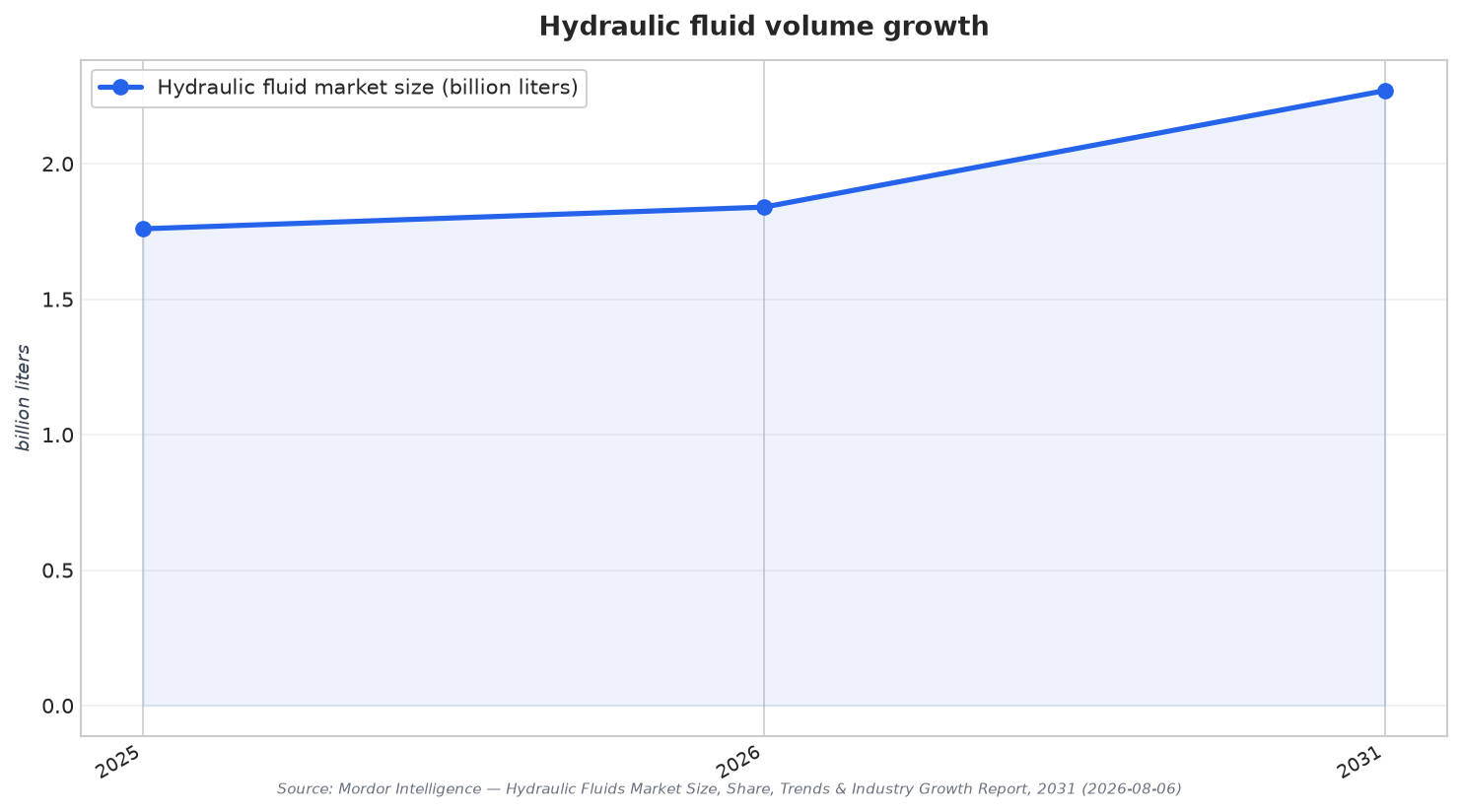
Industrial hydraulic fluids sit inside a fast-moving global market where buyers are already using performance and compliance language in purchasing decisions. Mordor Intelligence values the hydraulic fluid market at 1.76 billion liters in 2025 and estimates growth from 1.84 billion liters in 2026 to 2.27 billion liters by 2031, with a 4.32% CAGR (2026–2031). In parallel, Grand View Research notes mineral oil held the largest revenue share at 63.1% in 2025, and Mordor places mineral oils at 48.81% share in 2025 by base-oil type. For GCC users and blenders, the point is not which global share is “right,” but that mineral oils still dominate high-volume use while procurement language increasingly includes higher-performance and environmentally aligned blends.
Before Q4 2026, the most practical preparation is to treat the new GSO hydraulic fluid standard in the GCC as a cross-functional issue, not only a lab spec sheet. Market demand is linked to equipment modernization, rising automation, and infrastructure spending, according to Mordor Intelligence. It also highlights that regulatory pushes for cleaner operations are encouraging end users to shift away from legacy formulations toward low-viscosity and biodegradable blends, even while cost-effective mineral oils remain prevalent. That means blenders should confirm what their customers’ equipment duty cycles and operating environments require, and users should align purchasing specs with realistic service conditions, rather than buying purely by lowest cost.
What to Check First: Demand Drivers, Use Cases, and Proof
A strong way to structure readiness is to start from use case and verification. Mordor Intelligence attributes 54.76% of 2025 hydraulic fluid market share to mobile hydraulic systems, and it states construction equipment accounts for 76% of hydraulic equipment usage, which drives fluid consumption. Grand View Research also places construction as the largest end-use revenue share at 18.4% in 2025. Those global figures underline why GCC fleets, contractors, and industrial plants should map where fluids are used (mobile vs. stationary), then demand matching evidence packages from suppliers. Documentation-heavy procurement is already visible elsewhere in GCC compliance markets, where IndexBox describes validation documentation packages and requalification services as structurally significant in high-compliance equipment purchasing.
Blenders should also plan for audit-style expectations that resemble other GCC standardization patterns. In GCC automotive lubrication services, MarkWide Research links tightening requirements to GSO regulations and describes a national quality authority implementing GSO technical regulations with phased compliance timelines. While that source focuses on automotive lubrication services, it signals how enforcement can shape verification behavior, including certified providers and dispensing verification practices. Separately, Mordor’s GCC feed premix report shows how GSO can formalize permissible and prohibited inputs via a named standard, GSO 2813:2026 (approved 30 April 2026). Taken together, these sources support a practical GCC playbook: ensure your hydraulic fluid specs, labeling, and proof of conformity are prepared to withstand phased implementation and cross-border trade scrutiny.
Finally, procurement teams should benchmark their formulation strategy against credible market realities, then lock in supply and service models. The Business Research Company values the global hydraulic fluid market at $9.09 billion in 2025 and projects $11.68 billion by 2030 at a 5.1% CAGR, while highlighting trends such as bio-based adoption, higher-performance synthetics, and expansion of aftermarket replacement. IndexBox, in a different GCC industrial context, notes aftermarket services can account for roughly 30–35% of total expenditures, reinforcing how service, documentation, and lifecycle support can be as important as the initial product. For the GSO hydraulic fluid standard GCC stakeholders are preparing for, the safest pre-Q4 2026 move is to align formulations to customer equipment needs and back every claim with repeatable documentation and verification.
What global market signals should GCC teams use when preparing for new hydraulic fluid specifications?
Which hydraulic fluid base type still dominates, based on the sources?
Why should mobile and construction use cases be prioritized in readiness checks?
How does GCC-style enforcement and documentation affect planning for a GSO hydraulic fluid standard in the GCC?